





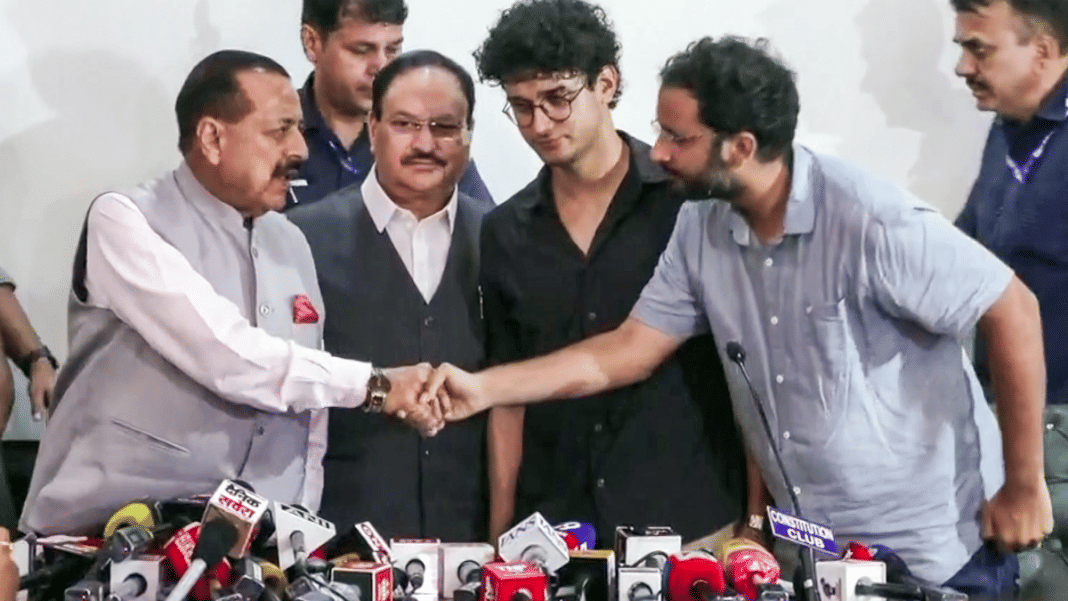


The Cockroach Janta Party (CJP) officially withdrew its protest on 25 July, 2026. But the objective of the movement has not yet been fulfilled and was somewhat overlooked by its main leadership.
We are all very aware of how this movement derailed morally, and even though all about students, it gradually became a politically motivated environment perfect for our parasite-like Opposition.
And the CJP’s inactivity in some cases, by turning a blind eye and not acting as a true leader, makes its own intentions questionable.
So basically, no one is altruistic here and we students have no one by our side. Everyone is on their own side just with a humane face—congenial yet cunning, democratic yet devious.
But whatever was wrong with this, there were several right things too, and those are clearly evident. Students united, showed discontent, made the government listen, and ultimately fulfil the demands put forward.
Now, the demands are fulfilled. Education minister Dharmendra Pradhan has resigned and the government has agreed for compensation and the removal of FIRs.
But did anything change? Do you see or feel any change except the current atmosphere of celebrations as opposed to the revolutionary state earlier? Not actually.
These students, who sat there for over a month, will now go home and start preparing for their exams again, start going to their colleges and schools again, and will face the exact same problems they were facing a month before. And they will keep facing them until such outrage erupts again.
After a movement centered on demanding accountability in education, one would have expected the government to appoint someone with a proven record of reforms or expertise in the sector.
Instead, it has entrusted the ministry to a leader already responsible for two major portfolios, in which there are persistent implementation challenges already.
If these structural issues remain unresolved under our new education minister Prahlad Joshi’s existing ministries, students have every reason to question what meaningful change this reshuffle alone will bring to education.
The government played well. It didn’t actually make any change in itself, except removing one minister and placing another in his place.
Providing compensation is nothing unusual for the government, but a regular response now. The FIRs issue doesn’t change anything as well; it t merely restores the appearance of normalcy again. And the policy charter of CJP will be “considered”.
Is justice served?
The prime minister said that fast-track courts will be opened. The CJP asked to make the 2024 anti-paper leak law stricter and give compensation and pin accountability after such incidents. These may work to some extent. But are we fixing the cause of the problem?
These are no structural changes, but just remedial measures after the damage is done.
A paper leak is not merely a legal failure—it is an administrative one. If examination systems remain vulnerable, accountability mechanisms weak, and oversight ineffective, no amount of compensation or punishment can restore the months of preparation, trust, and emotional investment that students lose.
Reform must, therefore, begin where the failure begins: within the institutions responsible for conducting these examinations.
Our education system needs drastic and urgent reforms, not on paper but in structure.
Paper leaks destroy a student beyond description, and the government needs to understand that. It should reform the system but from the point of view of a student. It needs to put down its obsolete glasses and wear a new perspective, that of the youth.
Some things that I think should be introduced immediately:
1. Set mandatory educational qualifications for ministers, if not for all MPs and MLAs, so that at least the important and top positions are filled by deserving leaders.
2. Have debates like the US presidential debates. In these past months, we have witnessed a mute and unaccountable government, and this silence infuriated the masses. So we need them to talk to us if we choose them. And here, when I say debates, I mean civilised discussion of ideas and not altercations like in parliament.
3. The Supreme Court, the protector of the citizens of India, should give directions to the government when it fails to meet the aspirations of the people. Use judicial activism as it was in landmark cases such as Kesavananda Bharati v. State of Kerala (1973) and Vishaka v. State of Rajasthan (1997).
4. Stricter implementation of the Dr. K. Radhakrishnan Committee (2024–2026) recommendations.
5. The government should conduct a public review of the measures or steps it plans to take regarding the issue at hand and proceed accordingly. Create a parliamentary committee to oversee and review exam system-related work and add important stakeholders like student representatives.
Apart from this, I don’t really have any great changes to suggest, but there are a lot of experts and good people out there who are suggesting what measures to take.
So, we as students should continue to hear and evaluate them. Also, keep a close check on the government’s functioning.
And the next time we stand up like this (though ideally, there shouldn’t be one), let’s not allow anyone to capitalise on our issues because just saying ‘I don’t care about the politics in play here and am here for just students’ doesn’t change the fact that politics is at play and winning.
Lastly, here’s a quote by the only leader who truly cared, respected and believed in the students and youth of India, Dr. A.P.J. Abdul Kalam:
“Every one of us has gone through the various phases of education from childhood to profession. A scene appears in front of me. A child, a teenager, an adult and a leader. How does each one react to a particular situation? The situation is human need. The child asks, ‘What can you do for me?’ The teenager says, ‘I want to do it alone.’ The young person proclaims, ‘Let us do it together.’ The leader offers, ‘What can I do for you?’
…So, the educational institutions have got a tremendous responsibility to transform a youth into a leader – the transformation of ‘what can you do for me’ to ‘what can I do for you’.”
Nimisha Mor is a student of Swarnprastha Public School, Sonipat, Haryana. Views are personal.
Also Read: India wants to hear from its youth—but only on its own terms