



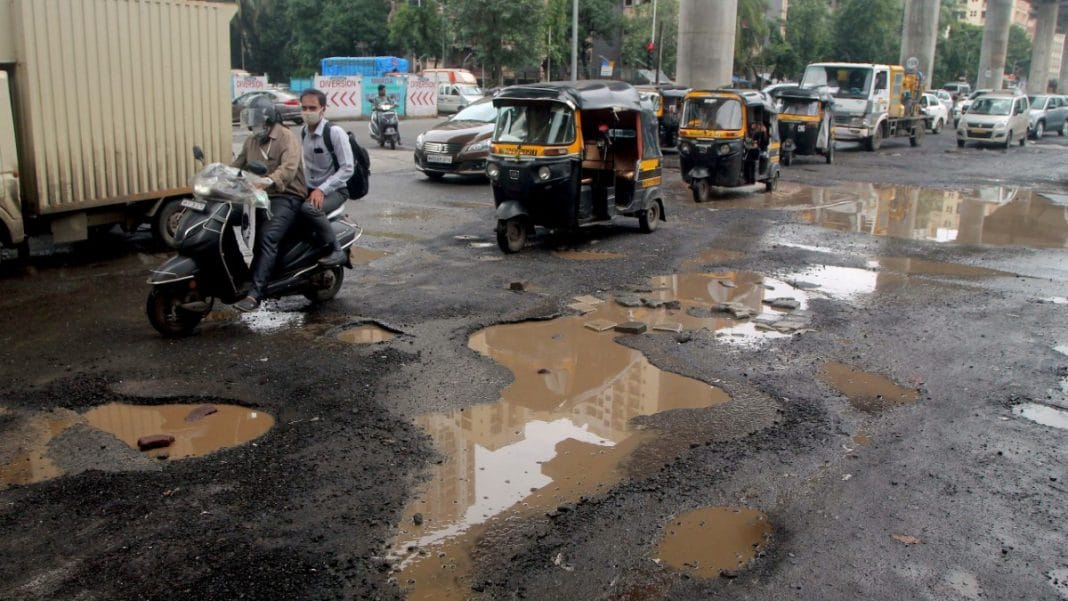


In late July, a bridge on Dehradun-Paonta Sahib Highway, built at a cost of Rs 16 crore, repeated a pattern of monsoon-induced infrastructure collapse. A fortnight after inauguration, a single night of rain exposed a crater in the newly constructed Nanda ki Chowki bridge. However, what was new was not the infrastructure failure, but the response.
The crater drew immediate attention as videos started circulating on social media. The district magistrate promised repairs within three to four hours, and the patchwork was completed within twelve hours. A crater, which could have been categorised as ‘yet another infrastructure issue’ and could have disappeared into a Public Works Department file, became a same-day political statement.
This reflects a broader shift in the political economy of infrastructure. Social media has significantly increased the political visibility of maintenance failures, limiting the time gap between infrastructure collapses and official response.
Yet, greater visibility on its own does not produce deeper institutional accountability. As a result, governments have become better at performing accountability than institutionalising it. Viral footage of potholes and cave-ins has shifted political focus from governing infrastructure to what governments must be seen doing.
Classical political economy explanation of infra maintenance
The textbook explanation of why construction catches greater political attention than maintenance is clearly familiar to us. Ribbon-cuttings are far more visible than potholes. Politicians rarely ask people to vote for them by saying they have improved basic infrastructure, like expanding or repairing drainage systems.
The reason governments receive electoral credit is for the inauguration of expressways, airports, bridges and engineering marvels while maintenance remains politically invisible until failure becomes devastating.
To classify this as corruption is a misread of the electoral motivation behind these grand inaugurations. Economists would describe this as the incentive problem. Elections disproportionately reward creation of new assets while the preservation of existing ones barely offers any electoral returns. Owing to this asymmetry, maintenance issues have remained localised, diffused and administratively contained.
Social media’s redesign of political economy
The internet community has structurally altered this equilibrium by transforming the visibility of neglect. Viral footage of a flooded underpass or collapsing bridge can move within hours from a WhatsApp group to X and Instagram, prompting even national television to cover the incident.
The consequences of viral content could come at greater political expense of becoming an agenda, evident in the recent youth protests. Therefore, digital visibility allows a reduced reaction time for political actors, translating into quicker government response to maintenance failures.
When an under-construction road on the Pune-Bengaluru National Highway near Nippani collapsed in January, NHAI suspended three officials within days after the local MLA publicly inspected the site and threatened to escalate the matter to the Union Road Transport Minister. Similarly, in Gujarat when the Mujpur-Gambhira bridge collapsed last year, killing twenty-two people, four engineers were suspended within two days.
However, an important question persists: Is suspension of concerned officers the end of the accountability road?
Performance of accountability
Governments seem to have adapted to the social media climate though mostly at the level of optics. The promise of a pothole-free state in Andhra Pradesh required before-and-after photographs of every repair. In Bangalore, when the civic administration launched successive apps like FixMyStreet, Sahaaya and recently PACE, they were presented as technology-based resolutions to the problem of potholes. However, these apps faced the same criticism for marking unresolved complaints as ‘resolved’.
The launch of apps to solve road maintenance issues which only do superficial compliance resembles the same ribbon-cutting pattern converting it into a public demonstration of responsiveness. Thus, this reveals the adaptive response of the government to social-media led visibility. This response often revolves around rapid repairs, suspensions and digital grievance mechanisms instead of strengthening institutions responsible for preventing infrastructure failures.
Viral outrage to institutional reform
Rapid response cannot be confused with structural reform. Italy responded with criminal prosecution, after an investigation uncovered years of neglect and corruption as the reason behind Morandi Bridge collapse in 2018, much different from India’s pattern of administrative actions which includes suspending officials and announcing inquiries. An independent investigation revealed that the collapse of 170 bridges have caused over 200 deaths between 2021 and 2025, substantially exceeding figures disclosed by the government.
Whenever deeper reforms have emerged like longer liability periods under NHAI, performance-linked maintenance contracts and IIT-led structural bridge audits, they have been a result of judicial intervention or procurement redesign rather than a being a consequence of viral outrage.
Thus, social media can expose failures but cannot substitute for institutions. The smartphone has now become an effective tool to monitor infrastructure collapses but remains a poor substitute for the institutions which prevent these failures. Until digital outrage is followed by procurement reforms, budgeting, lifecycle asset management and contractor liability, India risks replacing accountability with increasingly visible crisis management.
As the camera finds the crater, India must find structural accountability.
Saksham Raj is a student of O.P. Jindal Global University, Sonipat. Views are personal.
Also Read: Potholes on new Delhi-Dehradun expressway. NHAI blames local people, Congress says corruption