



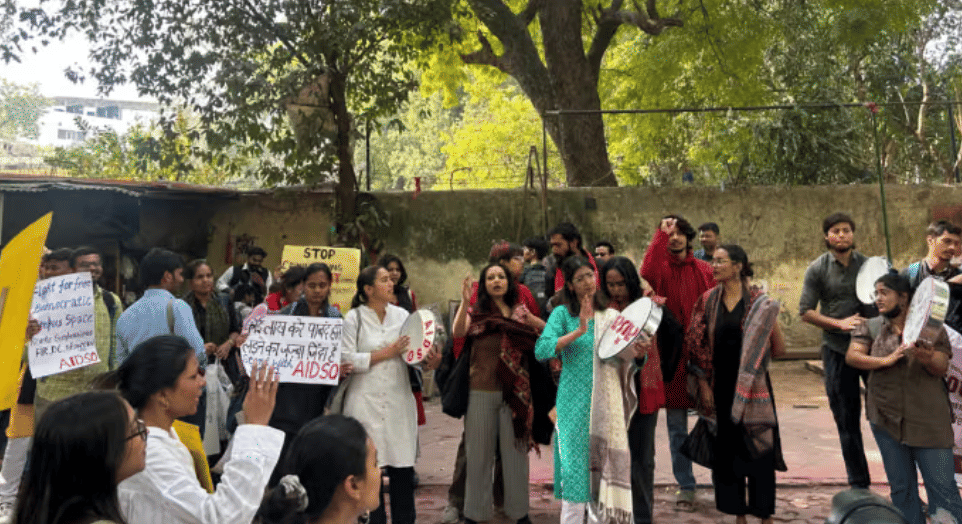


Indian universities have always been hotbeds of political discussion. From revolution to reservation, Kashmir to ‘Khalistan’, capitalism to communism, God to gods, nationalism to democracy, there has hardly been a topic that has not been argued and debated with great fervour.
Campus politics, though unnecessarily loud at times, has always been a means for students to voice their opinions. This did not always happen in the most polite or well-mannered ways. But the university, in turn, was meant to give students a degree of discomfort.
It seems, however, that something has changed.
Indian universities continue to be deeply political, but increasingly find that political expression leaves little room for actual debate. There is movement, slogans, pamphlets and protests, yet very often there is little patience for listening to what the other side has to say. Institutions that are supposed to foster dissent can themselves become uncomfortable with dissenting ideas.
Which is why the politics of institutions, such as Jawaharlal Nehru University (JNU), Jamia Millia Islamia, Aligarh Muslim University (AMU) and Delhi University, warrant deeper examination.
JNU has always been synonymous with fiery political debates. Its campus has given birth to writers, professors and political activists across the ideological spectrum. It has also been the setting for some of India’s most contentious political controversies. But perhaps that is precisely why JNU matters. A university known for political debate should not allow politics to harden into ideological camps.
Jamia, meanwhile, poses another set of questions. While the student union of the institution has not held elections since 2006, campus politics has not exactly ceased to exist. The contradiction of an institution that prepares its students for democratic citizenship while giving them limited space to practise democratic representation on campus is difficult to ignore.
The same applies to other institutions. While student politics at AMU has a long and winding history, student politics at Delhi University remains a prominent fixture of campus life. However, visibility is not always synonymous with political maturity.
A campus full of posters is not necessarily a campus full of political thought.
The problem with campus politics is not that students are political. They should be. The problem begins when politics becomes an identity.
Why does it matter that a student declares which side they are on before their argument is taken seriously? Why does questioning a left-wing position sometimes lead to being labelled right-wing, while voicing support for a government can immediately invite the label of a ‘bhakt’? Criticising the government, as often happens, may lead to being labelled ‘anti-national’.
The terminology may change, but the habit does not.
The argument has been substituted with an accusation.
Perhaps one of the most pernicious changes in campus politics is that once students begin to see political opponents as enemies, discussion becomes impossible. One can disagree with someone’s politics without questioning their loyalties, character or right to speak.
Universities should certainly regulate violence, intimidation and destruction. Freedom of expression should not mean freedom to threaten someone. A student who physically harms another student should face consequences. So should someone who threatens to silence their opponent.
But there is a world of difference between regulation and suppression.
A student should be able to question the administration, criticise a government, challenge a professor or defend an unpopular position without fearing that disagreement itself will become a disciplinary offence. The university may disagree with the student. It may challenge the argument or prove the student wrong. But disagreement should not be made unacceptable altogether.
Social media has complicated the situation further. Political discussion is increasingly reduced to statements, hashtags and solidarity. Students are often encouraged to take a position before they have had the opportunity to think through it.
Politics has become performance.
There is nothing wrong with solidarity. Young people naturally want to belong to something bigger than themselves. But a university should also teach them to step outside their political comfort zones. A student who cannot criticise their political opponents but can criticise their own side has not really learned politics.
A healthy university should make students sceptical not only of governments, but also of their own beliefs.
That does not mean universities should become politically neutral in the sense of being silent. They cannot and should not be. Politics is part of public life, and universities are institutions where young citizens learn to participate in that life.
The objective should not be to rid campuses of politics, but to improve campus politics.
Student organisations should be able to organise, protest and criticise. Administrations should be able to maintain discipline. Faculty members should be able to voice their opinions. Students should be able to disagree with all of them.
The difficult thing is drawing the line between the three.
That line should be clear: dissent must be protected; misconduct must be regulated.
A student who criticises an institution should not automatically be seen as wanting to destroy it. A person who criticises a government does not necessarily oppose the country. A student who disagrees with their organisation is not necessarily its enemy.
Criticism is not a position. It is a practice.
This is what universities should teach. Students should learn to oppose ideas without making enemies of people; challenge policies without treating institutions as enemies; and question the system without assuming that everything within it must be destroyed.
There will always be uncomfortable opinions. There will always be arguments that offend someone. That is why universities matter. If every uncomfortable opinion is taken away because it makes someone uncomfortable, the university ceases to be a marketplace of ideas and instead becomes its opposite.
The real test of a university is not how it treats popular opinions. Popular opinions rarely need protection.
The real test is how it treats the unpopular one.
Perhaps it is asking too much of JNU, Jamia, AMU, Delhi University or any other institution to recreate the political atmosphere of an older generation. Universities change, students change and politics changes with them.
But it is not asking too much to expect them to preserve the space for disagreement.
Democracy does not require unanimity. It requires people to learn to disagree without losing faith in the system that allows them to disagree.
Universities must remember that.
Because once they begin to oppose dissent, they do not get unanimity.
They get conformity.
Zahid Ahmad Khatana is a student of Jamia Millia Islamia, Delhi. Views are personal.
Also read: More than a joke: The subversive power of memes