



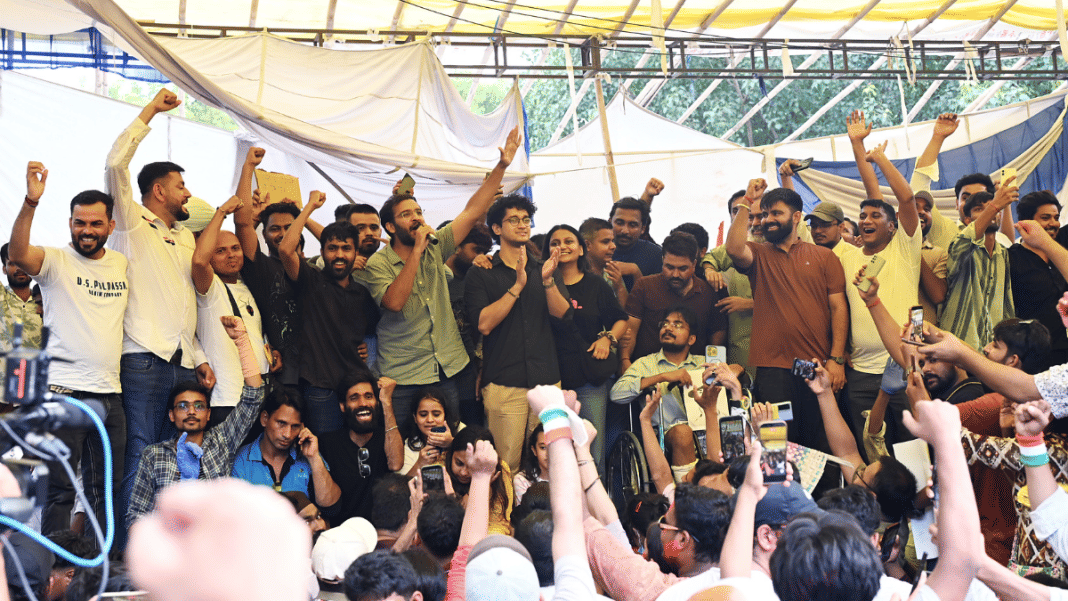


A protest movement can bring thousands to Jantar Mantar, dominate social media and capture the imagination of an entire generation. But none of that may necessarily translate into votes.
The Cockroach Janta Party (CJP) began as a social-media meme movement, emerging as an immediate reaction to the Chief Justice of India’s remark in May this year, in which he pejoratively labelled youth activists as “cockroaches”.
Founded by Abhijeet Dipke, an Indian student studying in the United States, the movement soon received support from Ashutosh Ranka, an IIT Kanpur alumnus, and Sourav Das, a freelance legal journalist. It also attracted social activist and environmentalist Sonam Wangchuk as its mascot. When Wangchuk went on an indefinite hunger strike demanding the resignation of Union Education Minister Dharmendra Pradhan and reforms to the NEET examination system, he captured the national imagination and galvanised young people across ideological and social divides.
After 12 years of uninterrupted rule, the BJP finally appeared to blink in the face of the CJP protests. The government’s response included Pradhan’s resignation, withdrawal of cases against student protestors, and compensation for students who had died by suicide in the aftermath of the NEET fiasco.
The CJP has captured the imagination of a large section of India’s youth by raising issues that affect their everyday lives: failures in the public examination system, deteriorating government schools and hospitals, unemployment, corruption and crumbling infrastructure. The movement appears to have tapped into a long-simmering frustration among young Indians that has finally reached a boiling point.
Even teenagers have grown willing to speak out. The viral protest by schoolgirls in Ujjain against the District Magistrate’s order relocating their school is a case in point. The fear of speaking openly about government apathy appears to be developing cracks. The protest at Jantar Mantar has given millions of dissatisfied young Indians a sense that mobilisation can force governments to pay heed to their voices and concerns.
But where does the CJP go from here? Should it follow the Aam Aadmi Party (AAP) model into electoral politics, or remain a pressure group, as Dipke has suggested? This question will go on to define the movement’s next phase.
From protest to politics
The CJP has built a substantial, organic support base among India’s Gen Z population, and some supporters may be tempted to enter electoral politics, following a path already taken by AAP.
The comparison, however, has limits. AAP was born in a fertile political environment: corruption allegations against the (United Progressive Alliance) UPA government and Manmohan Singh’s declining popularity had left the country actively searching for alternatives.
That flux fuelled both AAP’s rise in Delhi and the BJP’s rise nationally, with Kejriwal and Modi each presenting themselves as alternatives to an unpopular establishment. Kejriwal also brought a crucial advantage, with years of grassroots work among Delhi’s poorer communities before founding the AAP, which gave him considerable political credibility during the 2013 and 2015 Delhi elections.
The CJP, by contrast, has acquired considerable short-term credibility through mobilisation, but will need to prove itself over several years before becoming a serious electoral force. Electoral politics ultimately depends on votes and organisational strength, and nationwide sympathy doesn’t automatically convert into the electoral heft needed to win constituencies. India also remains a vast, rural country, not merely a collection of urban, digitally connected young voters, so how far the CJP’s appeal extends beyond that urban base remains unclear.
This is where the CJP differs most from AAP’s formative years. AAP’s strategy was geographically concentrated in Delhi; the CJP is a nationally dispersed movement without a defined geographical stronghold. That may bring visibility, but it also creates an organisational challenge, national visibility is not the same as an electoral constituency. A movement can trend online, draw thousands to a protest and win public sympathy while still lacking the booth-level organisation and constituency-specific networks needed to win elections.
The case for remaining a pressure group
This doesn’t mean the CJP lacks political potential. Its focus on public schools may offer a starting point. The movement’s School Thik Karo campaign helped push Rajasthan’s government to sanction a ₹12,500 crore fund for repairing dilapidated schools.
Such outcomes show the CJP’s potential without requiring it to become a conventional party. There may even be a strategic advantage in staying a pressure group: electoral politics forces movements to broaden their agendas, compromise, and build coalitions, while a pressure group can keep a narrower, issue-focused agenda. The CJP’s greatest strength may lie precisely in what sets it apart from conventional parties, its ability to mobilise young people around concrete issues without becoming entangled in electoral politics. Either way, the CJP looks set to stay.
Yajat Sen is a student at The National Law Institute University, Bhopal. Views are personal.
Also Read: Two freedoms, one system