





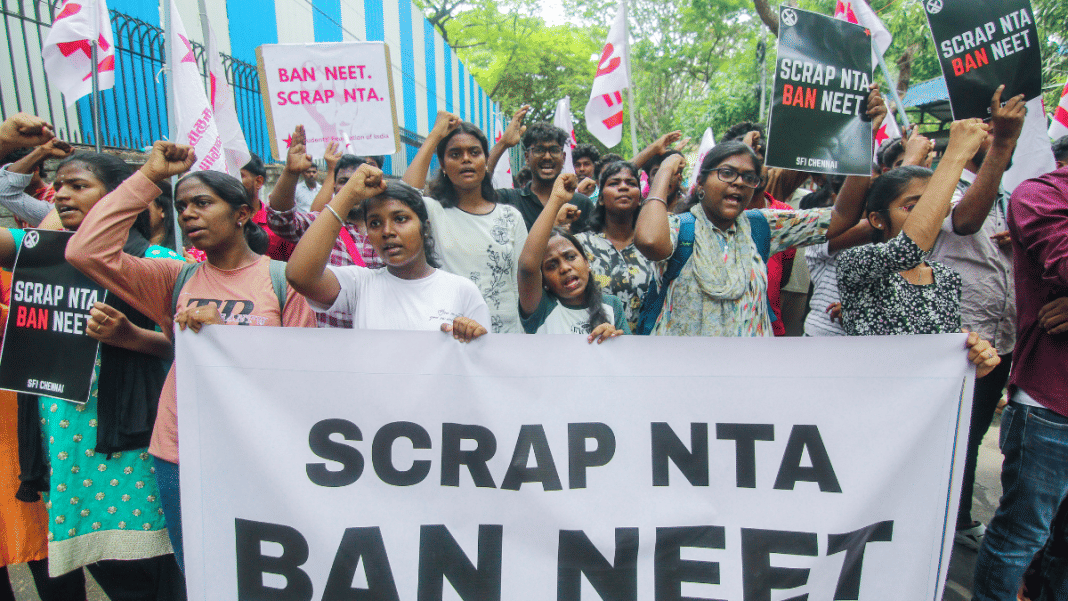


After the 2026 NEET paper leak incident, the students of India took to the streets for the question of their future, under the banner of an Indian youth-based digital political movement, Cockroach Janta Party. They rose against recurrent paper leaks, a shaky system, and inadequate legal mechanisms for their redressal.
In connection with this, the Parliament passed the Public Examinations (Prevention of Unfair Means) Amendment Bill, 2026. Following an acrimonious debate during the Monsoon Session of Parliament, the new law has emerged as a ray of hope for many students. It seeks to amend the Public Examinations (Prevention of Unfair Means) Act, 2024, with the objective of addressing the shortcomings exposed by repeated examination paper leaks.
The Act applies to public examinations conducted by bodies, such as the Union Public Service Commission (UPSC), Staff Selection Commission (SSC), Railway Recruitment Boards (RRBs), Institute of Banking Personnel Selection (IBPS), National Testing Agency (NTA), ministries under the Central government and other authorities notified by the Centre. The objective of the Act was to “bring greater transparency, fairness and credibility and inspire confidence in the public examinations system”.
The amendments come against the backdrop of recurring paper leaks that have disrupted the academic and professional aspirations of thousands of students seeking admissions, jobs and promotions. More than 150 paper leaks have reportedly occurred over the past decade. The 2026 NEET paper leak became the defining example, triggering nationwide protests demanding the resignation of the Union education minister and widespread demands for systemic reforms to make examinations more transparent and secure.
The 2024 Act left several gaps. It did not provide a time-bound mechanism for investigation and trial, lacked a standard procedure for handling paper leak cases, provided no comprehensive framework for identifying the masterminds behind such offences and contained no mechanism for confiscating assets acquired through proceeds of these crimes. The amendment seeks to address many of these shortcomings.
The proposed amendments substantially strengthen the existing penalties. Broadly, the changes fall into four categories.
Under the amended Section 10, the punishment has been enhanced to imprisonment of five years, extendable to ten years, along with a fine of up to Rs 50 lakh. Section 11, which deals with organised crime, increases the maximum fine to Rs 10 crore while prescribing imprisonment of up to seven years. Every person in charge of a service provider found involved in unfair means may also face imprisonment of up to five years and a fine of up to Rs 5 crore.
Another significant reform is the insertion of Sections 12A and 12B. These provisions require every state government and Union Territory administration to designate a Court of Session as a Special Fast-Track Court to try offences under the Act. They also mandate the appointment of a Special Public Prosecutor for every such court.
The need for specialised courts is not new. The Law Commission, in its 239th Report, identified several reasons for delays in criminal trials, including the absence of accused persons, laxity during investigation, frequent adjournments and inadequate court staff. Dedicated fast-track courts could help ensure timely justice in examination-related offences. In line with these provisions, the Chief Justice of the Delhi High Court, D.K. Upadhyaya, appointed Anu Grover Baliga as the Special Judge for the designated fast-track court on 23 July, 2026.
The law would further mandate day-to-day hearings, with trials to be completed within three months of the filing of the chargesheet. Investigations must be concluded within two months. Appeals against judgments, sentences or orders of the Special Fast-Track Court will lie before a two-judge bench of the High Court. Appeals must ordinarily be filed within 30 days, although courts may condone delays of up to 90 days upon sufficient cause being shown. These provisions mirror those contained in Section 21(5) of the National Investigation Agency Act, 2008.
The Hon’ble Supreme Court in Chandigarh vs Vaibhav Singli Chauhan stressed that malpractices in examinations in educational institutions should be curbed with an iron hand, and there should be strict discipline in punishments.
Similarly, in Ashwini Kumar Upadhyay vs Union of India, a writ petition filed under Article 32 of the Constitution seeks the formulation of a standard questionnaire and a special investigation procedure for paper leak cases. The petition arose from the NEET paper leak and highlights the financial, educational, and psychological hardships suffered by affected students.
The petition also raises the larger constitutional question of whether recurring paper leaks violate the fundamental rights guaranteed under Articles 14 and 21. In Krishna Yadav vs State of Haryana, the Supreme Court recognised that the integrity of public examinations forms an essential part of the fundamental rights under these constitutional provisions.
The petition further raises questions regarding the absence of a standard operating procedure (SOP). Taking account of a global perspective, the petitioner argued that China has a robust framework for an anti-paper leak mechanism under Amendment IX to China’s Criminal Law, which imposes stringent punishment for organized cheating.
The Parliament and the courts stepping in to resolve the problem is a welcome move. However, measures must be taken immediately to prosecute the offenders involved in the NEET paper leak upon completion of the CBI investigation. The proposed Amendment Bill should receive the President’s assent without delay, and its provisions should be brought into effect immediately.
Additionally, a few suggestions should also be considered, such as an independent oversight body being established to look into the excesses of the leaks, and all information regarding ongoing investigations being made readily available to the public. The aggrieved students should be provided adequate compensation, and families who have dealt with the loss of a child to a paper leak should be extended due care and compensation.
The amendment is the answer to a generation demanding justice, and the parliamentary debate furnished arguments from both sides of the table. Yet one argument stayed constant throughout: the government must not compromise the interests of its youth, and its students in particular. The Bill responds to those demands through the language of law. Whether it ultimately succeeds will depend not on the legislation itself, but on its implementation.
Anandita Kulhar is a student of Maharashtra National Law University, Nagpur. Views are personal.
Also Read: Before you scroll to the next reel, try being bored