







The Indian state respects the voice of the young, but only when it is the state’s own voice that is heard through them. This is the true account of two events, six months apart, one where the government embraced young people with open arms, and the other in which it met them with tear gas.
The Viksit Bharat Young Leaders Dialogue convened 3,000 selected youth at Bharat Mandapam in January to share their policy suggestions with the ministers. The participants were selected in a multi-round process including quizzes, essays and presentations, all of which were conducted on government platforms. The topics they could speak on were also pre-determined by the organisers, from innovation to women-led development.
This was a change from “celebration” to “consultation”, and the young delegates were dubbed “policy architects”. It appeared to be a genuine transfer of voice to the youth. All aspects of the process—who was chosen, what they were allowed to talk about, and how much time they had—was planned and managed by the state. It was the youth’s voice, but a voice that was approved, timed and filtered before reaching anyone with real authority.
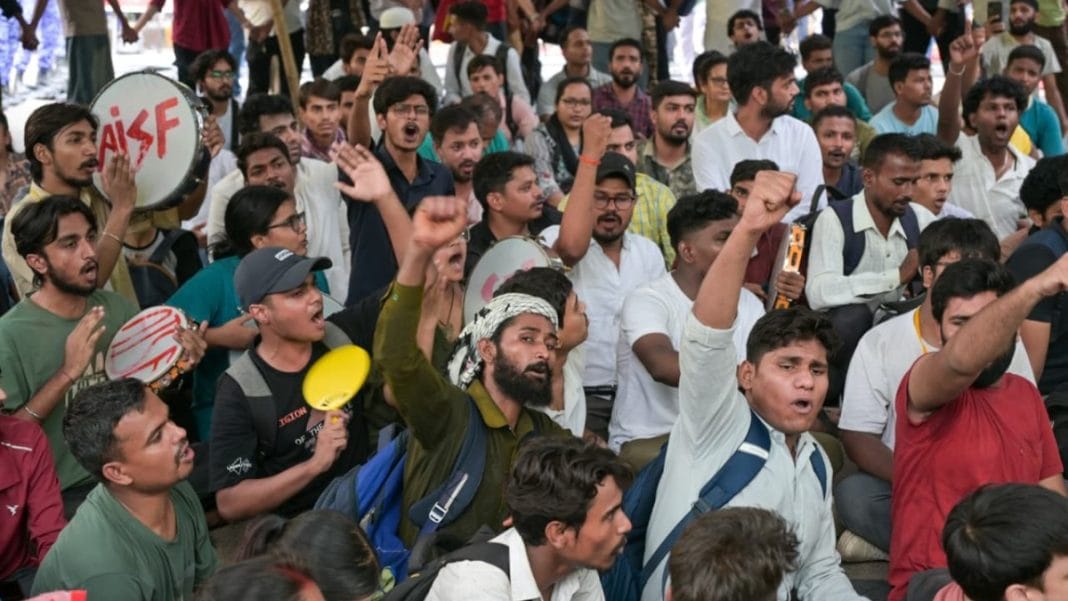
By July, a new voice of youth had come forth, one that did not seek permission. The anger over the NEET 2026 paper leak escalated into a nationwide movement by the youth against unemployment and corruption. The protests extended to other cities like Mumbai, Bengaluru and Patna. These were not delegates chosen for their essays, but students, job seekers, and graduates who were not invited to any discussion of the issues they were facing. No quiz, no time limit, and no ministry stage. Instead, there were baton charges, internet shutdowns, and several people left injured.
These two moments are juxtaposed to make a clear statement. When young people speak in a format designed and controlled by the state, they are referred to as “partners in nation-building.” If the same energy comes in without invitation, asking for things that were not on the government’s agenda, then it is considered a law-and-order issue, not consultation.
This pattern is not exclusive to India, but, that does not make it any less important to note. In many countries, governments would prefer youth engagement that can be scheduled, branded, and limited in time. What this shows is a deeper assumption: that young people are only worth listening to when they come to the state in a way the state has designed. The goodwill expressed in January faded when the assumption is challenged, when young people organise themselves, with their own demands and their own platforms.
None of this is to say that the Viksit Bharat Young Leaders Dialogue is a waste of time or that formal youth engagement forums are necessarily bad. The concern is not that such a dialogue exists. It is what that dialogue starts to look like when it is placed alongside a very different response to the same group of people, when they decide to organise on their own terms rather than the government’s.
It is also important to acknowledge that a street protest is not a policy dialogue and that no government equates the two. There is a reasonable argument that if a protest disrupts a city to the level seen in Delhi, the state has legitimate concerns of law and order and should respond in a proportionate manner.
However, this does not fully explain the difference in treatment. A platform like the Viksit Bharat Young Leaders Dialogue can only be meaningful if the same government is ready to listen to the voices that it did not script and invite. Otherwise, the term “engaging youth” is just a more euphemistic way of saying “managing youth”.
Vedang Shukla is a student of National University of Study and Research in Law, Ranchi. Views are personal.
Also Read: Algorithms are modern-day equivalent of karma. We must go back to Bhagavad Gita