




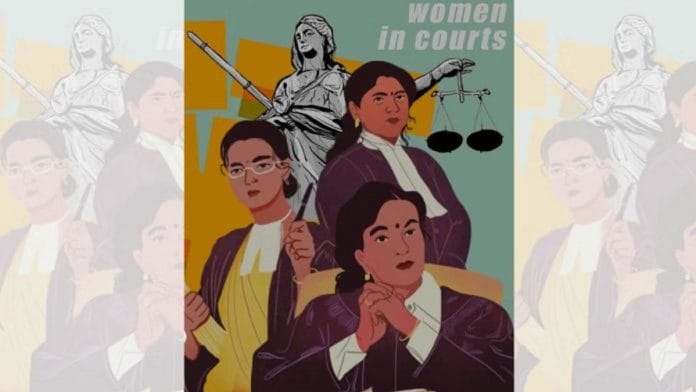

Women were allowed to practise law in India with the Legal Practitioners (Women) Act 1923. But a hundred years hence, data shows, they are still outnumbered by men at every stage, from taking the bar exam to taking on leadership positions across the spectrum of available opportunities.
Today, any person can practise before Indian courts only after qualifying in the Bar Council of India’s All India Bar Examination (AIBE), conducted biannually since 2010. Upon passing the exam, candidates receive a certificate of practice, which entitles them to enrol with a State Bar Council and practise law. The stated aim of introducing the AIBE was to enhance the quality of the legal profession.
The 21st edition of the AIBE was conducted on 7 June this year, with results announced on 18 July. The Bar Council of India’s press release provides crucial statistics on the composition of candidates and pass percentages.
Of the total of 1,75,701 candidates who wrote the examination, less than 37 per cent were women, a minor improvement from just over 34 per cent in the previous edition. The qualifying percentage was almost identical for male and female candidates (65.92 per cent). This is a drop from the pass percentage for the 20th edition of AIBE (69.21 per cent), when female candidates recorded a pass percentage of 71 per cent as opposed to 66 per cent for male candidates.
The gender disparity visible in these statistics is consistent with the most recent data on students pursuing law, published in the Ministry of Education’s 2023-24 All India Survey on Higher Education (AISHE). Of the 7,67,149 students enrolled in law universities and colleges across the country, women make up just over 37 per cent (2,84,163). As AISHE relies on higher education institutions to submit data voluntarily, these numbers may not be comprehensive, but they are certainly indicative of the overall trends of legal education.
These data points suggest two things. First, men outnumber women both in law school enrolment and in appearing for the AIBE. Second, female candidates are equally competent, given their similar, and at times slightly better, pass percentage.
While these numbers highlight a stark gender disparity at the stages of legal education and entry into the profession, the picture becomes even more concerning when we examine the number of women enrolled in State Bar Councils, taking on leadership positions, being designated as senior advocates and rising through the ranks of the judiciary.
Also Read: Bias, burnout & lack of infra: SCBA survey lays bare struggle of women lawyers in India
The leadership gap
In 2022, the Ministry of Law and Justice was asked in the Lok Sabha for data on enrolled female advocates. The reply provided in the Lok Sabha stated that women constituted 15.31 per cent of enrolled advocates.
It should be noted that this is inaccurate, as it compared the number of women advocates reported by 15 State Bar Councils with the total number of advocates reported by 24 State Bar Councils. Considering only the 15 State Bar Councils that furnished gender-disaggregated data, women constituted about 18.44 per cent of enrolled advocates (2,84,507 of 15,42,855)—only a slightly better share.
These numbers fall even further when we look at women holding leadership and decision-making positions within the legal profession. In 2021, women held just 9 of 441 elected posts (2.04 per cent) across the State Bar Councils. The Bar Council of India does not have a single woman member.
According to a 2023 Bar & Bench analysis, merely 3.4 per cent of designated senior advocates in India are women. Last month, the Delhi High Court designated 85 lawyers as senior advocates, of whom just 11 (13 per cent) were women. This was nevertheless lauded as historic, as this was one of the highest shares of women in a single set of designations.
Even on the judicial side, the story remains the same. The Supreme Court of India’s State of the Judiciary Report 2023 stated that, in 14 states, women held 50 per cent of the posts of Civil Judge (Junior Division). These positions are filled through a direct examination conducted by the state and its High Court. However, women’s representation falls to 36.3 per cent across the district judiciary, 13.4 per cent in the High Courts and 9.3 per cent in the Supreme Court. A Ministry of Law and Justice press release from February 2026 reports a marginal improvement, with women making up 14.25 per cent of High Court judges. Currently, the Supreme Court has only two women judges out of a total of 34, which is around 6 per cent.
Also Read: Supreme Court proposes stipend for young lawyers, better court infra for women advocates
Quotas cannot fix everything
Women advocates have consistently highlighted the lack of essential conditions and basic infrastructure as institutional barriers to practising in most courts across the country.
Earlier this month, the Supreme Court passed a series of time-bound directions to all states and Union territories to ensure the availability of basic amenities for women, including washrooms in all courts. One would imagine that 103 years after women began practising in India, the availability of washrooms in courts would not require intervention from the apex court. In the same case, the Supreme Court also called for the creation of a Young Lawyers’ Professional Assistance Fund to fund stipends for early-career advocates.
Data from JALDI’s Women in the Judiciary portal shows that, between 2007 and 2024, more women have been consistently recruited to the post of Civil Judge (Junior Division) in states such as Chhattisgarh, Punjab and Rajasthan, which have 33 per cent gender-based reservation. In a similar vein, the Bar Council of India has proposed amendments to the Advocates Act 1961 to increase the representation of women in State Bar Councils and strengthen welfare fund measures for advocates. While just 21 per cent of positions have been proposed to be reserved for women, this is a significant step, given that women held a mere 2.04 per cent of positions without reservation.
These are good starting points. But given the momentum, it is also time to think more comprehensively about how we can ensure that more women not only enter the legal profession but also thrive and grow to become leaders influencing future generations of women lawyers.
Merely mandating a quota without addressing systemic issues cannot achieve this goal. The absence of written contracts, no decent pay in the early years, lack of maternity benefits and creches, and long and unpredictable working hours without access to washrooms exacerbate already difficult circumstances, leading women to exit the profession. The stipulation that men and women need a minimum of three years of practice to enter the judiciary may be harsher on women.
Not all women face the same issues, and the numbers discussed above cannot capture all the intersectionalities involved. Some women may come from vulnerable communities or face financial hardship, making it far tougher for them to enter, cope and rise. The call of the hour is to aggregate more data, conduct research into the gaps and reform the system holistically.
Dr Ashrita Prasad Kotha is Associate Professor and Director of the Centre for the Study of the Legal Profession at the National Law School of India University (NLSIU). Atishya Kumar is Assistant Professor at NLSIU. Views are personal.
(Edited by Asavari Singh)