



New Delhi: About a month ago, a carbon copy of a successful candidate’s OMR answer sheet from a government recruitment exam was viral in Jharkhand. The post, which came days after the preliminary test results for the Jharkhand Public Service Commission (JPSC) exam were declared, claimed the candidate had qualified for the next round despite answering only 48 out of 100 questions in the first paper.
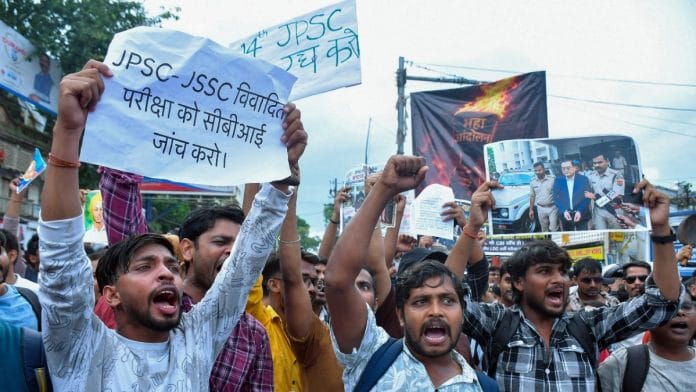
Paper leak allegations have since snowballed into a major flashpoint with hundreds of students protesting at Ranchi’s Jaipal Singh Munda Stadium for the past six days over what they allege are widespread irregularities in the conduct of government recruitment exams.
On Thursday, Jharkhand Criminal Investigation Department (CID) arrested the candidate, Suman Saurav, and 10 others, including those believed to be the ‘masterminds of the leak’.
But it wasn’t enough to quell the anger.
For the students, it isn’t just about one exam. They say the controversy is just the latest in a series of alleged irregularities—paper leaks and cancelled exams to delayed results —that have plagued competitive exams in the state since it was carved out of Bihar in 2000.
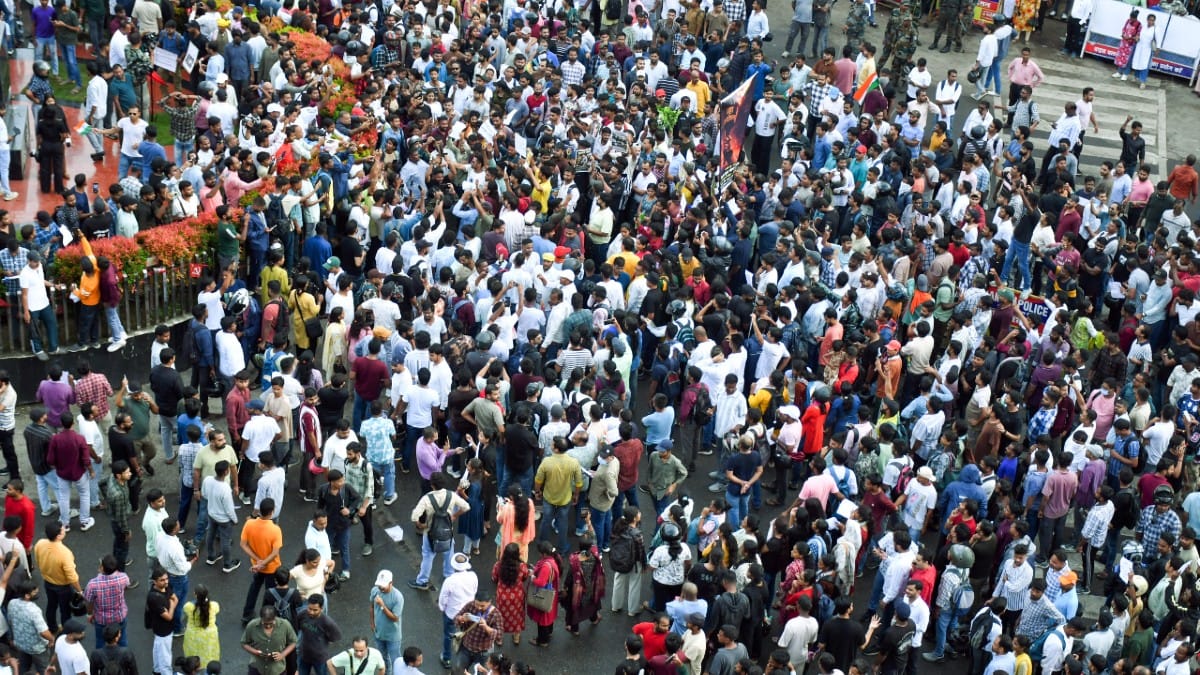
Not satisfied with a CID probe into the latest allegations surrounding JPSC and JSSC, the students are demanding a Central Bureau of Investigation (CBI) probe. The JPSC and JSSC hold a Combined Graduate Level (CGL) examination and Excise Constable examination, among others.
Protesting students are also seeking sweeping reforms, such as awarding contracts for different stages of the examination to different firms—prelims to one firm, the final to another—to improve oversight and prevent the monopoly of a single company.
The students say they have become more confident since the success of the massive Cockroach Janta Party (CJP) protests in Delhi over the NEET (UG) 2026 paper leak, which ended with Union Education Minister Dharmendra Pradhan’s resignation.
“This is not our first protest against irresponsible conduct of institutions in the state and rampant corruption and irregularities in holding competitive examinations for lakhs of youth,” Vinay Mehta, a member of the core committee behind the protest, told ThePrint.
“I myself have three FIRs against me for protests in Ranchi, but earlier ones lasted not longer than a day. The success of the CJP-led protests in Delhi has given us the confidence that accountability can be sought, and hence we have launched our first indefinite protest,” added Mehta, who has been preparing for competitive exams for five years.
Also Read: Echoes of Jantar Mantar—Jharkhand students rise against JPSC, JSSC paper leaks
Jharkhand’s track record
In Jharkhand, the issue of alleged irregularities in the conduct of government recruitment exams goes far beyond the JPSC examination which triggered the protest. Jharkhand’s civil services examination has been dogged by controversy for more than two decades.
One of the first scandals erupted in 2003, when allegations surfaced that the History paper had leaked, prompting JPSC to cancel the exam held in August 2003. It was then organised in 2004. Years later, the CBI filed five cases in connection with alleged irregularities in the 2012 JPSC examination. It found that several successful candidates who went on to join the services were related to politicians, civil servants and JPSC officials.
After a gap of 12 years, the agency charged 50 people, including former JPSC Chairman Dilip Kumar Prasad, secretary-cum-examination controller Usha Rani Singh, assistant coordinator (evaluation) Arvind Kumar Singh, and experts of the interview board, along with several candidates.
But students say the examination system is still compromised.
Earlier this year, the Ranchi Police arrested more than 150 students from an under-construction building on grounds of the suspicion that they were in possession of what was believed to be the question papers for the Excise Constable Examination.
However, the police later claimed that the questions did not match the actual questions.
Before the current wave of paper leak protests, students in Jharkhand had also protested the alleged paper leak ahead of the CGL examination in 2023. The results were withheld for more than a year, with students seeking a fresh examination amid widespread complaints of a leak and probes.
Divided stage, united demands
The protests in Ranchi may be inspired by the defiance shown by thousands of students at Delhi’s Jantar Mantar.
However, unlike the agitation in the national capital, the Ranchi protest has seen a split between the movement led by student leaders and another by political leaders.
The Ranchi agitation is being organised by a core committee of students who say that politicians can support but not lead the movement.
The difference is visible at the protest site where the protesting students have set up one stage and another has been erected by Mahendra Mandal, a youth wing leader of the Jharkhand Loktantrik Krantikari Morcha (JLKM) led by Jairam Kumar Mahato.
Mandal announced that he would go on an indefinite fast unto death until Chief Minister Hemant Soren agreed to the students’ demands.
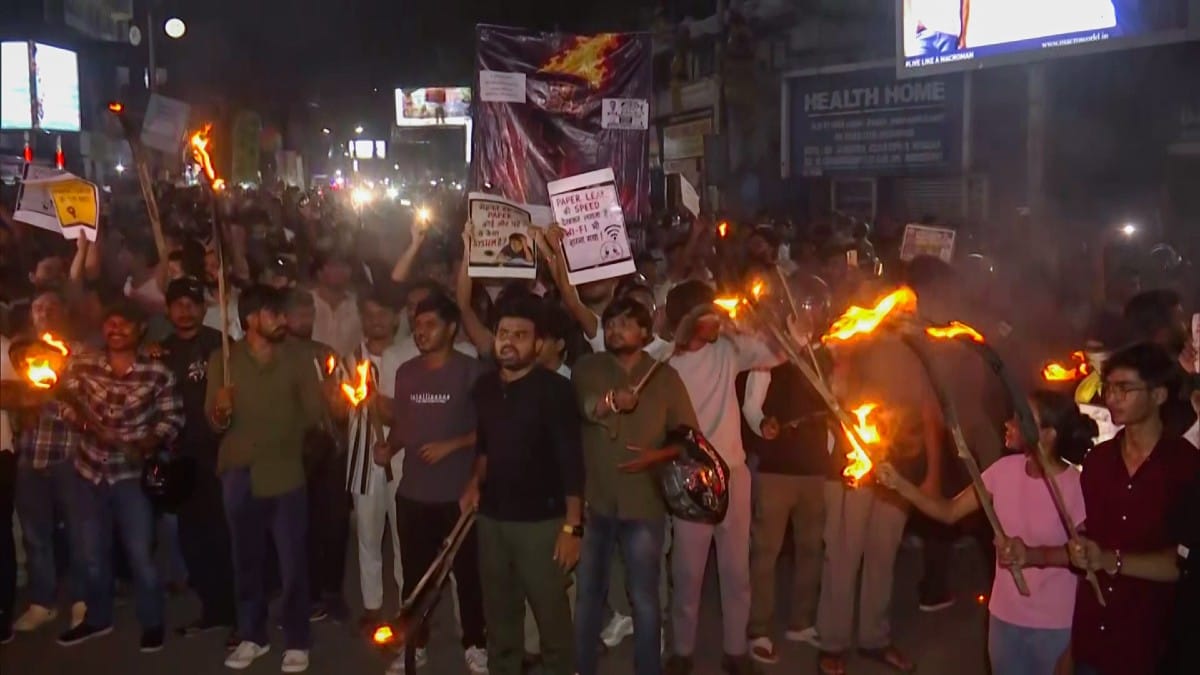
The students and JLKM members had earlier worked together, but significant differences emerged between them over the political leaders’ use of the students’ protest. “Our agenda was clear that we were protesting to bring reforms into the exam-conducting bodies of the state and to seek accountability,” Mehta, a core committee member, told ThePrint.
“Members of any political party who want to show solidarity with us are welcome, and we want them to provide their shoulders to our movement,” he added.
However, he pointed out that the agitation will be presided over by students alone.
“We shall not allow politicians to take centre stage in this agitation. We had differences with them over the same issue, and now they are protesting at a different place in the same ground,” Mehta said.
The protestors and the JLKM are also at odds over the next move to take their agitation to the next level.
The JLKM has announced it will organise a huge protest and hold a sit-in outside the state Assembly on Thursday, a plan that protesting students are not fully on board with.
“We shall meet Monday afternoon and decide the future course of action,” another core-committee member, Piyush Singh, told ThePrint.
Also Read: Abhinay Sir backs Ranchi students against paper leaks. Will hold classes from protest site
‘Process is the punishment’
The JPSC advertised 103 posts in January this year, with nearly half the jobs for the Deputy Superintendent of Police-rank.
More than 36,000 students appeared for the preliminary exam held on 19 April across two sittings of two hours each. Each round had 100 questions, worth two marks each, with no negative marking.
According to the results published on 2 July, 2,204 students qualified for the mains examination, the fate of which hangs in the balance amid students raising questions over the integrity of the preliminary examination and an ongoing probe by the CID.
Piyush Singh, a 34-year-old from Bokaro, says he has been preparing for competitive examinations in the state for the last seven years and has passed the initial rounds of the examinations on seven occasions. But the job has eluded him so far.
“I am 34 years old and have got caught in the endless cycle of paper leaks, cancellations or delays. Even if everything goes well and JPSC and JSSC take the examination, the time period between prelims and main exam is two weeks, but it will take one year to declare the results,” said Singh, a farmer’s son with two younger siblings dependent on him.
“The process has become a punishment for us students in the state,” he added.
‘Buck stops at the top’
Amid mounting protests and outrage, the Hemant Soren-led government ordered a CID probe into paper leak allegations.
The CID registered a case on 22 July invoking provisions of the Bharatiya Nyay Sanhita, 2023 related to criminal breach of trust, cheating, forgery of valuable security, forgery for cheating, using forged documents as genuine, and criminal conspiracy.
On the same day, the state agency arrested the JPSC’s deputy controller of examination, Shweta Kumari Gupta, and the directors of the firm entrusted with the responsibility of conducting examinations, TSR Data Processing Pvt Ltd (TDPL): Ramvir Singh, Abhay Kumar Tiwari. Two other employees were also arrested.
As part of its probe, the CID said it found that the firm conducting the examination was earlier blacklisted by the JSSC for not fulfilling the agreement to conduct the Jharkhand General Graduate Level Combined Competitive Examination in September 2024.
It agreed to the terms and conditions, including pricing, at the time of the tender process and then withdrew from the process citing what it called the low value of the contracts.
That examination was also marred by allegations of paper leak, which prompted a probe by the Jharkhand CID and the filing of chargesheets. The JSSC published the result more than a year later only after the Jharkhand High Court allowed it to do so, disposing of pleas seeking cancellation of the examination by around 1,000 candidates.
As the TDPL’s past history emerged, the focus of the probe shifted to the JPSC chairman, L. Khiangte, who was earlier appointed as chief secretary of the state under Soren between December 2023 and October 2024.
Khiangte was questioned four times by the state agency and faced raids at his residential and office premises in Ranchi before he resigned from his post as JPSC chairman.
As part of its probe, the Jharkhand CID has so far arrested 11 accused, including Abhay Kumar Tiwari, who was posted as Block Supply Officer (BSO) in the state’s Godda district.
Before assuming a government job, the CID has allegedly found that he had once worked as the marketing director of TDPL, the company under the scanner for irregularities.
“TDPL had issued an authorisation letter to JSSC with regard to the conduct of the examination in 2024 that Manoj Kumar Tiwari would be the authorised person. Manoj was one of the aliases used by him,” a police officer said.
Sources in the Jharkhand Police said Tiwari’s brother, his wife, and sister-in-law have also been found to have qualified for the JSSC CGL examination and are currently employed by the state government.
“Khiangte sahab has publicly said that he was not aware that TDPL was blacklisted by the JSSC and hence the contract was awarded to the firm. Either it is incompetence or his complicity in this mess. Either way, the buck stops at the top, and the mess has to be cleaned up starting from the top,” Mehta said.
“The CID has never brought the facts to light and has always manipulated probe results based on political demands of the government. That’s why we are asking for an independent probe by the CBI,” said Singh, a fellow member of the committee.
(Edited by Sugita Katyal)
Also Read: Jharkhand’s govt job dream is trapped in an examination system aspirants no longer trust
The only way to stop paper leaks is to the reduce the importance of examinations in this country. Also why should a minister resign huh ? No one blames the bureaucrats. There is a reason why even after voting politicians out you can’t see changes in such things because no bureaucrat is ever held responsible.
People need to be smart about it. Ironically this exam leak is to select the next corrupt bureaucrat. Some of the students who are protesting now are going to be the enemy of the students in the future. But no one protests about bureaucrats I.e. unelected officials.
I am not left wing btw so I don’t have any love for Congress allied party. But if you fail to see the problem then you are the problem. The country is a reflection of its people and people are stupid in this country. Maybe we should have an examination to determine who gets to vote in this country.