


New Delhi: India is expected to remain home to the world’s largest Hindu population by 2070, while Pakistan is projected to overtake Indonesia as the country with the largest Muslim population, according to a new Pew report.
Home to about one fourth of the world’s population, South Asia is projected to witness significant changes in its religious population over the next five decades, with the two neighbours as well as Bangladesh, Nepal, Sri Lanka and Afghanistan featuring in Pew’s ‘The Future of World Religions: Population Growth Projections, 2020–2070’ report.
Interestingly, Pakistan’s Hindu population is projected to more than double between 2020 and 2070. At the same time, the region is set to see a shift in Muslim population rankings, with Pakistan and India occupying the top two spots while Bangladesh making it to the fifth spot.
The projections are part of the Pew Research Center’s report, which examines how the populations of seven religious groups could change globally over the next 50 years if current demographic trends continue.
Hindu populations
While the number of Hindus in India is projected to rise from 1.11 billion in 2020 to 1.29 billion in 2070—an increase of 176 million, their share of India’s population is expected to decline from 79.4 percent to 75.8 percent over the same period.
“While India’s overall fertility rate has fallen rapidly in recent decades, Muslims in India still have more children per woman than Hindus do. Given this fertility gap and Muslims’ younger age profile, Hindus are projected to decline as a portion of the Indian population, while Muslims are expected to rise,” the report mentions.
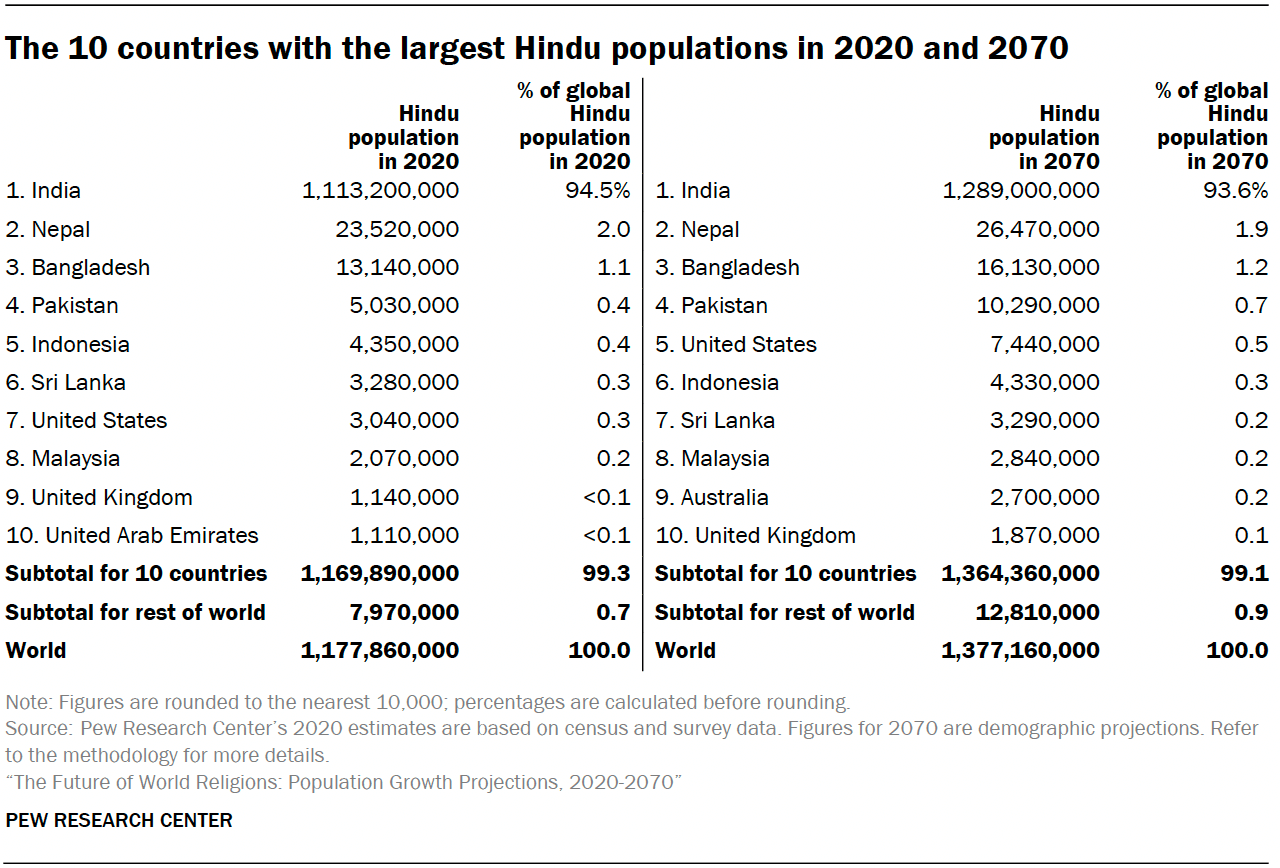
Beyond India, Nepal and Bangladesh are among the countries with the largest Hindu populations. Nepal’s Hindu population is projected to rise from 23.52 million in 2020 to 26.47 million in 2070. Bangladesh will see it grow from 13.14 million to 16.13 million over the same period.
Sri Lanka’s Hindu population is projected to remain relatively stable, increasing marginally from 3.28 million in 2020 to 3.29 million in 2070
Pakistan is projected to record one of the fastest increases in its Hindu population among countries with the largest Hindu communities. The number is expected to rise by 104.6 per cent between 2020 and 2070, from 5.03 million to 10.29 million.
Pew attributes the projected increase in Pakistan primarily to natural population growth, meaning births outnumbering deaths. The country is expected to retain its fourth position in the global ranking of Hindu populations, even as the number of Hindus living there doubles.
Also Read: Pakistan to surpass Indonesia to have world’s largest Muslim population by 2070—latest Pew report
Muslim populations
The report projects that all 53 countries and territories that had Muslim majorities in 2020 will retain it in 2070. Afghanistan, Bangladesh, Maldives and Pakistan are among the South Asian countries expected to have Muslim majorities. In fact, Pakistan and Bangladesh are two of only seven Muslim-majority countries projected to have a total population of at least 100 million.
Muslims are projected to account for 99.9 percent of Afghanistan’s population by 2070. In Bangladesh, the share is expected to stand at 92 percent, while the Maldives is projected to have a 94.4 percent Muslim population. Pakistan’s Muslims are expected to account for 96.8 percent of its total population.
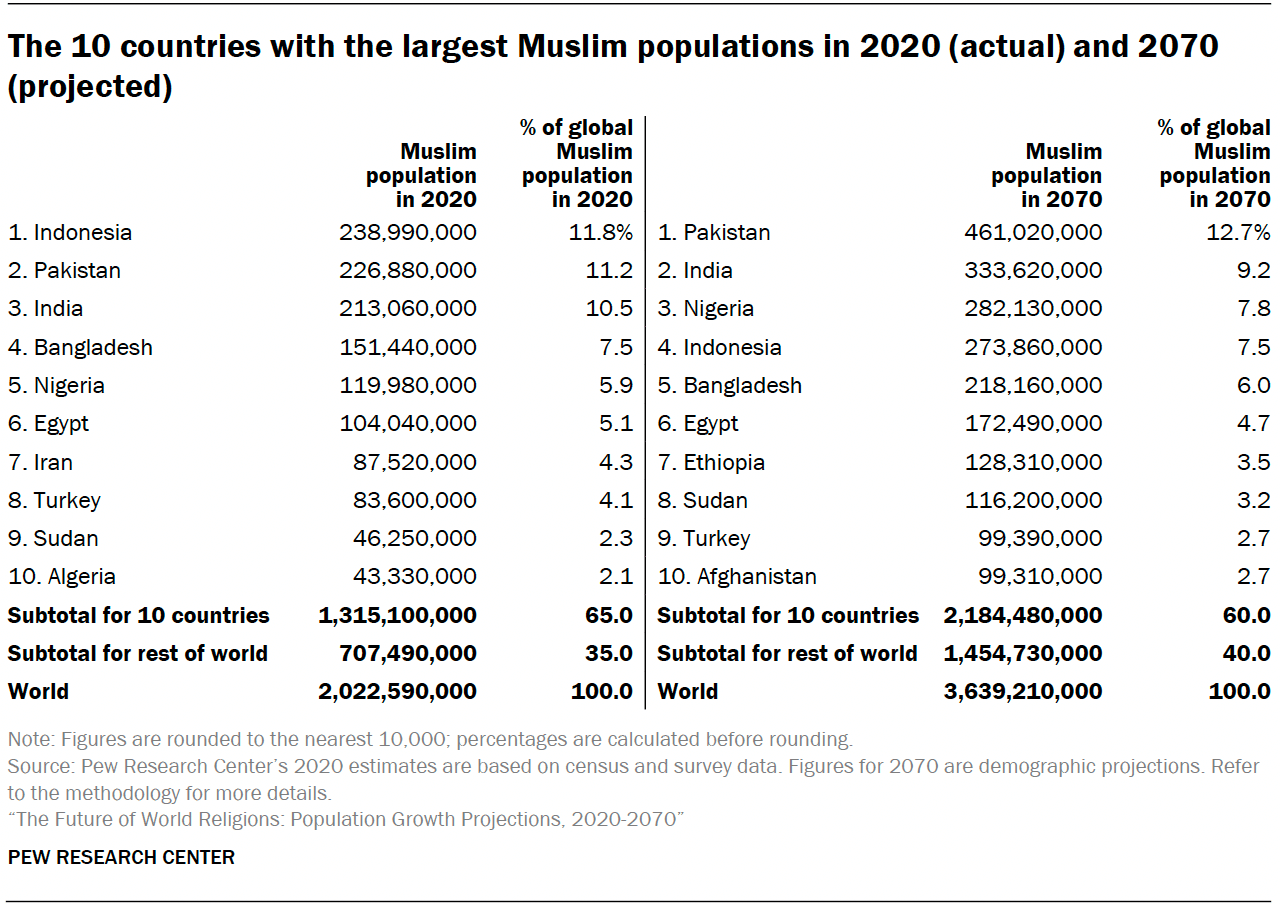
Pakistan, which accounted for the world’s second-largest Muslim population in 2020, is projected to take over the top spot from Indonesia. Its Muslim population is expected to increase from 226.88 million in 2020 to 461.02 million by 2070, accounting for 12.7 percent of the global Muslim population. India is projected to rank second, with 333.62 million Muslims, followed by Nigeria with 282.13 million.
Bangladesh, which ranked fourth in 2020 with 151.44 million Muslims, is projected to have 218.16 million and occupy fifth position. Indonesia, meanwhile, is expected to fall from first to fourth place, with its Muslim population projected to reach 273.86 million.
Afghanistan is also expected to enter the list of the world’s 10 largest Muslim populations. Its Muslim population is projected to reach 99.31 million by 2070, placing it tenth globally.
Buddhist populations
South Asia also features in the report’s projections for Buddhist populations, although the broader global trend points towards a decline.
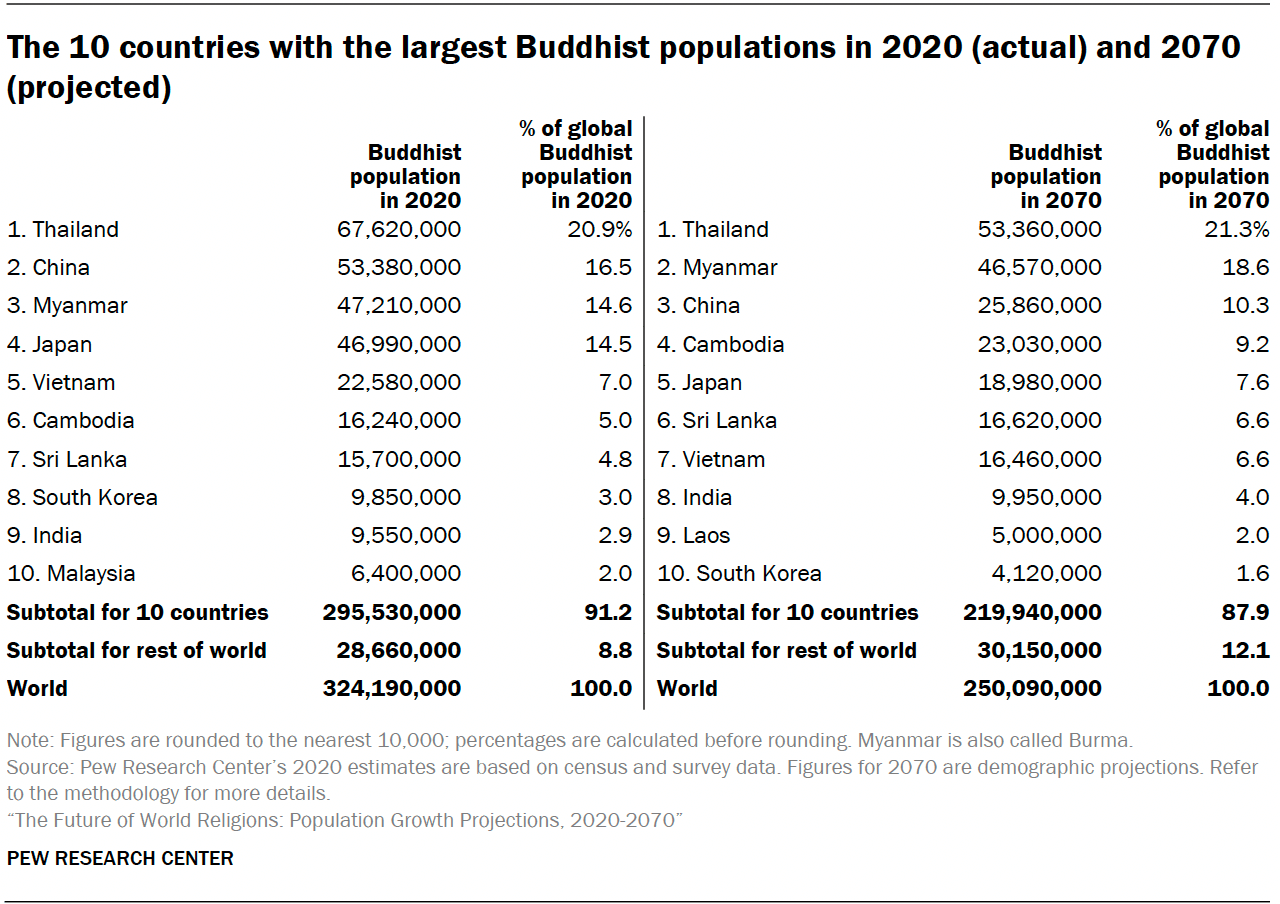
Sri Lanka is projected to have 16.62 million Buddhists by 2070, up from 15.7 million in 2020. It is expected to move from seventh to sixth place among countries with the largest Buddhist populations.
India, meanwhile, is projected to see a smaller increase, from 9.55 million Buddhists in 2020 to 9.95 million in 2070. It is expected to move from ninth to eighth place in the global ranking.
The landlocked country of Bhutan is set to retain its Buddhist-majority status even as their share in population will fall down from 74.7 percent to 70.6 percent. Buddhists in Bhutan and Sri Lanka will live alongside relatively large Hindu populations in 2070, the Pew report said.
The projections come against a broader decline in the global Buddhist population, which is expected to fall from 324.19 million in 2020 to 250.09 million by 2070. Pew attributes this decline to the older age profile and lower fertility of Buddhist populations, alongside religious disaffiliation.
(Edited by Tony Rai)
Also Read: Muslims to replace Christians as world’s largest religious group by 2035, Pew survey finds