





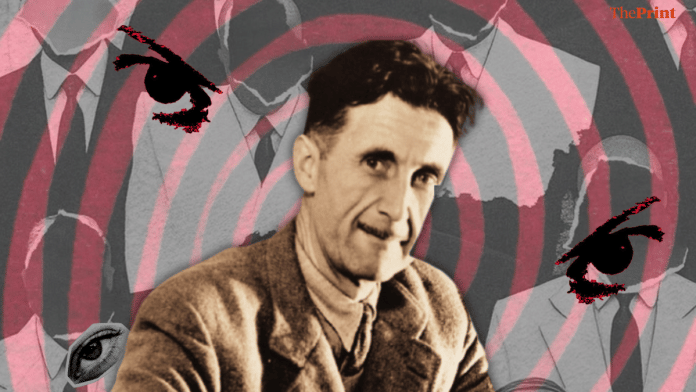


In the spring of 1928, a young Englishman named Eric Blair moved into a rented room in a working-class neighbourhood in Paris. The walls of which, he would later describe as ‘thin as matchwood”. Despite an Eton education and five years with the Indian Imperial Police in Myanmar, he gave both up voluntarily. Seventeen years later, Blair would write the allegorical novella Animal Farm and then the dystopian novel 1984 under the pseudonym George Orwell—a name that outlived the man who created it.
During the Cold War, Orwell was the prophet of totalitarianism. After 9/11, he became a writer of surveillance. In the age of social media, algorithms, misinformation and governments that know more about their citizens than ever before, “Orwellian” has become one of the most overused adjectives in political vocabulary.
On his 123rd birth anniversary, the writer remains a touchstone whenever societies argue about power, freedom and truth. The fascination shows little sign of fading.
Perhaps, it was his first-hand experience witnessing the harsh realities of poverty, class division, and the rise of totalitarianism that influenced his later writings. Or perhaps it was writers such as Charles Dickens and Jonathan Swift, but one thing is clear: George Orwell did not beat around the bush. With a sharp, crisp, and direct manner, Orwell weaponised language as an instrument of truth rather than a medium of embellishment.
Les jours sombres
Blair did not find initial success, like most authors. He lived at the Paris address for eighteen months, writing novels and short stories that no one would publish. For days, he went without food and eventually pawned his clothes to survive.
Robbed and destitute, the budding novelist took a job as a dishwasher in a Paris restaurant. Working brutal hours in the dingy kitchens, he continued writing. Drawing on these observations, he would later write in Down and Out in Paris and London (1933) that “the average millionaire is only the average dishwasher dressed in a new suit.”
In August 1929, still in Paris, he sent an essay to the Adelphi magazine in London. “The Spike” was an account of spending a night in a workhouse. It was accepted and published under his real name.
But the tide turned slowly and with help. In December 1929, Blair returned to England and went directly to his parents’ house in Southwold. Over the next three years he wrote reviews, taught at a private school, and wrote and rewrote what would become his first full-length work, Down and Out in Paris and London.
The manuscript was rejected by Jonathan Cape and then by Faber & Faber. Before it was rescued by a friend, Mabel Fierz, who showed it to a literary agent. Years after Blair had left Paris penniless, Victor Gollancz published it in January 1933. And so the world came to know George Orwell.
When the time came to publish, his parents, Blair feared, would be embarrassed by what the book revealed.
“As to a pseudonym, a name I always use when tramping etc., is PS Burton, but if you don’t think this sounds a probable kind of name, what about Kenneth Miles, George Orwell, H Lewis Always. I rather favour George Orwell” Blair wrote to his literary agent in 1932.
Also Read:Amrish Puri was more than Bollywood’s favourite villain. He mastered the language of power
‘Bah! Humbug!’
Eric Blair was born on 25 June 1903 in Bihar’s Motihari, the son of a British official in the Indian Civil Service. Before he was two, his mother had taken him and his sisters back to England. He would spend years trying to understand exactly where that placed him. In The Road to Wigan Pier (1937), he said, “I was born into what you might describe as the lower-upper-middle class.”
Scholarships carried Blair to Wellington and then Eton, two of England’s most prestigious schools. “
For people like me, the ambitious middle class, the examination-passers, only a bleak, laborious kind of success was possible,” Blair later wrote in Such, Such Were The Joys published in 1952.
He explained the different outcomes possible if the middle class slacked on its upward mobility ladder.
“You clambered upwards on a ladder of scholarships into the Civil Service or the Indian Civil Service, or possibly you became a barrister. And if at any point you ‘slacked’ or ‘went off’ and missed one of the rungs in the ladder, you became ‘a little office boy at forty pounds a year’. But even if you climbed to the highest niche that was open to you, you could still only be an underling, a hanger-on of the people who really counted,” he claimed.
But the Englishman knew the ladder well enough; he did, after all, become the ultimate voice of caution against it. He left in 1921 and climbed the rung leading to colonial service in the Indian subcontinent.
In his 1936 essay, “Shooting an Elephant,” written after he had walked away from the Indian Imperial Police, Blair described having been sent to shoot a rogue elephant. Standing there, with a rifle in hand, before a crowd of two thousand Burmese, he realised that the animal no longer needed to die, but he fired because the crowd expected it.
“I was only an absurd puppet pushed to and fro by the will of those yellow faces behind. I perceived in this moment that when the white man turns tyrant, it is his own freedom that he destroys. He becomes a sort of hollow, posing dummy, the conventionalised figure of a sahib,” he wrote.
By the time he left Burma at twenty-four, Blair had come to strongly oppose imperialism. He wrote later in his fifth book, Road to Wigan Pier (1937), “I hated the imperialism I was serving with a bitterness, which I probably cannot make clear”.
He left Burma in June 1927 on a medical certificate and never returned.
The following year found him in Paris: poor, unpublished, and persistently pursuing a life he had dreamt of as a child. After all, imagination cannot breed in captivity; it must be let free to roam, wander, and survive on its own.
“From a very early age, perhaps the age of five or six, I knew that when I grew up I should be a writer,” ,” he recalled in the 1946 essay “Why I Write.” He tried, for a while, to want something else. Between seventeen and twenty-four he turned away and felt, the entire time, that he was “outraging his true nature.”
He came back as writers always do, like a bee to the sweet scent of honey.
“What I have most wanted to do is to make political writing into an art,” he confessed.
But the young wordsmith also knew that work written without political fire went cold. He admitted that his purpose was not separate from his prose.
“Looking back through my work, I see that it is invariably where I lacked a political purpose that I wrote lifeless books and was betrayed into purple passages, sentences without meaning, decorative adjectives and humbug generally.”
Humbug. He spent his whole life at war with it. Truth, after all, is a revolutionary act.
A war that took him from Parisian slums to the coal mines of northern England, to the blood-soaked trenches of the Spanish Civil War and eventually, a cold farmhouse on a Scottish island.
Orwell’s war with totalitarianism also led to some of his greatest works and successes in life—Animal Farm. Written in 1943 and 1944, it was a thin fable about farm animals who overthrow their human master, only to find the pigs who lead the revolution had become everything they fought against.
Knowing it was a thinly-veiled critique Stalinism, the children’s book was rejected by four publishers for fear that the book might upset the Western wartime alliance with the Soviet Union. Even fellow essayist TS Eliot rejected it at Faber & Faber, and so did Gollancz.
It was finally taken on by Secker & Warburg and published on 17 August 1945.
But by then Orwell was already dying. On a remote Scottish island, consumed by tuberculosis, he typed the final draft himself working through fever and fits of bloody coughing. 1984 was published on 8 June 1949. It introduced terms such as “Big Brother,” the “Thought Police,” doublethink, and “Newspeak” to political discussions and popular culture. It was the dying man’s last gift to the language and the subject he had spent his life honing. 1984 went on to become one of the world’s most enduring warnings and an example of Orwellianism.
George Orwell died seven months later at the age of 46.
Also Read: Partition child Sunil Dutt fought for Hindu-Muslim unity, from marriage to peace marches
A nice cup of tea with Orwell
The man who gave the world biting satire also gave it eleven rules for making tea. Published in 1946, A Nice Cup of Tea finds Orwell arguing about teapots and the right moment to add milk. Like any real Englishman and tea lover, Orwell had strong views about tea, one that should never be taken lightly or messed with.
Tea, he declared, should be strong. The pot should be warmed. Milk should be added after the tea is poured. Sugar, meanwhile, had no business being there at all.
His letters are witnesses to his love affair with the world’s greatest beverage. Writing to Mamaine Koestler, the second wife of journalist Arthur, in January 1947, during the grey austerity of post-war rationing, he thanked her for sending some.
“We always seem to drink more than we can legally get, and are always slightly inclined to go round cadging it,” the tea-lover commented.
For years, the story of Animal Farm was told as Orwell’s alone. It is a version his adopted son, Richard Blair, has further elaborated on in an essay for The Guardian. In August 2025, he argued that the novel should be understood as the work of two people: Orwell and his wife, Eileen O’Shaughnessy, who typed manuscripts and offered detailed suggestions throughout.
He added that it was his mother who may have steered the project away from a straightforward political polemic toward the beast fable it came to be.
“The result of my parents’ teamwork was one of the most beautifully written books of the century,” Richard wrote.
In a world where authoritarianism, xenophobia, nationalism, and political lying remain, he added, “We need Animal Farm by our side more than ever now.”
Also Read: Prithviraj Kapoor championed unity during Partition. He shaped the imagination of a young India
Looking for ‘Jaarj Arwil’ in 1984
In 1984, as readers around the world revisited Orwell’s masterpiece, journalist Ian Jack wrote a piece in The Sunday Times titled “In search of a Jaarj Arwil.”
A year earlier, the Scottish journalist had travelled to Motihari and had gone through documents kept in archives at the collectorate. Jack recounted that locals were clueless that their town was the famed dystopian writer’s birthplace.
“I found that nobody, save the district magistrate, had ever heard of Orwell,” Jack wrote.
That began to change in 2003, the centenary of Orwell’s birth, when a local businessman named Debapriya Mookherjee decided something had to be done.
“It’s a matter of pride for us that a writer of his stature was born here. When we saw that no one else was willing to come forward and save the place, we thought it was our duty to do so,” he told The Caravan.
With the help of the Motihari Rotary Club, Mookherjee launched a campaign to protect the site, celebrating Orwell’s birth and death anniversaries, inviting government officials and journalists. In April 2012, Bihar Chief Minister Nitish Kumar stopped by at the site while on his sewa-yatra in Motihari.
But Mookherjee met resistance at every turn. Residents rebuked him for promoting an “angrez (British)” writer.
“They simply didn’t know him,” Mookherjee said.
The town’s railway station bore a sign reading Bapudhaam Motihari—Gandhi’s town. The district had staked its identity on the Champaran Satyagraha of 1917. The tension broke into the open when officials laid a foundation stone at Orwell’s birthplace to dedicate it as a monument to Gandhi.
The plan was eventually scrapped. The state government declared the site—the 2.48 acres of Orwell’s house and the nearby opium warehouse—a protected area under the Bihar Ancient Monuments Protection Act (1976).
Gandhi and Orwell were born thirty-four years apart, on opposite sides of the colonial divide. Orwell was not entirely comfortable with Gandhi, and he said as much plainly.
“I have never been able to feel much liking for Gandhi, but I do not feel sure that as a political thinker he was wrong in the main, nor do I believe that his life was a failure,” he wrote in his 1949 book Reflections on Gandhi.
The temptation, with a life like his, is to make it into a monument. To begin in Motihari, pass through Burma and Spain, arrive at 1984, and call the journey complete. Orwell’s life resists such manichean characterisation.
And perhaps, no one understood that better than Orwell himself.
“Autobiography is only to be trusted when it reveals something disgraceful,” he wrote in “Benefit of Clergy: Some Notes on Salvador Dali” (1984).
“A man who gives a good account of himself is probably lying, since any life when viewed from the inside is simply a series of defeats.”
Preksha is a TPSJ alumnus currently interning with ThePrint.
(Edited by Insha Jalil Waziri)