







In the emotional crescendo of Rajkumar Hirani’s 2003 film Munna Bhai M.B.B.S., the old-school patriarch Hari Prasad Sharma and his wayward son Munna share a jaadu ki jhappi—magical hug. The father was played by Sunil Dutt and Munna by Sanjay Dutt, and their own bruised father-son story seemed to be folded into that embrace.
When the film released, Sunil Dutt had traversed decades of immense public triumph and deep private grief. He was less than two years away from his death, leaving behind a legacy as one of Bollywood’s great stars and as a principled politician who was never afraid of espousing unpopular views.
Long before Shah Rukh Khan or Amitabh Bachchan rewrote the grammar of stardom, he was the ultimate industry outsider—a self-taught maverick who blazed an unconventional trail across the celluloid landscape of the 1960s and 1970s.
In a political career that stretched two decades, Dutt returned again and again, in word and deed, to “bhaichara” and “dosti” between communities, and to the futility of communal hatred.
Also Read: Prithviraj Kapoor championed unity during Partition. He shaped the imagination of a young India
Partition refugee to celluloid icon
Tragedy entered Sunil Dutt’s life early. Born Balraj Dutt in Nakka Khurd village in the Jhelum district of undivided Punjab on 6 June 1929, he lost his father at the age of five. Partition later uprooted his family, forcing them to flee across the border into India before resettling at a refugee camp in Ambala.
He’d later recount that it was a Muslim friend of the family, Yakub, who “saved my entire family” and helped them leave Pakistan.
Arriving in Bombay to study, Dutt managed a relentless dual life. He pursued his graduation at Jai Hind College — a bustling sanctuary for displaced refugee youth — while simultaneously anchoring his finances as an engineering-division clerk at the BEST transport depot until late into the night.
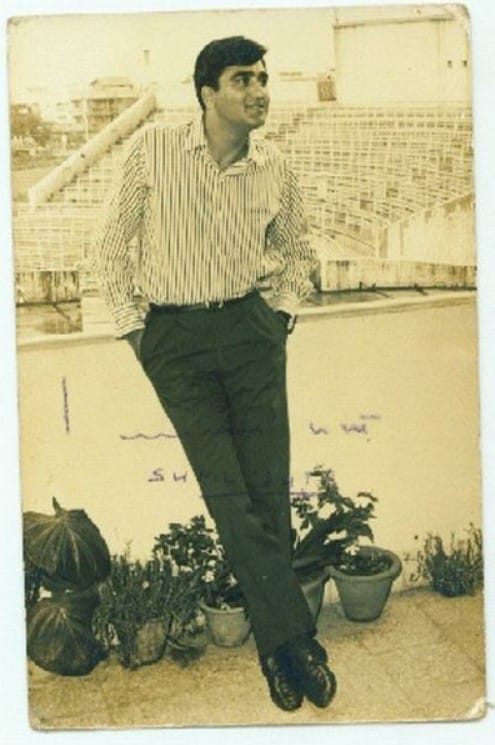
It was at the college that he discovered a passion for theatre – a stepping stone that eventually landed him a coveted role as an announcer on Radio Ceylon’s popular show Lipton Ki Mehfil.
It was on the set of Shikast (1953), where Dutt had come to interview its star Dilip Kumar, that he caught the eye of director Ramesh Saigal. Impressed by his commanding voice and six-foot frame, Saigal offered him a role.
Keeping a promise made to his mother, Dutt deferred the offer until his graduation was complete. He eventually stepped in front of the cameras for his debut in Railway Platform (1955). To prevent any confusion with the reigning veteran Balraj Sahni, he adopted the screen name that would soon become legendary: Sunil Dutt.
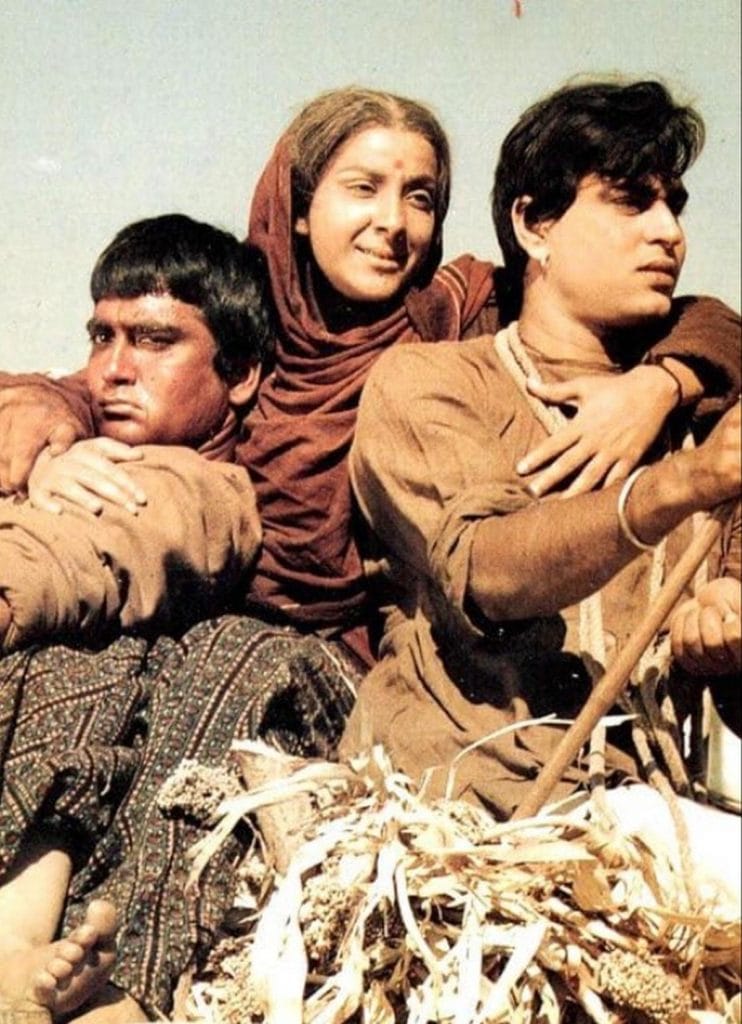
While films like Ek Hi Raasta (1956) opposite Meena Kumari cemented his romantic credentials, it was his casting as Birju in Mehboob Khan’s opus Mother India (1957) that shattered the mould of the clean-cut Hindi film hero of the day. Well before the advent of the ‘Angry Young Man’, Dutt’s raw, explosive performance as a rebellious peasant-turned-bandit pioneered the concept of the Bollywood anti-hero.
Risks in love and stardom
Beyond its cinematic legacy, Mother India redefined Dutt’s personal life. After he suffered severe burns while rescuing Nargis from a raging fire on the set, the two grew close. Their connection deepened into romance when Nargis took charge of his sister’s medical treatment during a family crisis.
They married in 1958, a courageous inter-faith union that challenged the socio-political anxieties of the era. Bollywood lore goes that the marriage even drew the scrutiny of then up-and-coming underworld don Haji Mastan. Dutt himself said that his biggest fear was getting his mother’s approval, which came.
“You love and marry a human being. You are not in love with Islam or Hinduism. When Nargis and I got married in 1958, we did not face opposition, despite the fact that my mother was uneducated and belonged to an orthodox family from Pakistan,” he noted in a 1998 interview.
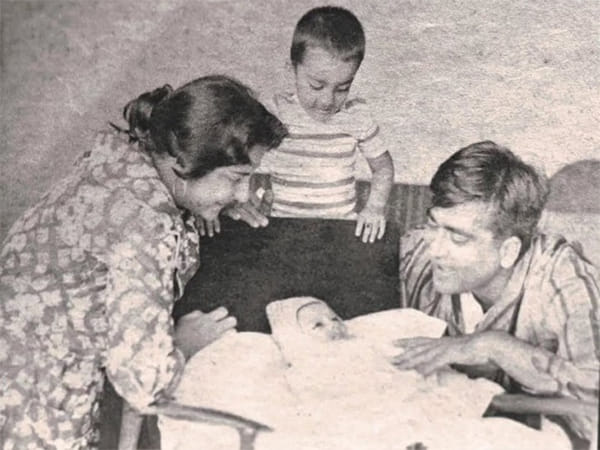
Following their marriage, Nargis made the deliberate choice to retire from active acting to nurture their three children—Sanjay, Namrata, and Priya—and pivot toward social advocacy, while Dutt continued to push the boundaries of commercial cinema.
Dutt’s five-decade, eighty-film career was defined by a constant willingness to gamble with his stardom. If Mother India gave him volcanic force, Bimal Roy’s Sujata (1959) showcased quiet, progressive tenderness. This elasticity allowed him to slide effortlessly between the gentle romanticism of his pairings with Nutan in Milan (1967) and the murderous Chambal dacoit in the redemption drama Mujhe Jeene Do (1963). Even as he anchored mainstream blockbusters like Gumrah (1963), Waqt and Khandan (1965), he simultaneously launched avant-garde experiments like Yaadein (1964)—a single-actor psychological drama that secured a Guinness World Record—and outings in ensemble comedy such as Padosan (1968).
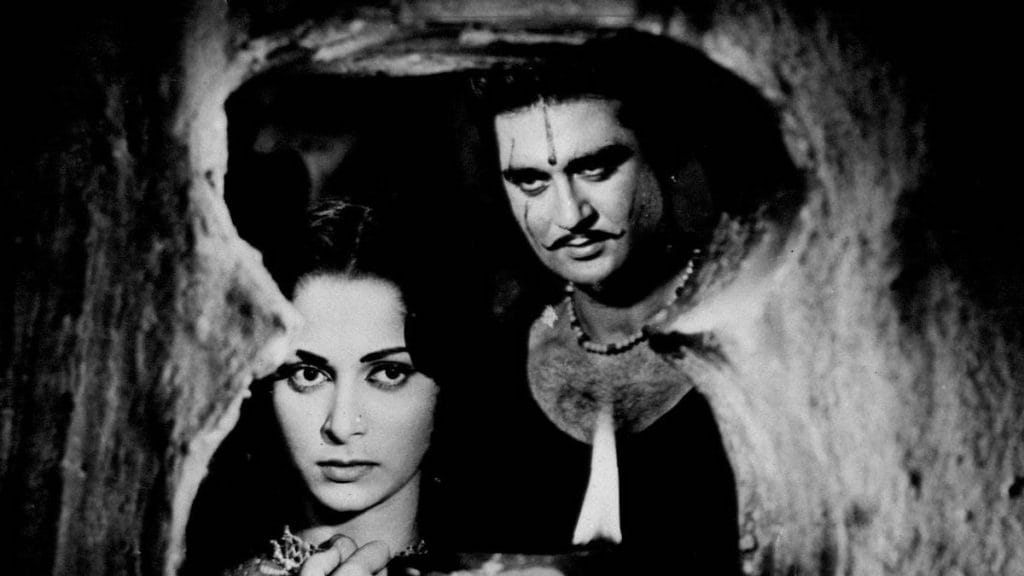
As producer-director under his banner Ajanta Arts, he systematically acted as an industry kingmaker, opening doors for raw talent who would go on to reshape commercial cinema. He launched Vinod Khanna and Leena Chandavarkar in Man Ka Meet (1969), cast a pre-Zanjeer Amitabh Bachchan in the sweeping desert noir Reshma Aur Shera (1971) and gave Johnny Lever an early platform in Dard Ka Rishta (1982).
The public and private crucibles
The 1980s and 90s were a trial by fire for Dutt.
The close-knit family was shattered by Nargis’ diagnosis of pancreatic cancer in 1980. Dutt waged a monumental battle for her survival, flying her to the United States for advanced treatments. But Nargis died on 3 May 1981—a mere four days before their son Sanjay’s debut film, Rocky, premiered. At the premiere, a seat beside her husband was symbolically left empty for her.
This grief compounded when Sanjay slid into a severe, tumultuous struggle with substance abuse, forcing Dutt to embark on another exhausting campaign for his son’s physical and psychological rehabilitation in the United States across 1983 and 1984.
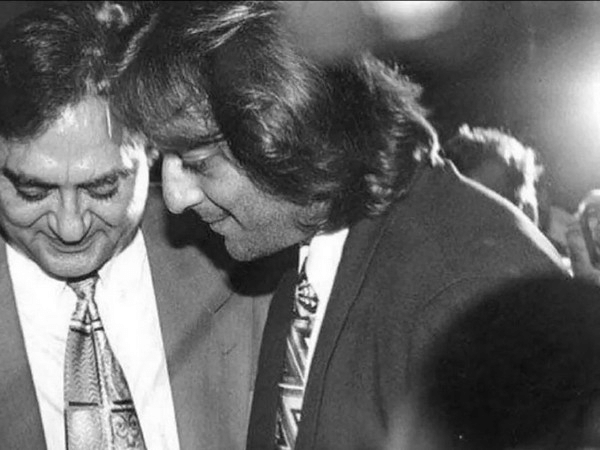
The ultimate test of the family’s resilience arrived after the Bombay riots of 1992-93 and the 1993 serial blasts. Sanjay was arrested in the blasts case and accused of possessing illegal weapons, including an AK-56 rifle, that had come through the same arms-smuggling network— he later claimed he had kept the weapons to protect his family. He was booked under the Terrorist and Disruptive Activities (Prevention) Act, though he was later acquitted of conspiracy charges and convicted under the Arms Act.
For Sunil Dutt, then a sitting member of parliament, his son’s arrest became an albatross around his neck for years.
Also Read: SP Balasubrahmanyam was irreplaceable in Bollywood. Asha Bhosle wondered what he ate
A politics of presence
As a Partition refugee, the fires of 1947 and the lived trauma of Partition anchored Sunil Dutt’s political awakening.
In a Doordarshan interview he recalled being shaken to see members of the Sikh diaspora in New York celebrating Indira Gandhi’s assassination in 1984—and, on his return to Delhi, by the anti-Sikh riots there.
“As you know, I myself am a victim of Partition,” he said, speaking in Hindi. “With events like this, mera dil kaamp jaata hai (my very being trembles). I feel we are going backwards, not moving forward.”
Shortly thereafter, when Rajiv Gandhi invited him to join politics, he did so, saying that he saw it as a platform to “speak my heart”. He contested the Bombay North West Lok Sabha seat that year and won—the first of five times the constituency would send him to Parliament.
Dutt repeatedly said in interviews that entering Parliament was his way of giving back to the country.
“The people raised me up from the ground… so I thought, why not dedicate my life to the country,” he told Farooq Sheikh in the chat show Jeena Isi Ka Naam Hai.
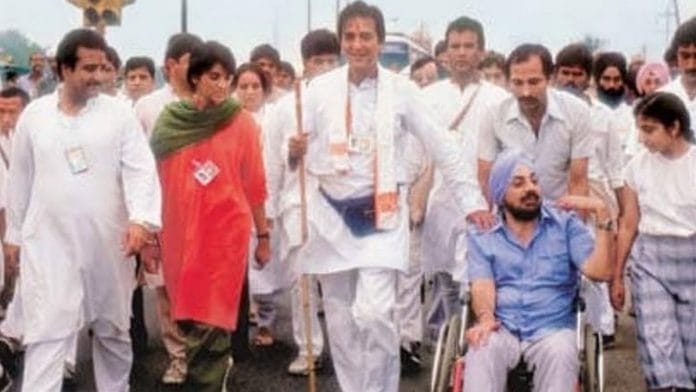
Rejecting the safety of mere rhetoric, he practised a politics of physical presence. At the height of the Punjab insurgency in 1987, Dutt completed a gruelling 2,000-kilometre Mahashanti Padyatra on foot from Mumbai to Amritsar.
“My walk from Bombay to Amritsar was [because] whatever is happening is not good for us,” he said.
Peace marches became something of a signature. In 1988, he walked from Hiroshima to Nagasaki for global nuclear disarmament. And in 2002, as Gujarat burned after Godhra, he was among the few national leaders to go into the worst-hit areas, urging the political establishment to protect the secular fabric of the republic.
“I first went to Godhra and then Baroda. I did a peace march in the most affected area. People told me it was risky, but I said, you have to take risks. A person lives once and dies once—what’s left is what we do with that time,” he said in the DD interview.
That same year, he marched from Jallianwala Bagh to the Hazratbal shrine in Srinagar, again brushing aside warnings of danger in the militancy-fractured Valley.
“I told them, why am I here? I am here for peace. Some people there were speaking with agitation, but I kept listening,” he said. “And then I hugged them… and it felt jaise aadmi pigal jaata hai (as if their hearts melted), their voices changed.”
He never retired. As Union Minister for Youth Affairs and Sports, he suffered a heart attack at home on 25 May 2005, days after returning from an arduous ministerial tour in the summer heat. He was 75.
A man well-versed in Urdu poetry, he said he lived by a couplet by the poet Bekhud Dehlvi: “Har rahguzar pe shama jalaana hai mera kaam, tevar kya hain hava ke, ye main dekhta nahin”—My job is to light a lamp on every path; I do not stop to see which way the hostile wind is blowing.
(Edited by Asavari Singh)