





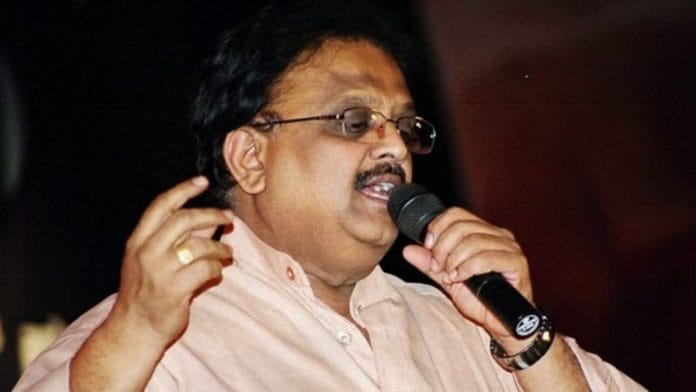

SP Balasubrahmanyam began his artistic journey before he even knew what art was. When he was five years old, his father was a Harikatha artist who acted in several plays, portraying characters such as Ramadas. Members of the theatre group and the production team asked his father to give young Balasubrahmanyam a chance to perform. Initially, he declined, but eventually Balasubrahmanyam was cast in the role of Raghuram, playing his on-screen son.
As he had practised for the play without props or a proper set, he was unprepared for what happened on the day of the performance. During a scene, his father was handcuffed and taken away by King Tana Shah’s guards. Seeing his father in that condition, the innocent Balasubrahmanyam began to cry. However, when the play ended, the audience applauded him, believing his tears were part of the performance.
“The curtain fell, and everybody came, and they took me. My father said, ‘Why are you crying?’ I said, ‘Nanna, you are arrested, that’s why I’m crying,” he said in a YouTube video.
Balasubrahmanyam, born on 4 June 1946, is often referred to as an accidental singer. His father wanted him to become an engineer, and to fulfil that dream, he enrolled at JNTU College of Engineering, Anantapur. Alongside his studies, however, he actively participated in music competitions organised by the Madras Social and Cultural Club. It was at one such competition that he met composer and playback singer SP Kodandapani. From then on, his life changed.
Kodandapani gave him his first break with the song ‘Emiyee Vinta Moham’ for the Telugu film Sri Sri Sri Maryada Ramanna. Balasubrahmanyam always regarded Kodandapani as his guru.
“The guidance, the corrections, and the way he held my hand and led me through those early songs… those blessings and his guidance are my greatest treasures,” he said in an interview with ETV Telangana.
Also read: ‘Abbaji’ Alla Rakha changed the sound of Indian music—Jammu to NYC
Bollywood debut and Lata’s saree
While he is known for countless songs across languages, his Bollywood debut was made with a song in Ek Duuje Ke Liye (1981), for which he received the National Film Award for Best Male Playback Singer.
Decades later, on his YouTube channel, he revisited the memories of the film and how he recorded ‘Tere Mere Beech Mein’. He narrated the story of how he was talking to Lata Mangeshkar, and someone brought them tea. Balasubrahmanyam was so nervous that his hands started to shake and he spilled the tea on Mangeshkar’s white saree. All eyes in the recording room were suddenly on him. The singer assumed that his career in Bombay was over right at that moment.
“It’s nothing to worry about. This is a good omen. I wish you all the best in the Hindi film industry,” Mangeshkar told him.
Mangeshkar, in an interview with Akashvani, recalled her experience of working with Balasubrahmanyam. She said the two often teased each other during recordings and described him not only as a great singer but also as a wonderful human being who was always ready to help others. She also remembered how much he loved travelling to Bombay for recording sessions with her.
“Many ideas and variations would instantly come to his mind. While our song was being recorded, he would creatively introduce an ‘alaap’ right in the middle of it,” she said.
Balasubrahmanyam remained irreplaceable in Bollywood for years, delivering iconic songs like Tumse Milne Ki Tamanna Hai (1991), Pehla Pehla Pyar (1994), songs from Hum Aapke Hain Koun (1994), Yeh Raat Aur Yeh Doorie(1994), and Saathiya, Tune Kya Kiya (1991). The list is never-ending.
He took a break for 15 years and then returned with the title song of Chennai Express (2013), composed by Vishal-Shekhar.
Across Balasubrahmanyam’s career spanning five decades, he collaborated with several big names in the Hindi music industry, including Laxmikant-Pyarelal, RD Burman, Bappi Lahiri, Lata Mangeshkar, Kishore Kumar, Alka Yagnik, and Udit Narayan. He lent his voice to more than 40,000 songs across different Indian languages, unmatched by any of his contemporaries.
Balasubrahmanyam also set a remarkable record by singing 21 Kannada songs in a single day, along with similar records of 19 Tamil songs and 16 Hindi songs in a day. He often recounted his experience of recording 15–20 songs a day.
His immense contribution to Indian cinema earned him six National Film Awards for Best Male Playback Singer, the Padma Shri in 2001, the Padma Bhushan in 2011, and the Padma Vibhushan in 2021.
In the course of his career, he became the voice of Salman Khan, much like Kishore Kumar had become for Rajesh Khanna in the 1970s. He also became a dubbing artist with the film Manmatha Leelai (1976) for its dubbed Telugu version, starring Kamal Haasan. Later, he became the default dubbing artist for Kamal Haasan.
Haasan, speaking about his relationship with Balasubrahmanyam, called him the “voice of romance.” He credited the singer’s songs for playing a role in his love life and marriage, adding that he heard Balasubrahmanyam’s voice long before he met him in person.
“He is part of my melancholy, part of my happiness, and part of my first love and marriage as well. I used to complain to him that, ‘You got me into marriage. It’s only your song that got me into marriage,’” the actor said.
He also lent his voice to acclaimed actors like Rajinikanth, Vishnuvardhan, K. Bhagyaraj, Mohan, Anil Kapoor, Girish Karnad, Gemini Ganesan, Arjun Sarja, Nagesh, Karthik, and Raghuvaran in various languages. He also dubbed Ben Kingsley’s voice in the Telugu version of the film Gandhi.
Balasubrahmanyam also used the acting skills he had learned from his father. His acting debut came with the satirical comedy film Muhammad Bin Tughluq (1971), directed by Cho Ramaswamy. Later, he worked in films like Keladi Kanmani (1990), directed by Vasanth, Thiruda Thiruda (1993), directed by Mani Ratnam, Kadhalan (1994), directed by Shankar, and Raja Paarvai (1981), acting in more than 40 films across the Telugu, Tamil and Kannada languages.
Singer Hariharan, who worked with Balasubrahmanyam on songs such as Paattukku Palaivanam, Desingu Raja, Punniyam Punniyam Thedi, Thanga Thalaivan, and Adi Aathi Adi Aathi, among many others, reflected on his experiences with the legendary singer in a memoir. Remembering his idol, Hariharan wrote about Balasubrahmanyam’s remarkable memory and deep technical understanding of music despite having no formal training.
Hariharan recalled an incident from the 1970s, when he was still in college and performing ghazals at a youth festival on Chennai Doordarshan. Years later, he was astonished that an already established star like Balasubrahmanyam could still recognize and remember his voice.
“All our problems regarding the decisions about the compositions of various songs were always solved by SP, single-handedly; yet it was him who had received no formal training,” he wrote.
Hariharan also recounted an incident that left Asha Bhosle amazed. During a recording session for a song composed by RD Burman, Balasubrahmanyam arrived in Bombay at around 11:30 am and was ready to record after lunch. However, Bhosle, despite rehearsing since morning, was still preparing.
“What does he eat to have a tremendous memory like that?” Asha remarked.
(Edited by Ratan Priya)