




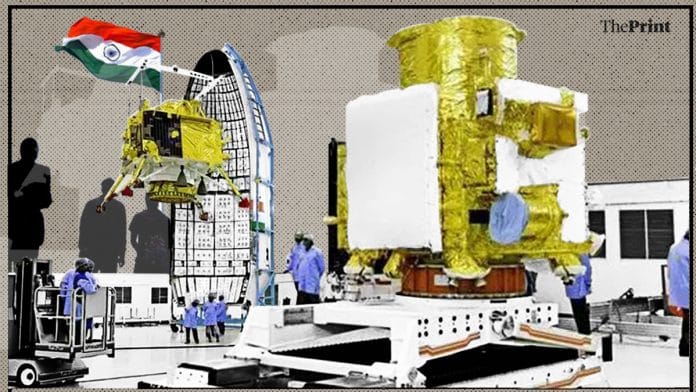

As Prime Minister Narendra Modi said earlier this month, the successful orbital launch of Vikram-1, India’s first privately developed launch vehicle, is “a historic new frontier for India’s space journey”.
This milestone signals a new chapter in India’s space programme, based on the foundation laid by ISRO but with fewer bureaucratic constraints and more room for private enterprise.
Before looking at how India can build on this momentum, it is worth revisiting the country’s space journey over the past several decades.
Also Read: Why foreign universities alone won’t fix India’s higher education crisis
ISRO’s pioneering groundwork
What began as the Indian National Committee for Space Research (INCOSPAR), founded by Dr Vikram Sarabhai in 1962, evolved over time into the Indian Space Research Organisation (ISRO) in 1969.
India’s first step into outer space was the launch of the Aryabhata satellite in 1975. Three decades later, Chandrayaan-1 added value to lunar exploration by discovering water molecules on the Moon. In 2014, India became the first country to reach Mars on its maiden attempt with the Mars Orbiter Mission, Mangalyaan. ISRO further solidified its scientific prowess with Chandrayaan-3, Aditya-L1 and the SPADEX space docking experiment.
Behind many of these recent successes was ISRO’s long effort to develop its own launch capabilities.
ISRO began developing the solid-fuelled Satellite Launch Vehicle-3 (SLV-3) in 1973 under its then project director, and later President of India, Dr APJ Abdul Kalam. In 1980, it launched the 40 kg remote sensing satellite Rohini, making India the seventh country to demonstrate the capability to launch a satellite and place it in orbit. The development of the Augmented Satellite Launch Vehicle (ASLV) in the late 1980s and the launch of the Polar Satellite Launch Vehicle (PSLV) in October 1994—which placed the 870 kg Indian Remote Sensing (IRS) P2 satellite into Low Earth Orbit (LEO) at an altitude of 825 km—were ample proof of India’s self-reliance.
The Indian space agency also developed the technological capability for outer space exploration through the Geosynchronous Satellite Launch Vehicle (GSLV), designed to place heavier payloads into Geosynchronous Transfer Orbit using cryogenic rocket engines.
Desperately in need of this technology, India signed a USD 120 million deal with Glavkosmos of the Soviet Union in January 1991 for the supply of two KVD-1 cryogenic engines and the transfer of technology.
As the India-Russia agreement was being put in place, the US, in July 1993, arm-twisted both countries by imposing sanctions on ISRO and Glavkosmos, stalling the engine supply on the grounds that it violated the Missile Technology Control Regime (MTCR). ISRO responded by launching its ambitious indigenous Cryogenic Upper Stage (CUS) project in 1995 and eventually mastered the ultra-low-temperature technology.
Giant leaps & systemic setbacks
Due to the untiring efforts and monumental research of ISRO’s scientists, and the vision of successive governments, India’s space programme over the decades has leapt forward on three major fronts: technological capacity building, strengthening self-reliance, and laying the foundations for public-private partnerships in space-related commercial ventures through R&D and innovation.
ISRO’s space-based innovations, projects, launches and applications are now supporting governance, commercial payment systems and banking, healthcare, education, disaster management and livelihoods in India, while also providing support to countries in the region. GSAT-9, conceived as the SAARC satellite and launched as the South Asia Satellite in 2017 after Pakistan opted out, is a Rs 450 crore geostationary communication satellite equipped with 12 Ku-band transponders. It provides Fixed Satellite Services (FSS), including television broadcasting, DTH, VSAT connectivity, tele-education, telemedicine, as well as delivering critical communication links and real-time coordination during natural disasters such as cyclones, earthquakes and floods.
Against this backdrop, it is sad and frustrating that the government’s premier institution for pioneering research in outer space should experience a massive talent exodus.
The reasons for this are not far to seek: lack of vision, bureaucratic rigidity and organisational inertia.
While nothing prevents ISRO from commercialising and monetising its capabilities and investment in research, the government also made the wise choice of allowing private investors to tap into the agency’s expertise, as is the method followed by American institutions and industries.
Also Read: Skyroot’s Vikram-1 success shows it’s time for ISRO to redefine its role
India’s next space odyssey
On 18 July, Skyroot Aerospace Private Limited, founded in 2018 by former ISRO engineers Pawan Kumar Chandana and Naga Bharath Daka, successfully executed the Aagaman mission, launching Vikram-1 from Sriharikota. It thereby announced India’s entry into the private orbital launch market.
Incidentally, just a few days before the launch, Brian Babin, chairman of the US House Committee on Science, Space and Technology, was eulogising America’s “innovative commercial sector”. He also sounded a warning: “As other nations, particularly China under the Chinese Communist Party, seek to overtake us in space, we must ensure that American innovators are competing against our adversaries—not against unnecessary government bureaucracy.”
ISRO was experiencing precisely this — being stifled by bureaucracy.
The US presents a different model. Mike Haridopolos, chairman of the Space and Aeronautics Subcommittee, speaking about the thriving commercial space sector, said that the American aerospace industry now supports nearly 150,000 private sector jobs, more than five times the roughly 30,000 jobs it sustained just 15 years ago. The number of launches in the US, he added, had grown from 54 in 2021 to 199 in 2025.
Now, ISRO and India’s private sector can jointly position the country as a leader in astronautical and aeronautical research and commercial projects.
Commercial ventures must be incubated in research projects from the beginning to reduce risk and improve their viability. However, research, innovation and commercial space ventures require huge investments, robust supply and value-chain mechanisms, strong legal and security systems, and government facilitation to discharge international obligations.
Prime Minister Narendra Modi should personally intervene and initiate a massive reform process. This should include reducing bureaucratic control, giving greater autonomy to ISRO’s top management, allowing scientists to participate in industry and university projects without quitting ISRO, and strengthening the NewSpace India Limited (NSIL) and Indian National Space Promotion and Authorisation Centre (IN-SPACe).
Even the sky is not the limit for India’s space odyssey.
Seshadri Chari is the former editor of ‘Organiser’. Views are personal.
(Edited by Asavari Singh)
Even Public – private has problems . Letting go of bureaucratic control should not mean no accountability for private sector failures or a free hand to private sector to any form of monopoly powers and blackmail other smaller players. It must be dynamic and in national interest only . This will lead to building private sector unhealthy monopolies. Incentives must be aligned for greater purpose not just profit. Both state and private players must coordinate rather than celebrating the destruction of ISRO.
Neither can socialist India remove ‘socialism’ from the Constitution nor let go of bureaucratic control over ISRO. Nehru was a socialist control freak, and Modi is following in his footsteps. Greater the control, greater the corruption, and greater the satisfaction. It is a win-win programme for the politicians and bureaucrats.