





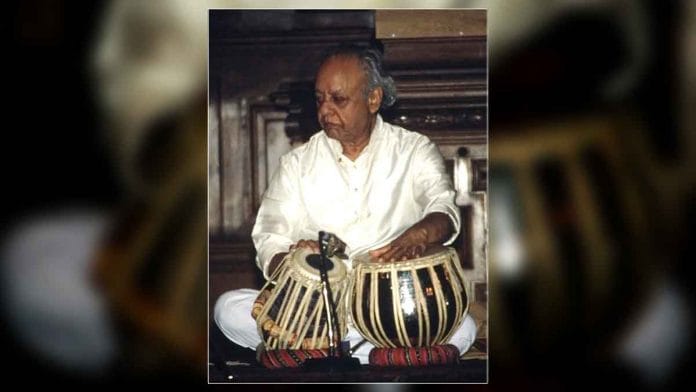

New Delhi: Those who knew tabla maestro Alla Rakha rarely called him by name. He was “abbaji”, which means father in Urdu, to his disciples, admirers, and peers. Even singers and composers today refer to him as “abbaji”. After all, he raised a family of extraordinary musicians and an entire generation’s understanding of rhythm.
Rakha received the Padma Shri in 1977 and the Sangeet Natak Akademi Award in 1982. But his actual legacy lives elsewhere—every tabla recital on a stage, every fusion experiment that bridges cultures, and every student who takes rhythm as a medium to convey a story.
Born in 1919 in the small village of Phagwal in Jammu, Rakha was the son of a soldier and the eldest of seven brothers. Naturally, he was expected to follow the conventional military path. But he found peace in music. At the age of 12, he left home and found his way to Lahore, where he trained under the formidable Mian Qadir Baksh of the Punjab gharana.
He joined All India Radio in the 1930s, later moving into film music under the name AR Qureshi, composing for several Hindi and Punjabi films. Some of the films for which he composed music include Maa Baap (1944), Maa Baap Ki Laaj (1946), Bewafa (1952), Laila (1954), Khandan (1955), and Alam Ara (1956).
Here is a track from the film Bewafa:
But cinema, for all its glamour, couldn’t contain him. By the 1960s, he stepped away from films, returning fully to classical music, with a renewed purpose. He wanted to put the spotlight on the tabla so it would no longer sit quietly in the background.
Iconic ‘sawal-jawab’ jugalbandi
If Rakha gave the tabla its voice, Ravi Shankar gave it a global stage. Their partnership, which spanned nearly three decades, remains one of the most iconic collaborations in music history.
Though Rakha had already been accompanying leading vocalists, instrumentalists and dancers, his concert tours with Shankar were a highlight. The collab, which lasted over three decades, brought Rakha to audiences across the world.
For instance, in 1966, he provided tabla accompaniment for a recording that was released the following year on an album entitled West Meets East. It featured a musical collaboration between Shankar and world-renowned violinist Yehudi Menuhin. He also accompanied both of them in a concert held at the United Nations General Assembly in New York to celebrate Human Rights Day on 10 December 1967.
Rakha also collaborated with well-known jazz drummer Buddy Rich on the album Rich a la Rakha, which was published in 1968.
On stage, Rakha and Shankar didn’t just perform; they also had a conversation, jugalbandis (duets), with each other through music. Their “sawal-jawab” was a playful yet intense question-and-answer exchange between sitar and tabla.
Shankar’s collaborations with George Harrison, the lead guitarist of the Beatles, particularly through The Concert for Bangladesh in New York and its accompanying album and film, introduced Hindustani classical music to an unprecedented Western audience. The project’s massive success, which includes it achieving gold record status and winning the Grammy Award for Album of the Year, brought global recognition to Rakha as well.
Sukanya Shankar, Ravi Shankar’s wife, once said that “Alla Rakha and his tabla were one”, a statement that captures his spiritual immersion in the instrument.
Also read: Humour, sex, and attention—The Zohra Sehgal philosophy
Solo works
Rakha’s solo works include albums like The Ultimate in Taal Vidya (1989) and Sangeet Sadhak Allah Rakha (2006), while his celebrated collaborations with his son Zakir Hussain produced memorable recordings such as Memorable Tabla Duet (1991), Together (2004), and the Drums of India series (Ecstasy and Tabla, 2006-2007).
These recordings remain essential listening for anyone seeking to understand the depth and dynamism of tabla performance.
After his concert career, Rakha established the Ustad Allarakha Institute of Music in 1985, creating a space to train young musicians.
Rakha passed away in 2000, shortly after the tragic loss of his daughter, an event believed to have led to a fatal heart attack. His legacy, however, continues to resonate through his students, most notably Zakir Hussain, who has carried on his father’s art.
(Edited by Saptak Datta)