





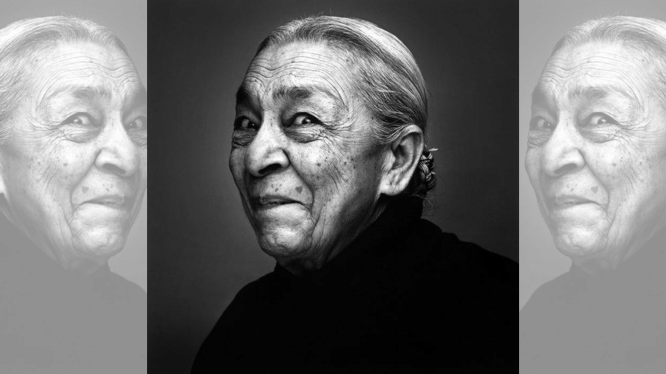


New Delhi: Zohra Sehgal, widely known for her grandmotherly characters in the Indian film industry, was far more than the affectionate “dadi” audiences remember her as. Sehgal, while not always happy with her physical appearance, took pride, instead, in her humour — something many admired about her.
Her work in theatre and dance stretched across continents and decades, bringing her both fame and fortune. Yet, what stayed most vividly with those she worked with was her humour — sharp, bold, and unapologetic in attitude.
“Humour and sex! Sex is very important for life to get going; I still want it!” said Sehgal at the age of 101, in an interview with The Guardian.
Sehgal’s humour was raw and situational. It surfaced in everyday moments, often catching people off guard. It was sometimes shocking, but it dismantled expectations of age, gender, and propriety in a single breath.
Her daughter, Kiran Segal, recalled how nothing embarrassed her mother— not even the most awkward situations. She often cracked jokes, even about herself. During a medical scan, for instance, the actor joked about not being pregnant.
“Thank God, I’m not pregnant!” Zohra said after the CT scan, as shared by her daughter Kiran during the event ‘Ghar ki Murghi Daal Baraabar’, held at Delhi’s Academy of Fine Arts and Literature in September 2025.
Zohra Sehgal was born as Sahibzadi Zohra Begum Mumtaz-ullah Khan on 27 April 1912 in Uttar Pradesh’s Saharanpur, to a traditional Sunni Muslim family. She went on to become one of India’s most enduring performers, with a career spanning theatre, dance, and cinema across almost seven decades.
She passed away on 10 July 2014 in New Delhi at the age of 102.
Reflecting on her life, superstar Shah Rukh Khan spoke of her true self, slightly removed from the artist audiences always saw.
“A journey of a million miles overloaded with smiles… Even at 100 plus, I have yet to meet a naughtier young girl,” read his tribute to the late star.
Unforgettable Zohra
Sehgal began her artistic journey in the early 1930s, training at the Uday Shankar India Cultural Centre in Almora, where she became part of his pioneering modern dance troop. She travelled internationally, performing across Europe, the United States, and Japan during the late 1930s and 1940s with the company.
After returning to India, she joined Prithvi Theatre in 1945, becoming one of its early members. And her work at the theatre in the 1940s and 1950s established her reputation as a strong stage performer.
She moved to the United Kingdom in the 1950s and worked in British television and theatre before returning to Indian cinema in the 1990s. She appeared in films such as Ek Din Achanak (1989), and internationally acclaimed projects like Bend It Like Beckham (2002) and Cheeni Kum (2007).
She was honoured with several awards, including the Padma Vibhushan in 2010, India’s second-highest civilian honour, recognising her lifelong contribution to the arts.
“I have lived a full life and squeezed the best out of it,” said Sehgal in an interview.
However, Sehgal’s journey and career achievements are not the only things people remember her for. Even in later life, she refused to become a passive symbol of age or legacy. Sehgal continued to perform, recite poetry, and engage audiences with the same mischievous energy that had defined her youth.
“She was great fun, you know. I could crack all kinds of filthy jokes with her — nothing shocked her,” said her daughter in 2025.
Also Read: When Nehru got arrested a day before Zohra Sehgal’s wedding
A thirst for attention
Sehgal’s life unfolded alongside some of the most turbulent moments in Indian history. When she married Kameshwar Segal in 1942, the political climate was so volatile that Jawaharlal Nehru, who had intended to attend their wedding, was arrested during the Quit India Movement just before the ceremony.
Despite every aspect of her life and the way she chose to live it with joy, what she truly enjoyed was attention and being seen.
Sehgal’s daughter, Kiran, spoke of how deeply her mother enjoyed attention and how aware she was of whether or not she was being noticed. If she felt invisible in a gathering, she would say so openly — not as a complaint, but with theatrical honesty.
At social gatherings, when Kiran spoke about meeting old friends, her mother would sharply reply, “What fun? No one noticed me.”
Sehgal’s self-perception also played a role in shaping her personality.
“You see me now when I am old and ugly — you should have seen me when I was young and ugly,” she had remarked.
Beneath her wit and achievements was a persistent desire to be seen.
“I want to be blonde with blue eyes,” she once said.
(Edited by Insha Jalil Waziri)