





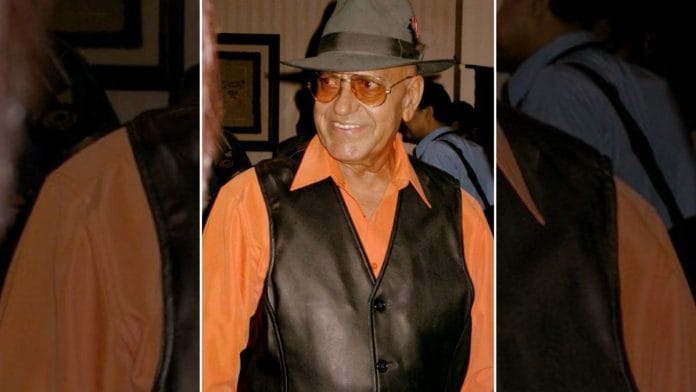


New Delhi: In the climax of Dilwale Dulhania Le Jayenge, released in 1995, when Baldev Singh—the stern, traditional patriarch—finally releases his daughter’s hand with the words, “Ja Simran, ja, jee le apni zindagi”, which roughly translates to ‘Go, Simran, live your life’, it isn’t just a moment of cinematic grace. It is a masterclass in authority. The scene works because the actor delivering it understood the weight of power—and the cost of relinquishing it—better than almost anyone else in Indian cinema.
Throughout his career, Puri specialised in authority figures. Apart from his ability to project power, what made Puri remarkable was his understanding of how authority operated. He could portray domination, insecurity, cruelty, and vulnerability without ever surrendering control of the screen.
Beneath that flicker of paternal warmth lay a man forged by decades of professional uncertainty, repeated rejection, and a disciplined approach to the craft that was unprecedented for his time.
It all started in 1950
Born in 1932 in Punjab, the fourth of five children, Puri grew up in Shimla. While his father was unexpectedly impressed by his performance in a play called Tasveer, he was deeply suspicious of the film industry. The premature death of his cousin, the legendary actor-singer KL Saigal, to alcoholism, had convinced the father that cinema was an unstable and dangerous profession. Despite these reservations, Puri followed his elder brothers, Chaman and Madan, to Bombay in the 1950s to pursue acting.
His path to the screen was never guaranteed. In 1953, when Puri was 21, he appeared for a screen test. The verdict was swift: his face was considered too “harsh” and his voice too “intimidating” for a conventional lead. He was dismissed as unheroic. Ironically, the industry had identified the very tools that would make him indispensable.
For nearly 21 years, he worked an obscure, clerical job at the Employees’ State Insurance Corporation (ESIC). For most aspiring actors, such a setback would have ended the dream. For Puri, it became an apprenticeship in theatre, discipline, and patience. While he toiled at a desk job by day, he spent his evenings at Prithvi Theatre. Under mentors like Ebrahim Alkazi and Satyadev Dubey, he absorbed a more disciplined theatrical approach than was common in mainstream cinema of the era. He learned minimalism, voice modulation, and stage presence through seminal plays like Aadhe Adhure and Andha Yug.
During these years, he met Urmila Divekar; they married despite initial familial resistance and shared a 48-year partnership that lasted until his death.
By the 1970s, Shyam Benegal’s parallel cinema provided the space for Puri to develop range and confidence. Roles in films like Nishant (1975), Manthan (1976), and Bhumika (1977) caught the attention of mainstream directors. Soon, he transitioned to commercial cinema, but he did not merely fill the role of a villain—he fundamentally altered it.
Before Puri’s rise, many Hindi-film villains relied on recognisable archetypes—the smuggler, the dacoit, the corrupt landlord, or the criminal mastermind. These characters were obstacles to be removed.
Puri, however, brought physical dominance and theatrical authority to the screen. Whether as the ruthless lawyer GD Thakral in Meri Jung (1985), the larger-than-life Mogambo in Mr India (1987), or Thakur Durjan Singh in Karan Arjun (1995), he projected the certainty of a man accustomed to being obeyed. He did not merely threaten the hero; he dominated the frame.
This presence extended to global projects. When Steven Spielberg looked for an Indian priest Mola Ram for Indiana Jones and the Temple of Doom (1984), he did not settle for the first actor he saw. Unable to secure an audition abroad because of Puri’s packed filming schedule, the production team chose to evaluate him in India. The result was one of the most memorable performances in the franchise.
While actors in the 1970s viewed 40 as the high-noon of a career, for Puri, it was the dawn. His rise coincided with India’s entry into a new mass-media age. As VHS and television began to spread cinematic catchphrases into living rooms, Puri’s villains—frightening, yet morally unambiguous—became cultural phenomena.
Also read: Los Angeles will now celebrate Diljit Dosanjh Day. Clear your calendars
Not only a villain
Audiences, even children, could enjoy hating him. Unlike the morally conflicted antiheroes that would become popular decades later, Puri’s villains embodied a theatrical certainty: they were frightening, captivating, and utterly unsympathetic.
Whether he played a lawyer, landlord, king, police officer, industrialist, or criminal mastermind, Puri rarely relied on overt aggression. His characters projected authority as something natural and unquestioned. Audiences did not simply fear them; they believed others would obey them.
Nowhere was that quality more evident than in Mr India (1987). When Puri bellowed ‘Mogambo khush hua,’ he demonstrated that a villain could dominate the public imagination as completely as the hero. By the end of the decade, his popularity had translated into extraordinary bargaining power. He reportedly earned fees comparable to leading men and was juggling as many as 22 films at a time.
Such a workload would have been impossible without unusual discipline. Puri later credited the punctuality and rigour that colleagues admired to habits acquired in his youth, including his time in the Rashtriya Swayamsevak Sangh (RSS).
Later in his career, Puri proved his range extended well beyond the villainous archetype. By pivoting to characters in Ghatak (1996) and Viraasat (1997), he proved that his command of the craft was not limited to villainy. These nuanced performances earned him Filmfare Awards for Best Supporting Actor.
Yet perhaps his most consequential reinvention came in DDLJ. Baldev Singh retained the authority of Mogambo but stripped away the menace. The performance revealed that the qualities that had made Puri an iconic villain—command, conviction, and emotional intensity—could also make him an unforgettable patriarch.
Puri’s work ethic remained unyielding until the end. Even while battling myelodysplastic syndrome and the aftereffects of an eye injury sustained on the sets of Jaal: The Trap (2003), he continued to honour his professional commitments. He worked until his death on 12 January 2005, aged 72.
Puri’s journey was defined by his refusal to quit. Rejecting the limitations imposed upon him by a rigid industry, he carved a path that made him one of the most commanding presences in Indian cinema. He lived by a simple, unwavering credo: that professional integrity—the honest execution of one’s duty—was the highest form of devotion.
The irony of Amrish Puri’s career is that the qualities that once disqualified him from stardom—his imposing face, booming voice, and intimidating presence—ultimately made him indispensable. Hindi cinema spent decades searching for its ideal heroes. Puri demonstrated that audiences often remember something else entirely: the figure powerful enough to challenge those same heroes.
(Edited by Saptak Datta)