






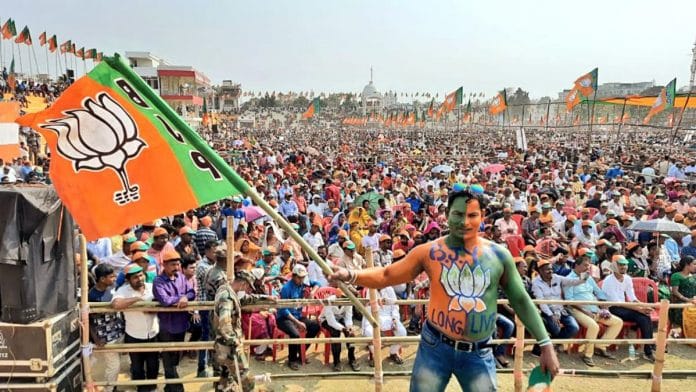


The BJP swept the West Bengal Assembly elections last month, dethroning Mamata Banerjee’s TMC and securing a two-thirds majority in the state. With the formation of the BJP government, hopes have strengthened across the country that West Bengal can regain its historical glory and advance on the path of development.
In the Fiscal Year 2024-25, West Bengal’s per capita income at current prices stood at Rs 1.63 lakh, whereas the national average was Rs 2.05 lakh. Thus, West Bengal’s per capita income was approximately 79.5 per cent of the national average, with a gap of Rs 42,000 between the national annual per capita income and that of the state.
However, the situation in West Bengal had not always been this way. In 1960-61, the state’s per capita income was 127.5 per cent of the national average. Even in 1970-71, it remained 18 per cent higher than the national average. Yet, by 1980-81, it had fallen to 97 per cent of the national average, and by 2010-11, it stood at merely 84 to 86 per cent—a trend that continues to this day.
While India’s GDP was growing at an annual rate of 3 to 3.5 per cent in the 1970s, West Bengal’s GDP growth rate was between 1.5 and 2.0 per cent. Although GDP growth in the state reached 5.5 per cent in the 1980s, the pace of industrial development remained extremely sluggish. In the 1990s, West Bengal’s growth rate surpassed the national growth rate. Between 2000 and 2011, despite the absence of an industrial upswing, the state performed relatively well due to the expansion of the service sector. Between 2011 and 2025, West Bengal’s growth remained below the national average, ranging from 6.5 per cent to 7.0 per cent.
BJP’s challenge
As West Bengal’s pace of development lagged behind other parts of the country, its share of the national GDP declined from 10.5 per cent in 1960 to merely 5.6 per cent in 2024-25. While the state did witness GDP growth driven by sectors such as services, construction, trade, transport, and government expenditure, the state lagged in industrial development, compared to states like Gujarat, Tamil Nadu, Karnataka, and Maharashtra, as well as several emerging industrial regions.
It is noteworthy that West Bengal suffered the most significant setbacks due to industrial decline between 1970 and 1990, a period that saw its share of India’s GDP plummet. Even though GDP growth subsequently improved, the state’s share of the national GDP remained low.
The question arises: can West Bengal regain its past glory? Can this state—once an industrial powerhouse that saw industries turn away due to various reasons—successfully re-establish an industrial base? Can West Bengal’s per capita income—currently just 79.5 per cent of the national average—rise to match or exceed that of the national average? These are critical questions facing the nation and present a significant challenge for the newly formed BJP government.
The core issue is how to put the state back on track—a state that was once leading in economic development, with a per capita income 27.5 per cent higher than the national average. The first step is to examine the causes of West Bengal’s economic distress and formulate a roadmap for solutions. It is also evident that economic decline stems from multiple causes and requires multifaceted solutions rather than a single fix.
Also read: Mamata Banerjee’s Osman Hadi killing speech has put India in a geopolitical mess
The Singur disaster
First, we observe that the economic distress in West Bengal stemmed from impediments to the development of its industrial sector. Infrastructure development is a prerequisite for industrial growth, yet West Bengal lagged significantly in this regard. Not only was there a lack of basic amenities like roads and electricity, but incentives for industrial development were also minimal.
Notably, investment drastically declined during the era of communist rule, and investors turned away from the state due to strikes and labour disputes. When West Bengal’s left government tried to undo the mistakes of the past by allowing Tata to set up its Nano car plant in Singur, it was too late. This time, Mamta Banerjee, the then Opposition leader, led the movement against the allocation of land to Tata, prompting the company to relocate the proposed plant to Gujarat. And, see where Gujarat stands today.
While this specific dispute garnered significant media attention, there have been numerous instances over the past six to seven decades where industries have been alienated from West Bengal. Major industrial houses, including the Birlas and Tatas, shifted their headquarters from Kolkata to other locations. The politicisation of labour disputes and opposition to modernisation and automation have caused immense damage to the state’s economy.
In this context, it is crucial to recognise that West Bengal is exceptionally well-suited for industrialisation, given its geography, human resources, and cultural and industrial heritage. The ports of Kolkata and Haldia are major assets for the state, serving as potential gateways for trade between India’s eastern region and ASEAN nations. High agricultural productivity, the presence of a city like Kolkata, and an educated population position West Bengal to become a growth hub.
With the development of urban infrastructure and metro connectivity, Kolkata could be transformed into an IT hub. The state’s high-quality, high-productivity agriculture offers immense potential for horticulture, fisheries, and floriculture. Furthermore, establishing food processing industries, strengthening cold-chain infrastructure, and boosting exports could lead to a significant surge in rural incomes.
Skill development and labour reforms could prove to be a boon for West Bengal. We need to improve the industrial relations climate there and simultaneously increase women’s participation in the workforce.
During the communist regime, the ruling class’s sceptical attitude towards large corporations, the regulatory environment, and attempts at redistribution, before actual growth, hampered development.
Also read: Why Mamata Banerjee joining Congress would be a terrible idea
Need for a development model
The decline of traditional industries also impeded West Bengal’s progress, particularly as new industries failed to emerge in the region. The situation has changed following the change in government, and there is hope that the formation of a stable BJP government will attract investors to West Bengal.
Post-1991, other states attracted foreign and domestic investment due to a favourable environment; these states developed their IT and infrastructure sectors.
However, West Bengal failed to attract such investment, and successive state governments did not prioritise infrastructure development. The government must increase capital expenditure, curb unproductive spending and minimise the leakage of public funds by enhancing digitalisation within the administration.
Nature tourism in the Darjeeling hills and the Sundarbans of West Bengal can be promoted, and the state’s Durga Puja festival can be developed into a global cultural brand.
While the eastern region, including states like Odisha and Jharkhand, is already known for mining and other natural resources, West Bengal could emerge as a hub of economic growth for Eastern India by improving connectivity with the Northeast and synergising with the resources of these states.
What is needed is a development model—backed by political will and a shift in narrative—that prioritises industrial growth and fosters public confidence. If this is achieved, West Bengal can regain its past glory.
Ashwani Mahajan is National Co-Convener of Swadeshi Jagran Manch and a former professor at PGDAV College, University of Delhi. He tweets @ashwani_mahajan. Views are personal.
(Edited by Saptak Datta)
West Bengal is already the most developed State in Eastern India. States like Asom, Odisha and Jharkhand are way behind us. West Bengal is lagging behind was only a fake noise created by the BJP just to dethrone TMC .