




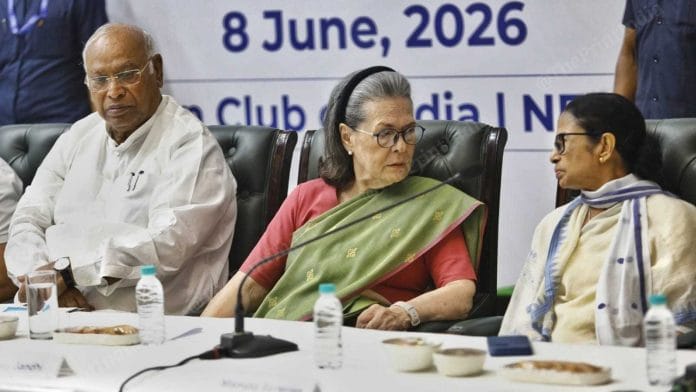

Sometimes the people with the best intentions have the worst ideas. For the last few days—and especially after Mamata Banerjee came to Delhi for an INDIA bloc meeting—there has been a grand liberal reawakening around the importance of the Congress as a great national alternative to the BJP.
The best way forward, according to many liberals, would be for regional parties to fold themselves into the Congress, which is, after all, the mother party of many regional players. A good first step, according to this view, would be for Mamata’s Trinamool Congress to merge with the Congress as a sort of homecoming.
I can see the emotional power behind this idea, and I understand why it seems appealing as a way of standing up for secularism, fighting for liberal values, taking on the BJP, or making India great again (take your pick).
But emotions are not always a substitute for strategy, or even logic. The idea of streams flowing back into the river that gave birth to them makes for good imagery.
But it also makes for very bad politics.
The Mamata-in-Congress idea
Let’s take the talk of the TMC returning to the Congress. You need to think rationally about such a merger for only five minutes to realise why it is a truly terrible idea. Here are the reasons one by one.
First, the Congress has nothing to gain from the Trinamool. Mamata Banerjee has never been more unpopular than she is now. I don’t dispute that the Election Commission contributed to the BJP’s victory in West Bengal, but it is now clear, judging from the depth of anti-Mamata sentiment, that the Trinamool would probably have lost anyway.
Why would the Congress not want to start with a clean slate and try to occupy part of the anti-BJP space? Why would it willingly associate itself with Mamata’s unpopularity?
Second, can any party successfully align with Mamata? Her strength as a leader is also her greatest weakness as an ally. She is a power unto herself and has never been answerable to anyone. When she was in the Congress, she fought with everyone. When she aligned with the BJP, she fought with everyone there too. And when she returned to an alliance with the Congress, her biggest contribution was to break the party’s Bengal unit by urging Congress workers to join the TMC instead.
Third, even assuming that Mamata were an amiable person whom everyone got along with, rather than a mercurial fighter, can you really see a woman who has been the supreme Leader of her state for three terms willingly accepting party discipline and listening to the Congress president? About the only person in the Congress for whom she has any respect is Sonia Gandhi. And even Sonia had little influence over her during the period when the TMC and the Congress were allies. When it comes to the crunch, Mamata listens to nobody.
Her presence in the Congress would be a recurring nightmare, with weekly tantrums and regular crises. No merger could ever work given Mamata’s personality.
Fourth, liberals are making a huge mistake by talking about uniting the Muslim vote. It is exactly this kind of rhetoric that led even liberal Hindus to turn against Mamata and what they saw as a nakedly communal and partisan politics.
Given that Suvendu Adhikari seems incapable of speaking without broadcasting a Hindu-versus-Muslim agenda, it is clear that the BJP will further alienate the state’s largest minority in the months ahead. No secular party needs to “cultivate” the Muslim vote. The BJP will push it towards whichever party seems most capable of defeating it.
The worst thing any party can do is pursue an explicitly pro-Muslim agenda because the moment it does so, it will have to answer the obvious question: why is it acceptable to say you are pro-Muslim while criticising the BJP for saying it is pro-Hindu?
Mamata had her own conception of secular politics. That conception has led the TMC to where it is today. It would be a massive mistake for the Congress to abandon its more measured and reasonable approach to secularism and adopt Mamata’s model. It would be far better to promise good governance and fairness towards all communities than to follow a Muslims-are-my-voters strategy.
Also read: Sonia Gandhi and Mamata Banerjee’s friendship faces the test of conflicting interests
What about the coalition then?
These arguments are Bengal-specific, but they apply nationally as well. The Congress has much to gain from alliances with regional players. That was the strategy Sonia Gandhi used to build the UPA, and it worked for two terms in government. But most mergers would inevitably fail. Why would a regional satrap who is already the boss of his own party agree to become a Congress state chief and take instructions from Mallikarjun Kharge or Rahul Gandhi?
The only way a non-BJP alliance can work is if it functions as the UPA did, with each party leader treated as a member of a cabinet of equals. There is a case for winning back individual Congress leaders who feel they were forced out by rivals within the party or by poor decisions taken by its leadership—Amarinder Singh, for instance. But let’s be honest. The Congress, as it stands, is no vote-winning machine. No regional party has anything to gain from merging with it unless that party is down and out and desperate.
That, you could argue, is exactly the state the TMC is in now. But Mamata Banerjee is smarter than her liberal well-wishers. She knows that a merger is not the answer. For Mamata, the only way forward is to return to her roots as a street fighter and win back her popularity. In 1977, when Indira Gandhi was thrown out of power and abandoned by many of her party colleagues, she fought a lonely battle to win back the support she had once enjoyed. It was not easy. But she did it.
That is the only path open to Mamata. And yes, she is no Indira Gandhi. But only a fool would ever write her off.
Vir Sanghvi is a print and television journalist and talk show host. He tweets @virsanghvi. Views are personal.
(Edited by Prashant Dixit)
After seeing all the things that are coming out of WB, showing what TMC was doing for 15 years, I do not understand how can any liberal find it acceptable. Like the author, many liberal commentariat have either lied or avoided talking about what was happening in WB. And now they are saying that the ‘depth of anti Mamata sentiment is deeper than they thought’. Even after saying that, the writer says that it’s the rhetoric of being pro-muslim that has cost TMC the election. Rhetoric? The writer himself stated in previous column that well meaning people in WB told him, how TMC was making it easier for people across the border to come over and grow a voting block. Muslim appeasement wasn’t just a rhetoric then. The sheer lack of governance shows, that the reason for defeat was more than religious polarisation.
Just because she was able to defeat BJP in past, does not make her liberal. And those who thought she or even congress for that matter, stand for liberal values, then I think it is time they call themselves something else. It’s because of this lot, liberalism has got a bad name in this country. At this moment, economically or socially, no party in India has any liberal ideology. Everyone is busy in their own politics of pandering to their preferred identity groups.
Without taking away any credit to Mrs Gandhi, her return to power in January 1980 owed a great deal to the poor working of the Janata government. The leadership style of Morarji Desai. The loose cannon that Charan Singh proved to be. Compared to that, there is the combined power of two engines now at work in Calcutta. The BJP is almost impossible to dislodge once it comes to power. There is virtually no opposition left in Bengal. The Congress and the Left are lucky to have one MLA each. The TMC has imploded. So Phoenix arising from the ashes is not something I would bet a clay pot of mishti doi on.
A tragic, forlorn figure in the deep autumn of her political career.
Sir,if Mamta was to merge with the congress then it would become almost impossible to break the TMC as for a clean break the nee 2/3 rd of the numbers.Cong+ Tmc will then have 125 MPs making it very difficult for the bjp to break them
Mamta should make way for other leader s of her party to fight back. But Regional parties never move away from the fonder leaders and his family members who are always supreme and call the shot.