




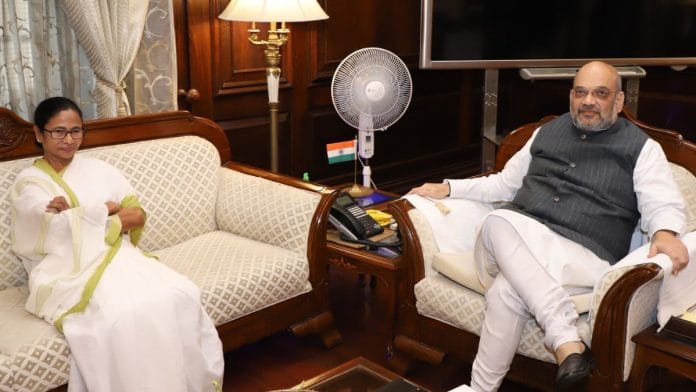

With the TMC imploding and 20 of 28 MPs now supporting the BJP-led NDA, there is evidently no love lost between former West Bengal Chief Minister Mamata Banerjee and the BJP.
At a time like this, it would be unrealistic to expect that a hardened streetfighter like Banerjee would extend any political niceties to the BJP. Rather, at such times of existential crisis for her party, perhaps it is natural for her to do everything that would put the BJP in an embarrassing political situation.
But the one thing that should not be mingled with, not just for Banerjee but any politician belonging to any political dispensation in India, is compromising the country’s national security interests.
Banerjee talking to the press about Bangladeshi student leader Osman Hadi’s killer and his alleged India connection is thus less about embarrassing the NDA government at the centre and more about putting India in a geopolitical soup.
This move by Banerjee might just become the last nail in her party’s coffin because TMC is already enduring its gravest political crisis following a crushing defeat in the 2026 West Bengal Assembly elections.
What does Mamata know?
At a political event in Kolkata recently, Banerjee alleged that the Union Home Minister Amit Shah had asked her not to divulge information related to the daylight assassination of popular Bangladeshi youth leader Osman Hadi in Dhaka last December.
Hadi’s murder had plunged Bangladesh into chaos as murderous mobs attacked minorities, cultural institutions and media houses even as anti-India sentiment peaked in the country.
Protesters staged demonstrations outside the Indian High Commission in Dhaka.
“In Rajshahi, protesters tried to advance towards the office of an Indian regional diplomat, but police blocked them. Several social media videos showed incidents of stone-pelting near the Indian Assistant High Commission office. The office had to shut operations for the day, along with services at two visa centres,” a news report said.
The report added that in a Facebook post, Hadi’s political platform, Inquilab Moncho, called Hadi’s death a struggle against “Indian hegemony”.
“In the struggle against Indian hegemony, Allah has accepted the great revolutionary Osman Hadi as a martyr,” it reads.
India made its position clear. On 14 December last year, the Ministry of External Affairs said India has never allowed its territory to be used for activities “inimical to the interests of the friendly people of Bangladesh”.
“We expect that the interim Government of Bangladesh will take all necessary measures for ensuring internal law and order, including for the purpose of holding peaceful elections,” the statement reads.
On 8 March, Faisal Karim Masud and Alamgir Hossain, identified as the two main accused in the Hadi murder case, were detained by the Special Task Force of the West Bengal Police in Bongaon, a border in the North 24 Parganas district.
“They illegally entered Indian territory through the Meghalaya border and moved through different places in India and finally came to Bongaon with the intention of crossing back into Bangladesh,” the West Bengal Police said in a statement.
For the new government in Bangladesh under Prime Minister Tarique Rahman, which is trying to mend ties between Delhi and Dhaka, the arrest of Hadi’s killers was positive news.
“The arrest… ensures that India is not seen as a neighbour that allows its territory to be used for activities inimical to the interests of the people of Bangladesh. What is also important to note is that the arrests follow the visit of Bangladesh’s military intelligence chief, Major General Mohammad Kaiser Rashid Chowdhury, to New Delhi,” a report said.
But that was before Banerjee entered the picture. She claimed she has full knowledge about a ‘major murder’ in Bangladesh and alleged that Shah personally called her and asked her to suppress the news after the suspects in the murder case were arrested in West Bengal.
“I had not spoken about this for so long. I am speaking now because oppression has crossed all limits. Even now, I am not naming the person out of courtesy. People in Bangladesh will become furious. I do not want that. I love the country,” Banerjee said at a sit-in with her party workers in the presence of the press.
When asked to reveal the name, Banerjee said, “No, I will not say it for the sake of the country. The Home Minister told me, ‘Please tell the Bengal Police not to let this matter come out. It is in the country’s interest.’”
She went on to say, “Who was used to carry out the murder? Whose names had surfaced? Even though the government has changed today, I still know everything. My heart is a repository of words, information and truth.”
Also read: TMC’s LoP in Bengal has given BJP control over both govt and Opposition. Mamata is rudderless
Reversing the Chetwode Motto
Banerjee’s statements generated a fresh wave of anti-India sentiment across the border. Sharing a video on X of a public speech given by a young leader of the students’ wing of Bangladesh’s opposition party, the Jamaat-e-Islami Bangladesh, journalist Salah Uddin Shoaib Chowdhury wrote that Banerjee’s statements have emboldened the Islamist groups.
On 3 June, Bangladesh’s state minister for foreign affairs Shama Obaed Islam said that Dhaka will not respond to Banerjee’s statements.
“An election has taken place in another country, and a political leader has made certain remarks. That is not our matter to discuss,” Islam told reporters.
The Telegraph wrote that the immediate diplomatic impact may be limited, particularly given Dhaka’s effort to downplay the issue.
“But the episode illustrates how quickly unresolved political controversies can cross borders in South Asia,” it added.
Even as Dhaka and Delhi try to mend ties, there are issues that need serious attention, one of the principal ones being the Indo-Bangladesh Ganges Water Treaty that is set to expire this December. Bangladesh’s Opposition leaders have also been trying to fan anti-India sentiment after a new BJP government has come to power in West Bengal.
The Bangladeshi press has reported that ‘bulldozer action’ by the new BJP government to remove illegal encroachment is primarily anti-Muslim.
In a report, Bangladeshi newspaper Prothom Alo English has said: “Following a fire incident in a factory in southern Kolkata that led to the death of two people, alleged illegal structures in the area have been demolished using bulldozers. The area is predominantly Muslim. Residents have staged protests over the incident.”
The same report has mentioned that ahead of Eid al-Adha, restrictions have been imposed on the cattle trade in West Bengal.
At such a critical time, Banerjee’s statements have the potential to do serious damage to India’s geopolitical interests. Anti-India sentiment also becomes fodder for terror groups operating beyond the border.
For anyone holding public office, the foundational creed of the Indian Military Academy, known as the Chetwode Motto, which prioritises nation, troops, and self, should be sacrosanct.
But according to Jaideep Mazumder, former political editor of Swarajya, Banerjee has always followed the Chetwode Motto in reverse.
“It is her own political interest that comes first, followed by that of her family, then her party and last, always the last, the country. Her allegation on Hadi’s murder was not just mischievous, but acutely anti-national and reflected the desperation of someone who has no qualms about jeopardising her country’s interests to score political points,” Mazumder told ThePrint.
Surely, the firebrand political leader who ruled West Bengal for 15 years and has served multiple terms as a Union cabinet minister would not want to hurt India’s interests.
Deep Halder is an author and a contributing editor at ThePrint. He tweets @deepscribble. Views are personal.
(Edited by Saptak Datta)
Who can forget her Parliament speech against illegal immigration when the Left ruled Bengal. She is a political opportunist. She got drunk on power. Which sitting CM ever ran to save files during a raid !?
Mamata Banerjee made an anti-Indian statement. NIA must probe it, ask Mamata to provide evidence, else arrest her.