








There is no way of knowing if the first head of Soviet Russia Vladimir Lenin did indeed say: “The best way to control the opposition is to lead it ourselves”. But the quote, often attributed to him, succinctly sums up the current state of political play in West Bengal.
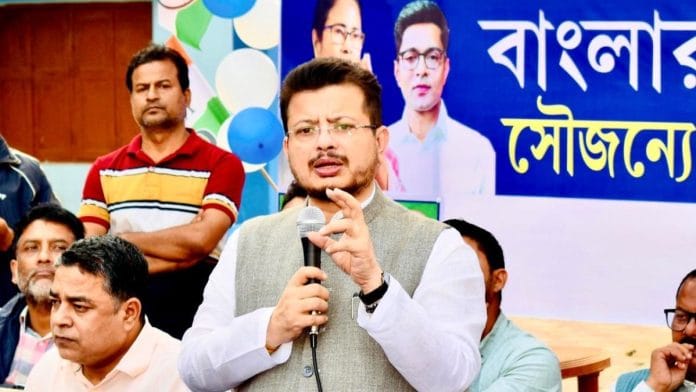
As expelled TMC MLA Ritabrata Banerjee was appointed Leader of Opposition (LoP) in the West Bengal Assembly on 3 June, with the support of 58 of 80 Trinamool MLAs, and party supremo Mamata Banerjee was left rudderless, West Bengal is staring at an Opposition-mukt state. It is a situation where a state’s ruling party controls both the government and the opposition, like Lenin may have once prescribed.
Ironically, it is the same Ritabrata Banerjee, who had declared that he understood Lenin’s famous dictum on mass politics by watching Banerjee work among the masses!
An unkindest cut
There is perhaps no better way to describe what Ritabrata has done to Banerjee than borrowing a phrase that the Bard of Avon used to describe the betrayal of Julius Ceaser by his friend Brutus: “unkindest cut”. It was, after all, Banerjee who had helped resurrect his political career.
At just 35, the suave and erudite Ritabrata became a Rajya Sabha MP from the CPI(M). Considered close to both the former West Bengal chief minister Buddhadeb Bhattacharyya and former CPI(M) general secretary Sitaram Yechury, Ritabrata was the Left’s brightest young star. And then in September 2017, the CPI(M) expelled him for alleged “anti-party activities, moral degeneration and having a lifestyle beyond his known means”. That was just the beginning of his troubles.
In November 2017, a West Bengal Police team reached Delhi to apprehend him after a woman filed a complaint accusing him of sexual exploitation. Denying the allegations, Ritabrata said the police action was politically motivated and filed a counter-complaint, accusing the woman of extortion.
Soon after, Ritabrata began cosying up to the TMC, and by 2020, after completion of the Rajya Sabha tenure, he formally joined hands with Banerjee.
Expelled from the CPI(M) and battling a case of sexual exploitation, TMC not only gave Ritabrata refuge but also a Rajya Sabha berth in 2024 and later an assembly ticket. On his part, Ritabrata publicly compared Banerjee’s politics to Lenin’s understanding of mass mobilisation.
The former communist argued that Banerjee’s connection with ordinary people represented the essence of genuine politics and suggested that her welfare-oriented governance reflected the true spirit of pro-poor politics.
“Few would have imagined then that the same leader would one day spearhead a rebellion against the very political establishment that had rehabilitated him,” states the PTI report.
On 3 June, in an open challenge to Banerjee, who had backed veteran TMC leader Sovandeb Chattopadhyay for the Leader of the Opposition post, 58 rebel MLAs submitted a letter naming Mamata as the party supremo, Ritabrata as the LoP, and Sheuli Saha, Javed Khan, Sandipan Saha and Sabina Yasmin as deputy leaders in the House.
“We are representing Trinamool Congress in the Assembly. We are a block of 60 MLAs. We would request Mamata Banerjee to be our advisor and guide us. We will play the role of a constructive opposition,” Ritabrata told the press. He clarified that though there were only 58 MLAs, including himself, on 3 June in public, there were two more who had assured him of their support.
Though executed by Ritabrata, who has gone against Banerjee to become the face of opposition in West Bengal, there is talk in Kolkata of the hidden hand that may have engineered the move.
Also read: TMC’s collapse does not suit BJP—because the Left is waiting in Bengal
The hidden hand
For author and academic Sarojesh Mukherjee, there’s hardly any need to speculate on the identity of the hidden hand for two reasons.
“It is an act of such finesse that one can be in no doubt about the engineering, and, much like in any crime fiction, one needs to only think about who benefits from the split?” Sarojesh told ThePrint.
He said that while Adam Smith, the father of economics, spoke of the ‘hidden hand’ that allocates resources efficiently across markets, much the same seems to have happened in the recent allocation of resources within the TMC Legislative party.
AAP’s Sanjay Singh has directly blamed the BJP. Speaking to the press after the TMC split, Singh said, “The way BJP operates involves breaking parties apart, intimidating with ED, CBI, and investigative agencies, which has become a game in the country. They broke Shiv Sena, broke NCP, broke Congress in Arunachal and Uttarakhand, broke Congress in Goa, Karnataka, and Madhya Pradesh. They broke our AAP party, too.”
Senior journalist and public policy analyst Pratim Ranjan Bose told ThePrint the TMC split has undoubtedly given the BJP an advantage, but it is not the same as the Maharashtra model, where the Shiv Sena had split.
“What is different and unprecedented here is that the opposition has split to remain in the opposition! The Shiv Sena had split, and one faction joined the government,” Bose said.
Bose said that the split has completely sidelined “the owner of the TMC franchise, Banerjee”.
“The BJP will be at an advantage because there are no big leaders in the new Trinamool Congress who can put up a fight against the BJP government, and the split itself has made both Mamata Banerjee and Abhishek Banerjee irrelevant and pushed them to a stage where they will simply wither away,” he said.
A senior BJP leader has told The Indian Express that the party does not need support in West Bengal and that the priority is to get MPs. With a fragmented TMC, its MPs could form a separate group, and the BJP could benefit from their support for the numbers required for passage of key bills like a revised draft of the Delimitation Bill and the One Nation, One Election Bill.
But it is not just in Parliament. In West Bengal, the new BJP government that has hit the ground running with decisive but hotly debated moves will gain from an opposition it can control. One can imagine Banerjee becoming a roadblock against bulldozing illegal roadside stalls and clearing pavements near major transit hubs, and directives prohibiting public namaz on roads, as well as banning cattle slaughter in public. But Ritabrata Banerjee?
For a former communist fond of quoting Lenin, he may well have carried out a move that gives the BJP control over both government and opposition.
Deep Halder is an author and a contributing editor at ThePrint. He tweets @deepscribble. Views are personal.
(Edited by Saptak Datta)