







The May 2026 West Bengal Assembly poll results are a slap on the face of those who swore by the secret ‘Modi-Didi setting’ theory.
According to the proponents of this theory, propounded not just in neighbourhood tea stalls but in highfalutin opinion pieces on Bengal’s current politics, the BJP had only done shadowboxing in West Bengal and was never serious about removing the Mamata Banerjee-led Trinamool Congress (TMC) government from power.
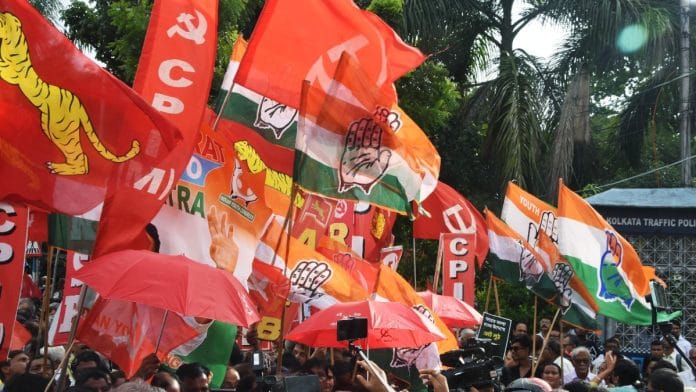
With the BJP besting the TMC by a wide margin of 207-80, the “setting” theory was proved wrong. What is interesting, though, is that the BJP may not want the TMC to implode after such a decisive defeat, even as several of its elected leaders want to jump ship. A total collapse of the party could revive the Left parties—which would mean mainstreaming of an ideology that not just the BJP, but the Sangh Parivar has fought tooth and nail against for decades.
Implosion imminent?
The once-formidable TMC is facing an existential crisis after losing the Assembly elections to the BJP. Saumitra Khan, a BJP MP, has told the press that as many as 50 Trinamool MLAs and 20 MPs were unhappy and were ready to switch to the BJP if the central leadership gave the go-ahead. Khan said the TMC would cease to exist as a political force if the BJP leadership decided to induct these leaders.
An India Today report said nearly 100 TMC councillors from different municipalities in West Bengal have resigned in the past few days. The political upheaval has opened a window for the BJP to expand its footprint in municipal bodies that remain largely under the TMC’s control.
At this point, TMC leaders are competing among themselves over who would join BJP first.
“The TMC could never become a proper political party as it doesn’t have a political ideology of its own. Mamata Banerjee opposed Congress and broke out to form TMC. Then she defined herself and her new party as everything that was anti-Left. After she came to power, her party gradually came to define itself as being anti-BJP,” Political affairs commentator and senior advocate of the Calcutta High Court Joydeep Sen told ThePrint.
For Sen, a party that stands for nothing and opposes everything is bound to implode eventually. With so many party workers ready to desert, and others facing court cases and arrests, the biggest challenge for Mamata Banerjee is to somehow hold it all together. To not concede the Opposition space to the Left.
Also read: How BJP’s Bengal win is shaping India-Bangladesh ties
Revival of the Left?
At first glance, the Left does not seem like a serious challenger to the TMC as the latter won as many as 80 seats in this year’s election.
In the Assembly polls, the Left Front alliance secured a total of two seats, one won by the Communist Party of India (Marxist) and one by the All India Secular Front. This came after a hat-trick of zeroes by the Left Front in the 2019 Lok Sabha polls, the 2021 Assembly polls and the 2024 Lok Sabha polls.
However, the Falta bypoll result on 24 May has brought the Left back in conversation. After BJP candidate Debangshu Panda, who won by a margin of more than one lakh votes, CPM-backed candidate Shambhu Nath Kurmi came second. He won 40,645 votes. The TMC was in fourth position.
“The numbers have led many analysts to believe that a section of anti-TMC voters shifted towards the Left this time,” a Zee News report said.
West Bengal politics was locked in a straight BJP versus TMC fight for several years when Left parties were consistently losing vote share and seats. Which is why Falta’s numbers have caught attention across party lines.
For Bengal watcher and British Academy International Fellow, University of Sussex, UK, Ayan Guha, it is not just Falta, but the defeat of TMC in the Assembly polls might create space for the CPM in a paradoxical way.
“In West Bengal with 30 percent Muslim population there is a ready-made anti-BJP opposition space. Therefore, structurally there is a large opposition space in West Bengal which in all likelihood will always hover around 40 per cent,” Guha told ThePrint.
He added that with the TMC exploding and facing public ire and severe image crisis, the Opposition space can gravitate to the CPM or CPM-Congress alliance.
“From an ideological point of view, politics of the Right is also likely to create its contestation through a politics of the Left. TMC did not allow the left politics to operate by superficially incorporating the left political idioms, rhetoric and agitational mobilisation,” Guha said. “At the same time, appropriating the logic of cultural Marxism, it also gave a blatant sanction and encouragement to identity politics in a way, which many in a traditional left force like CPM have found unpalatable.”
It won’t be an ideal scenario for the BJP government.
In a column last year for the Daily Pioneer, author and RSS ideologue Ratan Sharda wrote that while Communists removed nearly all the nuggets of Indian genius in governance, science and technology, the RSS kept highlighting them, despite being called orthodox and backward-looking.
“While Communists along with Nehru decried Hindus and their beliefs in a very demeaning way, RSS, stood firm holding aloft high values of Indian civilization. As the hundred years of the two organisations and current scenario shows, people of Bharat have awoken to the truth of Bharat,” he wrote.
And it is for such ideological differences that the BJP-RSS would never want to bring the Left back into any position of political prominence.
In an interview for my book Bengal 2021: An Election Diary, a senior RSS functionary who was working in Bengal had said the immediate political adversary may be Mamata Banerjee, but the Left would always be the real “enemy”.
“TMC’s rule, however problematic, will not damage the fabric of the state. But the Left has the power to damage the entire nation,” the functionary said.
Deep Halder is an author and a contributing editor at ThePrint. He tweets @deepscribble. Views are personal.
(Edited by Ratan Priya)