





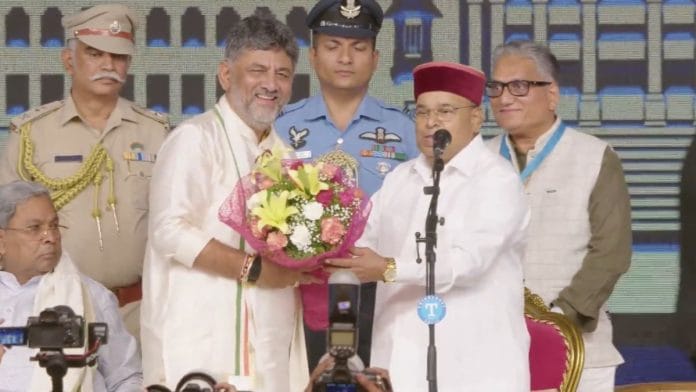


Bengaluru: As a downpour in Bengaluru brought welcome relief from rising temperatures the evening before DK Shivakumar’s swearing-in, supporters of the new Karnataka chief minister couldn’t help but see it as a blessing. The traffic snarl it caused, however, came as a timely reminder of the many challenges that the 64-year-old must address at the onset of monsoon.
And that’s just Bengaluru; Shivakumar has helmed the city development portfolio since 2023 but in his new role as head of the government, he will have to manage rising expectations for all of Karnataka. “The faith and confidence the people of this country have shown me, I am very much obliged, and I have to do a lot of hard work and deliver. I know roads will not be so easy. It will be difficult time, but I still have to manage things. I hope the people of Karnataka have confidence in me,” Shivakumar told ANI on Tuesday.
Shivakumar took oath a little after 4 pm Wednesday at the Lok Bhavan premises. ThePrint lists out some of the challenges the new chief minister of Karnataka faces in his new role.
Crumbling infrastructure
Arguably, Shivakumar’s biggest challenge is fixing the deep-rooted problems of Bengaluru, the state’s growth engine and India’s Information Technology capital.
Long before Shivakumar helmed affairs in Bengaluru, the city had become synonymous with traffic congestion and crumbling public infrastructure. With Bengaluru accounting for nearly one quarter of the state’s population, Shivakumar has to reimagine ‘Brand Bengaluru’ which has become a template of urban ruin.
One of the quickfire solutions available to Shivakumar is prioritising long-delayed Namma Metro stretches. The other is to keep Bengaluru’s roads free from potholes and dismantle the tightening grip of the ‘garbage mafia,’ which has tainted the city’s reputation in recent years.
Shivakumar also has to weld consensus for the contentious Rs 40,000-crore Tunnel Road project that proposes underground passages across Bengaluru to reduce commute times for cars. Bengaluru averages nearly 2,000 new vehicles every single day, taking its vehicle population on par with the total number of residents.
That an industrialist Gautam Adani-led firm is likely to be awarded the construction of the project is another challenge, considering how Congress leader Rahul Gandhi and his party have attacked the tycoon, alleging close ties between him and the Bharatiya Janata Party (BJP).
“The next two years is the opportunity for the new chief minister to undo the horrific cut-paste urban mobility planning he formerly oversaw as deputy. Bengaluru must remain vigilant, ask legitimate questions to prevent inter-generational disasters imposed in the name of development,” Satya Arikutram, an independent mobility expert said.
Prof. Ashish Verma’s Transportation Engineering research lab at the Indian Institute of Science (IISc) earlier told ThePrint that there is a deepening divide between transport demand and supply. He said that more transport supply through road infrastructure is not sustainable in the long run and makes the city more dependent on cars (or private vehicles), and is less friendly for public transport users, or for walking and cycling.
Neighbouring states like Andhra Pradesh and Telangana have been actively trying to capitalise on Bengaluru’s infrastructure challenges and archaic policies by encouraging entreprenuers and businesses to relocate. Addressing Bengaluru’s infrastructure challenges would allow the Shivakumar-led administration to thwart these advances and retain the city’s—and Karantaka’s—position as one of India’s most favoured investment destinations.
With no elected council for Bengaluru since September 2020, all blame–and credit–will inevitably land at Shivakumar’s doorstep.
Prominent industry captains like Kiran Mazumdar Shaw and T.V. Mohandas Pai are among those who have constantly flagged these issues while getting only assurances in return. Shivakumar will now have to go beyond those promises and deliver on them to help the Congress breach Bengaluru which has largely backed the BJP in state, central and local elections.
Shivakumar had reconstituted the city’s civic body from the earlier Bruhat Bengaluru Mahanagara Palike (BBMP) to Greater Bengaluru Authority (GBA), splitting it into five corporations for better governance and effective administration. Conducting and winning the GBA and urban local elections will be Shivakumar’s first challenge before he approaches the Assembly polls due in 2028.
Also Read: From Sathanur to Bidadi, how Shivakumar-Deve Gowda rivalry has shaped Karnataka politics in 40 years
Debt-model of growth
Outgoing Chief Minister Siddaramaiah had become the face of the Congress welfare brand of politics since 2013, which later transformed into the ‘guarantees’ of 2023. After assuming office in 2023, Shivakumar said that there are no funds for development since a significant chunk has been set aside to fulfil the flagship guarantee schemes.
The Siddaramaiah-led government has spent Rs 1,39,123 crore on implementing its five guarantees so far, forcing the administration to cut funding to other programmes and relying on debt to build infrastructure.
According to an analysis by ThePrint, Karnataka’s total liabilities are estimated to cross Rs 11.20 lakh crore in the next four years.
Since the turn of the century, it has been common for the chief minister to retain the finance portfolio; Shivakumar is unlikely to be any different. He would take over the state’s fledgling finances and still have to announce new schemes, development projects and completion of existing ones before heading to the state polls in 2028.
“Siddaramaiah has quietly walked away after completely wrecking Karnataka’s economy, leaving behind a broken-down lorry for D.K. Shivakumar to drive! This isn’t a graceful ‘change of guard’—it’s a calculated, cowardly escape from a financial disaster of his own making!” Leader of the Opposition R. Ashoka posted on Tuesday.
He added that the state is drowning in an insurmountable ocean of debt, and public development has ground to an absolute halt.
As per the 2026-27 budget, Karnataka’s total liabilities are expected to touch Rs 8,24, 389 crore by the end of the ongoing fiscal year, amounting to 24.94 per cent of the Gross State Domestic Product (GSDP). The state keeps within the 25 per cent debt ceiling mandated by the Karnataka Fiscal Responsibility Act (KFRA), 2002, but only just.
The revenue deficit for the ongoing fiscal is estimated at Rs 22,957 crore and the fiscal deficit is estimated to be Rs 97,449 crore, according to the budget. At 2.95 per cent of GSDP, the fiscal deficit is below the KFRA limit of 3 per cent, but again only just.
As per the 2026-27 budget, for every rupee that comes into the state coffers, 20 paise goes towards debt servicing. In other words, one-fifth of revenues go to pay interest on debt.
By the time Shivakumar heads to the 2028 Assembly elections, the total liabilities are projected to rise to Rs 10,17,756 crore in 2028-29, or 23.60 per cent of the GSDP, according to the Medium Term Fiscal Plan (MTFP), suggesting that the pattern of borrowings will continue.
The government is contemplating the introduction of new policies and economic reforms, such as implementing the parking policy, London-model congestion charges, use of Corporate Social Responsibility funds, and increasing the property tax net to raise capital for funding development. But higher borrowings would mean more funds set aside just for debt servicing.
Higher borrowings, more interest
It is estimated that interest payments alone will rise to Rs 53,332 crore in 2026-27 (budgetary estimates). By 2029-30, Karnataka’s fiscal deficit is projected to reach Rs 1,11,440 crore, according to the MTFP. Shivakumar will have to find a way to bring in more funds to bankroll ideas like a second airport, tunnel road, irrigation project and other development works.
The continued commitment to guarantees also shows a pattern of declining budgets for capital expenditure or investments in long-term asset creation that help create jobs and growth. Long known as the Congress’s ‘money man’ for his ability to handle funds for the party, Shivakumar will have to incorporate these skills in managing state finances now.
Regional imbalance
Karnataka has a skewed developmental landscape, the regional imbalance favouring Bengaluru and districts in the southern part of the state. The latest economic survey shows a nearly 500 per cent gap between Kalaburagi, the district with the lowest per capita income, and Bengaluru.
For 2025-26, Karnataka’s per capita income is estimated at Rs 4,33,326 at current prices, registering a growth of 12.2 per cent over Rs 3,86,156 in 2024-25. Though Karnataka’s per capita income is 97 per cent higher than the national average of Rs 2,19,575, the data reveals a stark and growing imbalance in the southern state.
The district-wise breakup for 2024-25 shows that Kalaburagi has a per capita income of Rs 1,44,449 while Bengaluru is at the top with Rs 8,55,960. Bengaluru contributes over 40 per cent to the state’s gross domestic product while Dakshina Kannada and Belagavi are at second and third position, contributing 5.3 and 3.8 per cent respectively.
The imbalance is so stark that out of 31 districts, only five are above the state average of Rs 3,86,156, data shows. Kalaburagi, the home district of All India Congress Committee (AICC) president Mallikarjuna Kharge and his legislator son Priyank, is part of Kalyana-Karnataka, one of the most backward regions in the country.
Since the early 1970s, the gap in per capita income has widened due to the focus on Bengaluru that has means inadvertent neglect of other districts.
This has forced migration into the city. Corrective policies like ‘Beyond Bengaluru’ have few takers due to the existence of an ecosystem created over the decades which neither private companies nor the government has tried to change.
Cities like Mangaluru that earlier relied on ports, shipping and refineries, have since diversified into infotech on their own with little or no government involvement.
Shivakumar will have to address this imbalance at the earliest to usher in policies that help facilitate equitable development.
Also Read: DK Shivakumar—the ‘Rock’ at the door of power. What it means for Karnataka and Congress
Commission curse
The Congress government used the ‘40% commission’ allegation against the Basavaraj Bommai-led BJP government as its poll platform in 2023. The Siddaramaiah-led government had even constituted a commission to probe the allegations. These allegations, however, remain a constant feature for the incumbent dispensation too.
The Karnataka State Contractors Association (KSCA), which had levelled allegations against the BJP government, has accused the Siddaramaiah government of carrying on with the same practice. In September last year, KSCA president R. Manjunath alleged that the association played a significant role in the Congress coming to power.
“Each time you (read Siddaramaiah) give us assurances and direct officials to act. Out of our respect for you, we have been patient with the hope that you would solve our problem. But, until now, we have had no benefit from your government,” they wrote. They went as far as to allege that the percentage of commission had doubled in comparison to the previous BJP government.
Shivakumar assumes office at a time when contractors are livid at non-release of payments for earlier works and rising demands for ‘commission’ or bribes to release payments for completed works.
Political challenges
Other than infrastructure and governance-related challenges, Shivakumar also stares at a multitude of political challenges. Although Siddaramaiah has stepped down, the 77-year-old has retained power to demand significant portfolio allocations, including inducting his son, Yathindra, into the Cabinet. This poses a significant challenge for Shivakumar who may not have a free hand over his ministers and creates the problem of multiple power centres, adding to policy paralysis.
Shivakumar also has to conduct the much-delayed elections to the GBA and urban local bodies, his first test as chief minister. He is also from the dominant Vokkaliga community, and earlier opposed the release of the caste census that goes against Rahul Gandhi and Siddaramaiah’s stated policy of social justice. A day before Siddaramaiah stepped down, his government accepted the second report of the ‘socio-economic and educational survey’, or caste census, and it is up to Shivakumar now to release the findings and remain committed to the party’s primary platform of social justice.
Internal reservations, which the government claims as an achievement, has left several extremely backward classes with no representation and being overshadowed by larger groups within the Scheduled Caste (SC) category. The H.N. Nagamohan Das commission had initially recommended that the government set aside 1 per cent of internal reservation for 59 nomadic, semi-nomadic and micro-communities. Siddaramaiah, however, scrapped the proposal, bringing them under one category with 4.5 per cent quota, a single block that groups Banjara, Bhovi, Korama and Koracha and other nomadic communities, and has triggered disenchantment among them.
“They have become increasingly dependent on the minorities since major communities are not responding to them,” Sugata Srinivasraju, author and analyst, earlier told ThePrint.
The minorities too have openly expressed their discontent with the Congress, especially after it felt snubbed in the Davangere South bypolls. Muslims have accused the Congress of taking them for granted. At a recent convention in Bengaluru, Muslim leaders accused the Congress of not acting against communal and hate-mongering organisations like the Bajrang Dal, and alleged that the party was playing soft Hindutva. The Congress government is yet to scrap laws banning cattle slaughter as well as those against religious conversion. They have also objected to the state not resisting the proposed Special Intensive Revision (SIR) in the state.
Finally, Shivakumar has to emerge from Siddaramaiah’s shadow even though the latter is likely to have a significant chunk of the Cabinet allocations. The new chief minister will have to balance the expectations of his own Cabinet and party colleagues who have been demanding higher allocations to show some semblance of development before approaching the public and seeking another term in office.
(Edited by Nardeep Singh Dahiya)
Also Read: ‘I am a 100% politician’—what Siddaramaiah, Karnataka’s longest serving CM, said in 2017
Exit fool, enter rowdy. Not just Bengaluru but the whole state is broken—piece, piece.