





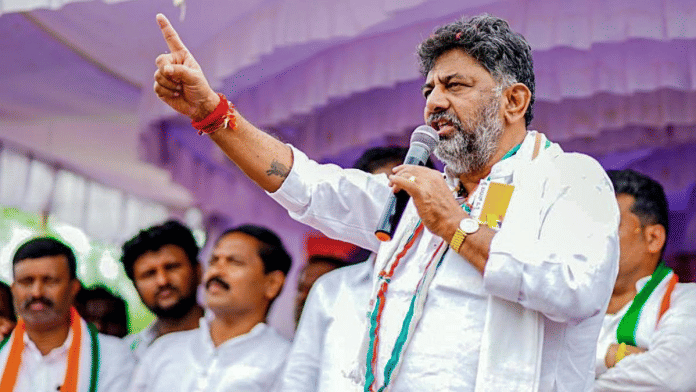

There are politicians who inherit power, politicians who wait for it, and politicians who build the machinery that makes power possible. DK Shivakumar belongs firmly to the third category. In Karnataka, where every political move is read through caste, coalition, loyalty, money, memory, and muscle, the man known as Kanakapurada Bande — the Rock of Kanakapura — has spent more than four decades making himself indispensable.
Now, as reports of an impending leadership transition in Karnataka gather force and DK Shivakumar is widely seen as the man most likely to succeed Siddaramaiah as Chief Minister, the question before the Congress is no longer whether he has waited long enough. It is whether Karnataka is ready for the most complete expression yet of the Shivakumar method: patient, transactional, fiercely loyal, administratively ambitious, and unafraid of power.
The making of the Rock
Doddalahalli Kempegowda Shivakumar was born on 15 May 1962 into an agrarian family in Karnataka’s Vokkaliga heartland. In his own telling, there was no inheritance of privilege.
“I come from a simple village background, nobody gave me anything… I built everything step by step.”
Shivakumar’s political instincts were sharpened in school and college elections, in hostel rooms, student unions, small gatherings, and the rough informal networks of Bengaluru’s youth politics. At GRC College, he entered the National Students’ Union of India (NSUI) and rose through the Congress’s student and youth structures. By his teens, he had already decided that politics was not an interest but a vocation. By his twenties, he had become the kind of young organiser older leaders both used and feared.
His first great test came in 1985, when he contested against HD Deve Gowda and lost narrowly. For most young politicians, such a defeat would have ended the experiment. For Shivakumar, it became fieldwork.
“I went back to the villages of Sathanur — not to ask for votes, but to listen,” he has said.
Four years later, at 27, he won Sathanur. In 1994, denied a Congress ticket, he contested as an independent and won again. The lesson he drew was simple: “If you have the people’s support and you stay loyal to your roots, you will always find your way back.”
Congress as identity
Shivakumar’s relationship with the Congress forms the core of his political self-description.
“When I say I am a born Congressman, I mean that the values of this party are in my DNA,” he says. “I will die a Congressman because I cannot imagine fighting for the soul of this country from any other platform.”
That loyalty has made him valuable to the Gandhi family and to the high command. It has also made him unusual in a political age defined by defection. Shivakumar’s politics is not soft, but it is anchored. He embraces Hindu cultural identity, temple traditions, and spiritual idioms, yet frames his politics within Congress secularism, welfare, and constitutionalism. In Karnataka’s polarised terrain, this has given him a distinct grammar: culturally rooted, organisationally hard-nosed, electorally pragmatic.
On caste, too, he chooses calibration over denial.
“Caste is the starting point, it is not the finish line,” he says. “Yes, I am a proud Vokkaliga, and I will always stand for my community. But my caste is the Congress, and my duty is to every citizen of this state.”
The crisis engineer
Shivakumar’s national reputation rests on one political skill above all others: keeping the flock together when the flock is being hunted. In 2002, when the Vilasrao Deshmukh government in Maharashtra was in trouble, he was called in to manage MLAs. In 2017, he sheltered Gujarat Congress legislators in Bengaluru ahead of the Rajya Sabha election that sent Ahmed Patel back to Parliament. In 2018, after Karnataka delivered a hung Assembly, he became central to the Congress-JD(S) coalition effort. Later, he was deployed in other difficult theatres where Congress needed numbers, nerves, and logistics.
His method is less theatrical than his reputation suggests.
“You have to stay calm,” he says. “In politics, trust is everything. If people trust you, they will stand with you.” It is this combination — personal credibility, resource mobilisation, political nerve, and discretion — that has made him Congress’s man for impossible assignments.
That skill was also visible in 2023, when the Congress won 135 of 224 seats in Karnataka, its most emphatic state victory in decades. Siddaramaiah supplied a powerful welfare idiom through the AHINDA coalition and the guarantee schemes. Shivakumar supplied the organisation, resource base, Vokkaliga heft, and campaign machinery. Together, they gave the Congress what the BJP least wanted: a united state leadership with contrasting but complementary strengths.
Also read: From Sathanur to Bidadi, how Shivakumar-Deve Gowda rivalry has shaped Karnataka politics in 40 years
Bengaluru as battlefield
If Shivakumar becomes Chief Minister, Bengaluru will remain both his prize and his test. As Deputy Chief Minister and Minister for Bengaluru Development and Water Resources, he has positioned himself as the leader willing to confront the city’s unglamorous emergencies: traffic, potholes, garbage, flooding, water, governance failure, and middle-class anger.
His diagnosis is blunt: Bengaluru has “best talent, best weather, worst infrastructure.” His prescription is equally ambitious. The Greater Bengaluru Authority, five city corporations, tunnel roads, the Bengaluru Business Corridor, double-decker corridors, white-topping, stormwater-drain works, Cauvery Phase 5, and citizen-facing initiatives like Walk With Bengaluru are all part of his attempt to recast the city’s future through administrative restructuring and hard infrastructure.
He understands the symbolism of Bengaluru. To investors, it is India’s global city. To citizens, it is a daily negotiation with broken roads and civic fatigue. To Karnataka, it is the economic engine whose success cannot be allowed to become self-destruction. Shivakumar’s promise is not poetry. It is execution.
“This is not one project,” he says of the Bengaluru overhaul. “This is a full transformation.”
Beyond the capital, his water portfolio has allowed him to speak to rural Karnataka: Mekedatu, lake-filling, lift irrigation, canal modernisation, treated wastewater projects, and drought resilience. The ambition is to connect the global city and the agrarian hinterland, the IT corridor and the silk farmer, the flyover and the tank.
Power, controversy, resilience
No serious evaluation of Shivakumar can avoid the shadows. He is one of India’s wealthiest politicians, with declared assets running into hundreds of crores. He has faced investigations, raids, arrest, and allegations that opponents have used to portray him as the embodiment of money power in politics.
Shivakumar’s defence is direct. “I am an agriculturist, a businessman, an educationist,” he says. “Everything I have is declared.” He argues that wealth built through enterprise does not disqualify public service; it provides organisational skill.
His career has also shown a remarkable ability to turn setbacks into solidarity. Jail did not diminish his hold over the Congress; it deepened the image of sacrifice among supporters. Denied the top job in 2023, he accepted the Deputy Chief Ministership after intense negotiation and publicly returned to discipline.
“I believe in party worship, not personality worship,” he says. Yet he also adds, with unmistakable meaning: “Time will answer everything. Patience will pay.”
The wager of patience
That patience may now be approaching its moment. Shivakumar has never hidden ambition, but he has rarely allowed it to appear as rebellion.
“The biggest force in politics, as in life, is keeping one’s word,” he says. “Word power is world power.”
This is the line that now frames Karnataka’s next political act. For the Congress, elevating Shivakumar to Chief Minister would not merely reward a loyalist; it would place the state in the hands of its most formidable organiser, a leader who commands a caste base, understands money and media, speaks the language of development, knows the uses of faith, and has survived the brutal mechanics of Indian politics.
For Karnataka, the stakes are larger. Shivakumar is not a soothing figure. He is a forceful one. He inspires loyalty, suspicion, admiration and unease, often all at once. But after four decades of climbing, waiting, fighting, and delivering when called, the Rock of Kanakapura stands closer than ever to the office he has long been expected to claim.
And if he does, Karnataka will not merely get a new Chief Minister. It will get a political animal in full command of his terrain.
Rasheed Kidwai is an ORF visiting fellow, author and journalist. His upcoming book D. K. Shivakumar: Congress’s Crisis Manager, Karnataka’s Kingmaker, is being published by Hachette India and will be out in July. He tweets @rasheedkidwai. Views are personal.
(Edited by Prashant Dixit)
The Congress is doing the right things in the South. Appointing Shri V D Satheesan as CM of Kerala. Switching its loyalty to the winner in Tamil Nadu. Now entrusting Warnataka to the man best poised to win the next Assembly election. Barring Himachal, where it alternates in power with the BJP, absent in the North. Also the East. It does not have the room to make any more mistakes.
Instead of building tunnel roads in Bengaluru, build another city in Karnataka.
Stop using Bengaluru as a cash cow.
What is the status of North Karnataka?
Will Bengaluru be feeding NK forever?
Do some development for heaven’s sake.
That zero-sum model of subsidizing poverty, doesn’t work anymore.
I am not a Congress guy but for the sake of that state I hope he can bring some much needed vision. Sid was absolutely pathetic as an administrator and so unambitious.