






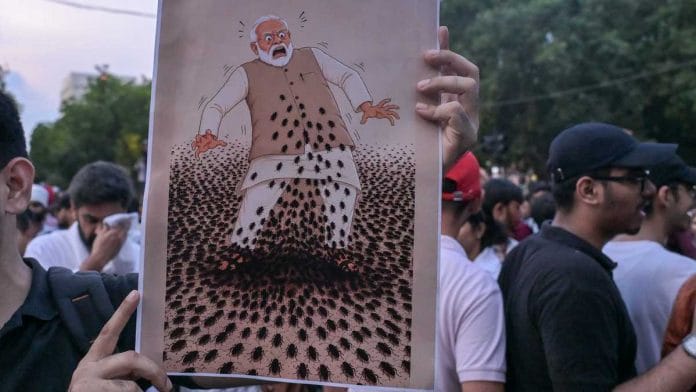


The moment was disorienting, strange. But it was a turning point. It was a moment to which future researchers and archivists will return when they study the Modi years. When they do, they may write a chapter on this moment and title it: ‘From “mitron” to “friends”: how India’s students forced an unlistening prime minister to listen.’
Just past midnight on 23-24 July 2026, Prime Minister Narendra Modi appeared on Instagram — vertical frame, poor lighting, stumbling delivery. This was not the usual Modi bellowing from a high-voltage campaign rally or strutting in a carefully stage-managed, teleprompter-aided setting. Visibly exhausted, his face lined and his expression uncertain, this was a different Modi. He used a word he almost never uses. Not “mitron”, but “friends”. “Friends.”
Two days and another ineffective Insta reel later, Education Minister Dharmendra Pradhan resigned.
Why did the Modi government wait until this point to act? For weeks, students and young people led by the plucky Cockroach Janta Party, protesting against exam paper leaks at Delhi’s Jantar Mantar and across India, had asked for one thing: the democratic principle of accountability, meaning Pradhan’s resignation. Ladakh activist Sonam Wangchuk remained on hunger strike, day after harrowing day, continuing even as his health began to worsen. Modi gave them all his usual escapist, imperious silence. No meeting, no statement, not one word on the students who died by suicide after NEET-UG descended into chaos.
Only after students, young people and other citizens, led by the CJP, marched toward Parliament on 20 July — and were met by police lathis, tear gas, and pellet guns — did the calculus change. The police were accused of using excessive force against unarmed protesters. Reports of pellet-gun injuries surfaced. In Bihar, there were reports of a policeman firing an AK-47 assault rifle. Parliament was locked down. But undaunted, the youth marched on. They wouldn’t stop. They wouldn’t be cowed by fear. Even the Modi-friendly mainstream media was forced to show the march. For once, the Modi government appeared rattled, even terrified.
Pushed onto the backfoot, the usually swaggering Modi government went scurrying into dialogue.
But as is usual with the Modi playbook on protests, negotiations with CJP were outsourced. Health Minister JP Nadda and PMO Minister Jitendra Singh were sent to negotiate, while the ‘Jodi No. 1’ from Gujarat, Modi and Amit Shah, stayed exactly where they always stay during a crisis: above it all, conveniently shielded from any possible blowback.
Also Read: Modi govt has failed India’s young. Exam fraud costs lives
The anti-protest playbook
It’s a familiar pattern. The Modi political system seems incapable of understanding the constitutional importance of protest. In a political system organised around a paranoid personality cult, all protest is interpreted as “conspiracy”. Yet protests are democracy in action, the arena in which citizens and state negotiate their relationship. India’s freedom itself was won through protest. But for Modi, protest is a personal insult.
Recall the Kisan Andolan. Farmers camped on Delhi’s borders through an entire winter, sneeringly dismissed by Modi himself as “andolanjeevi”, while nails and barricades were driven into roads to prevent their march. Agriculture Minister Narendra Singh Tomar was sent to negotiate, while Modi stayed distant. Tomar failed. After more than a year of protest, the three farm laws were finally repealed. Today, Tomar is Speaker of the Madhya Pradesh Assembly.
Recall Vinesh Phogat and Sakshi Malik, two of India’s most decorated wrestlers, dragged off the street by Delhi Police on 28 May 2023, the very day Modi was inaugurating the new Parliament building, the ‘temple of democracy.’ The PM loves being photographed with sports stars and declaiming on the grand narrative of “Khelo India”. Yet when those same sports stars protested on the street against sexual harassment, Modi refused to respond.
The same anti-protest instinct has surfaced repeatedly — from the anti-CAA protests to Jammu & Kashmir after Article 370 was revoked to the Manipur agitation. Grievances are not engaged with; they are delegitimised through labels: “Andolanjeevi.” “Khalistani.” “Anti-national.” “Jihadi.” “Urban Naxal.” “Foreign funded.”
This is the crucial sleight of hand. Once a protest has been labelled and demonised, a government no longer has to engage with it. Once the protester has been morally disqualified through name-calling and discredited by pliant TV channels, the grievance itself can be easily ignored.
Even Pradhan’s resignation letter carried the reflex. Along with language about respecting the aspirations of India’s youth was a now-familiar line: he was resigning so that “anti-national forces” could not exploit the moment. A minister resigns under sustained pressure from students and still must gesture toward an imagined “enemy”.
In most functioning democracies, a minister resigning after public failure is unremarkable — accountability doing its ordinary work. But the Modi government is different. Rajnath Singh once put the prevailing ethos plainly: “Hamaari sarkar mein istifa nahin hote.” We don’t resign.
Under Modi, dissent and protest are treated not as democratic correctives but as illegitimate, even criminal, challenges to god-like authority. The playbook is deployed again and again: ignore the protest, label the protesters, use overwhelming force, outsource negotiations and finally concede after an epic confrontation that could have been avoided had the government simply acknowledged the grievance in the first place. But admitting error is particularly difficult in a personality cult built around infallibility.
Why this agitation was different
But these protests achieved something else. They channelled the power of youth and the power of truth together in one avalanche that swept through the nation. The tragedy of the NEET suicides, the sheer injustice of the failed examination system, the thousands of young people in their jeans and backpacks, seized the national imagination.
Bare arms uplifted against the looming, helmetted Rapid Action Force. A teenager in a billowing patterned skirt thrown to the ground by lathi-wielding police. Round, earnest faces arguing with hostile cops. They were not just protestors; they were our future, our country, our hope.
“The Indian will tolerate everything,” a parent said to me at Jantar Mantar, “but the Indian will never tolerate anything bad happening to our children. We live for our children.”
This time Modi could not control the narrative. For twelve years, his communication model has run overwhelmingly in one direction: Mann Ki Baat, scripted events, carefully controlled appearances, no open press conferences. Questioning shut down. Argument stifled.
There is a continuity here with Modi’s years as Gujarat Chief Minister. Critics, journalists and civil society groups repeatedly accused Modi’s government of intolerance towards dissent, and Gujarat acquired the unsettling reputation of being a “protest-free state”, where prohibitory powers and Section 144 were frequently invoked to keep dissent off the streets. This mindset travelled with Modi from Gujarat to Delhi: protest was not something to engage with, but something to criminalise, discredit or simply make invisible. Indeed, as recently as December 2025, the Gujarat High Court objected to the mechanical invocation of extraordinary prohibitory powers, warning, in effect, that emergency provisions cannot become a permanent instrument of everyday governance.
This anti-protest political method has also been enabled by sections of the mainstream media. When television does not adequately show a grievance, when prime-time anchors do not ask uncomfortable questions, those in power can begin to convince themselves that dissent does not exist.
But India’s youth discovered something politically important. Instagram stormed the barricades.
Flipping control of the conversation
Young protesters used reels, memes, satire and digital mobilisation with extraordinary imagination. They did not require permission from editors to tell their story. They did not need a prime-time anchor to certify that their grievance existed. Their phones became television studios. Their feeds became public squares. There they were in rain and sun: young, luminous, armed with nothing but relentless courage, intelligence, laughter, music and soaring imagination, shining their pure new light onto a jaded land.
And suddenly the supremely media-savvy Modi found himself chasing the conversation rather than controlling it. Hence the midnight reel. Hence the curious sight of Narendra Modi attempting to enter the media space of the very generation whose voices his government had been trying to block. Hence that curiously pleading tone: “friends”.
Modi even asked Cabinet ministers to get onto Instagram. But this spectacularly missed the point.
The CJP-led students did not defeat the government because they were better at Instagram. They forced the government to respond because they sustained a peaceful, constitutional protest in which Instagram was the vehicle carrying their message. Their message was truth-telling: Satyameva Jayate as their Insta story. The Modi government may have been armed with lathis. But the students were armed with the truth.
Modi has always understood the power of social media. But these young protesters understood something else: social media works best when it opens a window onto an authentic grievance, and when it relays the raw truth in visual language.
The mainstream media worked hard to marginalise the protest. But Instagram could not. Modi could imitate the students’ medium. He could not neutralise their demand.
Also Read: Youth’s struggles won’t end with Dharmendra Pradhan’s resignation. Govt must decentralise education
A new relationship status
That is why Modi’s midnight reel of 23-24 July deserves its place in the political archives. Not because of what Modi said. He said nothing particularly new. He spoke about a new law on examination leaks, but Parliament had already enacted a tough anti-paper-leak law two years ago: the Public Examinations (Prevention of Unfair Means) Act, 2024. The crisis was never simply about the absence of yet another sakht kanoon. It was about implementation and accountability.
But the real importance of the midnight reel lies not in what happened before it, but in what happened next. Even after Modi’s reel, the students kept protesting. Even after Modi’s reel, the Education Minister had to resign.
Modi’s insta reel did not swing public opinion. It was widely dismissed, swept away by the power of truth. Modi has been more lampooned and attacked in the last two months than in his entire tenure as PM. The midnight appearance was intended perhaps as an assertion of command, but something else happened instead: the carefully manufactured image of Modi’s invincibility and infallibility suddenly evaporated. His political stock looked like it was at its lowest ever. The scripted words sounded woefully inadequate.
For once, the so-called media expert PM was not setting the terms of the conversation. He was responding to them. The students have already demonstrated an unprecedented reality. A Prime Minister who built massive political power partly through mastery of media has today encountered a generation whose media ecosystem he can neither gatekeep nor dominate. He entered their medium, but misunderstood their message. Modi lost the media plot. For the first time in 12 years, Modi’s monopoly over political communication broke down.
On the night of 23 July, Narendra Modi, master of the microphone for more than a decade, discovered that he no longer possessed the microphone that mattered.
Thousands of much more important microphones had begun speaking back, forcing him and his government to listen. From “mitron” to “friends” may seem like only a word. But sometimes a single word reveals that the relationship between ruler and ruled has shifted.
And yes, while Modi’s political opponents can be intimidated into submission through the weaponisation of the ED and other agencies, the young have no such fears. The triumph of the CJP-led youth protest is the definitive triumph of truth and hope over fear and authoritarianism. Modi’s relationship with India’s people will never be the same again.
Sagarika Ghose is a Rajya Sabha MP, All India Trinamool Congress. She tweets @sagarikaghose. Views are personal.
(Edited by Asavari Singh)
Is The Print the refuse for Rejects, the Nincompoops, the woefully Pathetic whose fathers used the weight of their office to influence their offsprings hiring into a “journalist” position?
Everything she writes is a hyperbolic drivel.
By Sagarika’s standards, this is not a bad article. I agree with much of what she writes. But how democratic was her leader, Mamata Banerjee? Her party reflected the same authoritarian streak, arrogance and suffered no accountability. Here is an instance of the pot calling the kettle black.
Hi Sagarika!
Hope you are doing fine. Please enjoy to the fullest your remaining term as a Rajya Sabha MP. As you can understand, this will be your last term as a TMC MP. The TMC can no longer afford to send you to Rajya Sabha.
However, if you can successfully jump ship like Mr. Kapil Sibal did and manage to get a ticket from some other party – that would be great indeed. But given your lacklustre performance as an MP – you are far too polite, well-mannered and polished to abuse, cuss and shout like Ms. Mahua Moitra or Mr. Derek O’Brien – it’s a thin chance.
Nevertheless, I hope you will keep writing and entertaining us with your impotent fulminations. If not for anything else, I must appreciate you for the impeccable English.
Thanks & Regards.