




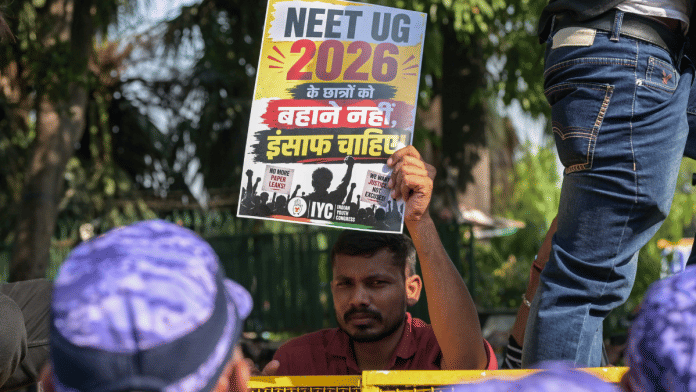

Nothing exposes the catastrophic governance deficit of the Narendra Modi government more brutally than the collapse of India’s examination system. A government obsessed with slogans, PR, media narratives, and photo-ops has failed to protect the integrity of competitive exams.
Ministers busy targeting and “fixing” the Opposition and “managing” elections, are neglecting the duties of governance. Under Modi, central institutions are either weaponised for political ends or left to decay from within. Nowhere is this institutional collapse more visible than in medical entrance examinations. And the price is being paid by lakhs of young people.
I write this column not only as a columnist and parliamentarian but also as the mother of a doctor. My son was part of the very first batch to sit for the National Eligibility cum Entrance Test for undergraduates, NEET-UG, in 2013. At the time, there was genuine hope that one single national medical entrance examination would reduce the trauma of multiple tests and end the exhausting cycle of endless travel, crushing expenses, and anxiety for students and parents. Thirteen years later, that promise lies in ruins. A regime that speaks endlessly of “New India” has failed India’s young.
The human cost is devastating. A leaked paper is not merely an “irregularity”. It means a shattered, traumatised 18-year-old, a harried family, and a destroyed future. The cancellation of the NEET-UG examination this year reportedly pushed at least four young aspirants to die by suicide.
As a mother, I have seen the crushing pressure these examinations impose. Even during the first year of NEET, confusion reigned. Some medical colleges resisted the examination, others accepted, but no one seemed to know which was which. Students travelled endlessly between cities, airports, railway stations and exam centres. Coaching classes, logistical chaos and mounting costs imposed a herculean emotional, physical and financial burden.
And my son was among the fortunate. He had family support and financial stability. Millions do not. Across India, parents mortgage jewellery, sell land and exhaust lifetime savings to finance coaching fees and travel for examinations, which are increasingly corrupted by organised criminal networks. During my son’s NEET journey, I met many parents carrying stories of punishing hardship, all clinging to one hope: a medical seat for their child.
In these circumstances, the cavalier attitude of the Modi government toward medical entrance examinations — both undergraduate and postgraduate — is unforgivable.
NEET-UG paper leaks, postponements, cancellations, litigation and administrative chaos have today become routine. NEET-PG examinations too have repeatedly faced disruption. It’s not an aberration, but a recurring shameful national scandal, a systemic collapse.
Paralysed institutions, collapsed system
The data is damning. India has witnessed 220 documented exam fraud or exam-integrity-breach cases across 21 states and the Centre between 2005 and 2026, affecting an estimated 9 to 10 crore students. Of these, 72 occurred between 2005 and 2014. A staggering 148 have occurred between 2015 and 2026 — the overwhelming majority during the Modi era. Eighty-seven examinations had to be cancelled altogether.
The government’s lack of accountability is impossible to ignore. BJP or NDA governments account for 129 of the 220 documented cases — nearly 59 per cent. Post-2015, the concentration becomes even sharper: 99 of 148 documented cases, or 67 percent of examination leaks, occurred under BJP/NDA governance.
But perhaps the most shocking figure is this: despite 148 documented cases since 2015, there has been exactly one verified conviction. Only one.
The CBI has investigated at least 17 post-2015 examination scam cases. Zero convictions. The Enforcement Directorate has investigated at least 11 such cases. Again, zero convictions.
This exposes the fundamental hypocrisy of the Modi government. India’s premier investigative agencies today function less as institutions of justice and more as political weapons targeted at Modi’s political rivals. Opposition leaders are relentlessly raided, harassed and investigated with great media spectacle. But when it comes to protecting India’s students from organised examination mafias, the Modi government and its oh-so-powerful agencies suddenly become paralysed and incompetent.
In the NEET 2024 paper leak case itself, the alleged mastermind secured bail because the CBI failed to file a chargesheet within the mandatory 90-day period. Ninety days — and the mighty Modi government could not complete basic prosecutorial procedure in one of the country’s biggest education scandals.
The nature of examination fraud has also evolved. Before 2015, traditional (that is physical) paper leaks accounted for roughly 32 percent of documented cases of exam fraud. Today they constitute nearly 70 per cent. WhatsApp and phone cameras have enabled industrial-scale cheating, where one compromised insider in a printing press, transport chain, strong room or examination centre can destroy the futures of lakhs of students overnight. There are at least 15 documented controversies involving NEET, AIPMT, state PMTs, AIIMS PG, FMGE, JIPMER, COMEDK, and other exams.
Yet the Modi government continues to treat every scandal as though it were an isolated mishap. It is not. It is a pattern of sustained administrative failure.
The National Testing Agency (NTA), set up in 2017 by the Modi government, remains alarmingly opaque. Who runs it? Where are the transparent annual reports? Where is accountability? Why does an organisation controlling the futures of millions of young people function with so little public scrutiny? In 2024, I wrote a letter to the Education Minister asking for more details on the NTA. I never received a response.
The newly appointed NTA chief, former IAS officer Abhishek Singh, assumed charge only weeks before the NEET UG 2026 examination. How can any institution stabilise a nationwide examination mechanism with chaotic last-minute appointments? But lessons are never learned because under Modi, accountability simply does not exist.
The Radhakrishnan Committee—set up in 2024 under the chairmanship of former ISRO chief K Radhakrishnan—recommended structural reforms and greater transparency for the NTA. Yet implementation remains patchy and cosmetic. Under the Modi government, committees exist primarily to deflect outrage until the next scandal erupts. Because when winning elections becomes an obsession, governance is not a priority.
Also read: NEET paper leak came from a hole that wasn’t plugged in 2024. NTA is ignoring its problems
Elections over governance
India has only a part-time Education Minister in Dharmendra Pradhan. Placed in charge of elections in Haryana, Bihar, and even active in West Bengal, Pradhan is perpetually occupied with electioneering and party management. Political campaigning seems to consume more of his energy than repairing the educational infrastructure. The absence of a full-time education minister is a terrible disservice to the young.
This obsession with electioneering at the cost of governance is the defining syndrome of the Modi government.
Home Minister Amit Shah’s political energies have long been consumed by a driving need for electoral conquest and vendetta politics. Even as massive national security lapses occur, Shah remains in perpetual campaign mode.
The Pahalgam terror attack of 2025 revealed terrifying gaps in national security. No accountability has been fixed. The Red Fort bomb blasts in Delhi later in the same year showed that no attention had been given to strengthening national security systems. Shah campaigned relentlessly in the West Bengal assembly polls, constantly stoking fears that “ghuspetiyas” or migrants were crossing over from Bangladesh. Shah almost seemed to forget that as Union Home Minister, border security falls directly under his own watch.
Prime Minister Modi continues to host “Pariksha Pe Charcha” events even though his own ability to take a pariksha (exam) or earn a university degree is shrouded in doubt. Modi has even authored a book, Exam Warriors. But which particular exam has Modi cracked or excelled in? The public doesn’t know. Modi dispenses study tips through “Mann Ki Baat.” He speaks constantly of ‘Start-Up India’ and ‘Stand Up India.’ But what has the Prime Minister done to fix the examination system on which millions of young people depend? Can slogans secure examination papers? No, they can’t. Carefully choreographed photo-ops cannot compensate for a Prime Minister presiding over a governance collapse.
The tragedy is that even after enduring two deadly waves of Covid that exposed the fragility of India’s healthcare system, the Modi government has failed to prioritise healthcare or strengthen medical education. As early as the 1960s, the Kothari Commission had recommended 6 per cent of GDP to be allocated to education, but India’s public spending on education is stuck at 2.5 per cent of the Union Budget, and health at 2 per cent.
For much of the past two years, the Health Minister JP Nadda was preoccupied with party responsibilities as BJP party president. The Education Minister remains immersed in organisational politics. The Home Minister is busy “fixing” political rivals. Under the glittering PR and one-sided media trumpeting, the all-round administrative failure of the Modi government is sadly normalised.
Universities face increasing political interference. Vice-chancellors are appointed for ideological loyalty rather than academic merit. Independent educational institutions are being steadily weakened while centralised political control expands. The new Viksit Bharat Shiksha Adhiniyam Bill 2025, now being studied in a Joint Parliamentary Committee, centralises near-total control of higher education in the hands of the central government, abolishing funding and standard-setting agencies like the University Grants Commission (UGC). The over-centralising Modi government has failed to create the conditions for excellence in any field precisely because all it wants is control, control and more control.
Nothing captures the governance deficit of the Modi years more completely than the collapse of India’s examination system. India’s students deserve better than this permanent anxiety and chaos. Worried parents deserve better than watching their children’s dreams destroyed by a government too distracted by electioneering. The Modi government is a government of PR and slogans and nothing more.
In the era of slogans, here’s a new slogan. Modi Sarkar: not so NEET.
Sagarika Ghose is a Rajya Sabha MP, All India Trinamool Congress. She tweets @sagarikaghose. Views are personal.
(Edited by Ratan Priya)
How difficult is it to assemble an impeccable examination system. Some years ago, there was the outstanding mandarin, Shri Anil Swarup, who contributed a lot to the education sector. There must be others who can be tasked to do this.