






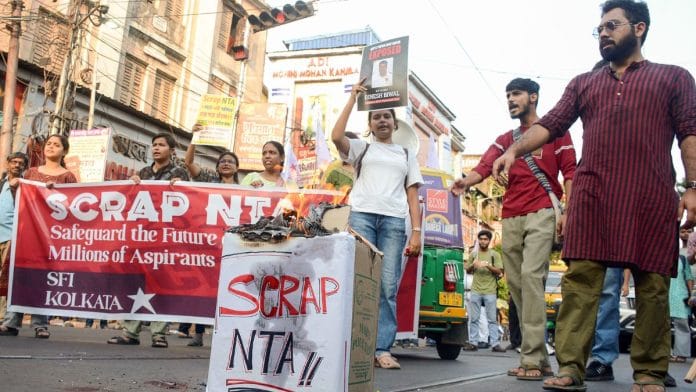


When NEET-UG 2024 collapsed—67 students securing the top rank, a paper leak racket unearthed in Bihar on the morning of the exam, the UGC-NET cancelled the day after it was held—the government did what governments do. It sacked the director general. It constituted a high-level committee. It passed a new law. It made promises.
The Radhakrishnan Committee submitted its report recommending structural reforms in the NTA. Parliament enacted the Public Examinations (Prevention of Unfair Means) Act, with jail terms of up to ten years for organised malpractice. The National testing Agency got new security protocols, GPS-tracked vehicles for question paper transport, AI-assisted CCTV, 5G jammers at exam centres, and biometric verification of candidates. But the paper wasn’t cancelled.
Two years later, on 3 May, NEET-UG 2026 was held. All the measures above were in place. After nine days, it was cancelled.
A document containing 410 questions had been circulating on WhatsApp—some students received it 42 hours before the exam, others had it a month in advance. Around 120 questions allegedly matched the actual chemistry and biology paper. The Rajasthan Special Operations Group (SOG) interrogated 13 suspects from Dehradun, Sikar, and Jhunjhunu. Copies of the paper were allegedly being sold for anywhere between Rs 20,000 and Rs 5 lakh.
NTA handed the case over to the CBI. The NTA’s director general—who had been appointed just days before the exam—deleted a LinkedIn post he had written praising the scale and transparency of the examination process.
Over twenty-two lakh students are now waiting for a fresh date to be announced.
That’s why the National Testing Agency is ThePrint’s Newsmaker of the Week.
Also read: ThePrint Exclusive: CBI traces NEET paper leak to prof who was part of NTA panel that set paper
An ignored pattern
The NTA was set up in 2017 precisely because India’s examination system was broken. State-level entrance tests had become synonymous with paper leaks and impersonation. The promise of the NTA was centralisation, professionalisation, and technology. One agency, one standard, accountable to the Ministry of Education.
Instead, the NTA became a coordinator of contractors. It outsources question paper printing, physical distribution, exam centre management, biometric verification, and result processing. Each function was performed by a different private vendor, with no single entity holding end-to-end accountability. When something goes wrong, and it has gone wrong repeatedly, the chain of outsourcing means responsibility dissolves before it can be fixed.
A parliamentary standing committee report from December 2025 found that out of 14 major examinations the NTA conducted in 2024, at least five had serious problems—paper leaks, question errors, postponed results. That is not a testing agency having a bad year. That is a testing agency with a structural problem it has not been asked to genuinely solve.
The Radhakrishnan Committee saw this clearly and said so. Build in-house capacity. Reduce vendor dependence. Create state-level coordination structures. Treat exam centres like polling booths. Elementary recommendations. Largely unimplemented.
The NTA has had three different directors in under two years. Institutions do not build security cultures or institutional memory under those conditions. The director who deleted his LinkedIn post on 12 May was handed a broken machine with no time to understand it.
Also read: Sikar’s NEET performance has been consistently well. Even when there were no ‘paper leaks’
What Rs 5 lakh buys you
The economics of the cheating ecosystem are worth understanding. They explain why a law with ten-year jail terms has not worked. A guess paper sold at Rs 5 lakh per copy, even at a fraction of that, generates enough money to absorb legal risk—especially when conviction rates under the new Act are estimated at only 5 to 10 per cent.
The examination mafia, as investigators now routinely call it, is not a loose collection of opportunists. It is an organised racket with links to coaching centres, paper setters, and distribution networks spanning multiple states. Rajasthan, Jharkhand, Bihar, Gujarat—the geography of every NTA scandal is the same because the same networks operate across all of them.
The 2026 leak did not come from nowhere. It came from a system that had not meaningfully dismantled the conditions that made 2024 possible.
Underneath every discussion of institutional failure and structural reform is a 17-year-old who spent two years of their life preparing for three hours in an exam hall.
NEET is the only gateway to every medical college in India. Students do not have an alternative route or a fallback window. Families take loans. Children leave home at fifteen to live in hostels in Kota. When the exam is cancelled once the papers have already been attempted it is a betrayal of the most basic contract between the state and its young people.
The students who paid Rs 5 lakh for a leaked paper and the students who paid Rs 5 lakh for legitimate coaching did not sit the same exam. That is the real scandal.
The CBI will investigate. Arrests will follow. Another committee may be constituted. The NTA will issue statements about its commitment to integrity. And twenty-two lakh students will wait—for a date, for an exam, for a system that finally means what it says.
Views are personal.
(Edited by Theres Sudeep)