




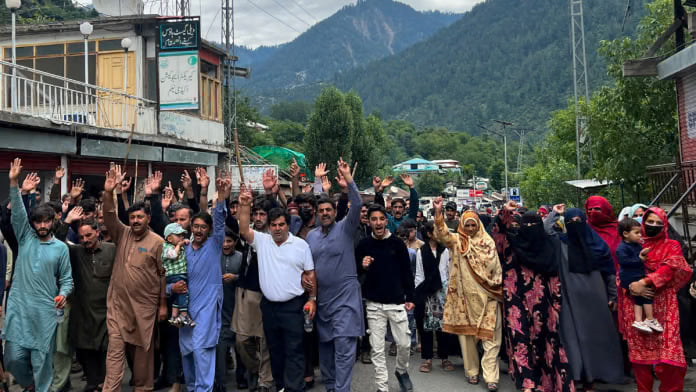

Once again, Pakistan observed 27 October as Kashmir Black Day this year.
For those who are unaware of the history, Indian troops arrived in Srinagar on 27 October 1947, a day after Maharaja Hari Singh signed the Instrument of Accession to India and requested military assistance. Pakistan remembers this date as a Black Day.
But what about 22 October 1947?
That was the day Pakistan-backed tribal fighters entered Kashmir. What followed was violence, looting and killings, with Baramulla becoming one of the worst-affected places. Men, women and children suffered, and the violence did not spare Muslims either.
According to a commentary published by the European Foundation for South Asian Studies (EFSAS), around 11,000 residents of Baramulla were massacred on 26 October alone that year. That is the organisation’s estimate, and the precise death toll remains difficult to establish. But the brutality of the attack itself is well documented.
It was against this background that Singh sought India’s military assistance. Indian troops arrived on 27 October, stopped the Pakistani military from advancing toward Srinagar and later retook Baramulla.
This should make anyone wonder why 27 October is remembered as the Black Day, while 22 October, when the invasion began, receives so little attention in Pakistan’s annual remembrance.
Pakistan’s double standard on Kashmir
What I find interesting is how Pakistan presents itself as a defender of Kashmiri rights. Every 27 October, we hear about human rights violations, restrictions on freedom and promises of “moral, political and diplomatic support” for Kashmiris.
But what about Pakistan’s own role in the suffering of Kashmiris?
For decades, Pakistan-supported militancy and terrorism have had a horrifying impact on life in Jammu and Kashmir. According to the South Asia Terrorism Portal (SATP), there have been 22,412 terrorism-related incidents in Jammu and Kashmir from 2000 to 24 October 2026.
Pay attention to the number; it’s not 100 or 200 but several thousand.
These incidents have affected ordinary civilians whose lives have been shaped by fear, violence, and uncertainty. Families have lost loved ones, children have grown up surrounded by conflict, and generations have paid a price.
While Pakistan continues to allege ‘human rights violations’ in Kashmir, demanding ‘freedom’ for the local residents, I find myself wondering how those same rights are being respected in the other half of Kashmir illegally controlled by Islamabad.
Look at what has been happening in Pakistan-occupied Kashmir (PoK).
What began as protests over the price of flour and high electricity bills gradually became a larger movement demanding political representation and a greater say in how the region is governed.
These were ordinary people raising questions about their daily lives and their future. The economic exploitation of PoK’s natural resources, particularly through hydropower projects on the Jhelum and Neelum rivers that benefit Punjab province, is the real source of such anger among the people.
But in June 2026, the Pakistani authorities banned the Joint Awami Action Committee under anti-terrorism laws. Protests continued, people were arrested, and internet services were restricted. The unrest also led to deadly clashes.
The authorities accused the protesters of threatening public order. But human rights organisations, including Amnesty International, questioned the use of anti-terrorism laws against protesters and the restrictions on their freedom, and reports recorded more than 32 civilian deaths, internet shutdowns, and mass arrests.
What particularly caught my attention was what schoolteacher Tariq Rehman from Kotli told The Diplomat about the elections. He described them as a sham and questioned whether ordinary Kashmiris had any real say when, in his view, the Pakistan Army controlled the political process. That is a serious accusation coming from someone living in the region itself.
Also read: Maldives and Pakistan have set ambitious targets that raise questions
PoK’s freedom question
If Pakistan believes Kashmiris should have the freedom to decide their own future, shouldn’t that freedom begin in PoK?
Shouldn’t they be free to protest, question their government, access the internet and choose their representatives without fear?
It is difficult to speak about the political freedom of Kashmiris across the border while struggling to protect those same freedoms at home.
And this raises another question about how much freedom Kashmiris in PoK actually have to decide their political future.
Go back to 28 April 1949, when the Karachi Agreement was signed between representatives of Pakistan, the PoK government and the All Jammu and Kashmir Muslim Conference.
Under that agreement, Pakistan assumed authority over the region’s defence, foreign relations, and United Nations negotiations, leaving the local regional administration to manage day-to-day domestic governance.
But the devil lies in the detail. Interestingly, the region’s own constitution has provisions on political choice. Under Section 7(2) of the so-called Azad Jammu and Kashmir Interim Constitution Act of 1974, individuals and political parties cannot promote activities against the region’s accession to Pakistan.
Just think about this joke for a moment.
Pakistan has spent decades demanding that Indian Kashmiris be given the right to decide their own future. Yet in PoK, openly campaigning for a future outside Pakistan faces constitutional restrictions.
The greatest contradiction in Pakistan’s Kashmir policy is that it demands freedom for Kashmiris on one side of the Line of Control while placing restrictions on political choices on the other.
For decades, Pakistan has tried to present itself as the advocate of Kashmiris. But the people of PoK have their own voices, their own concerns and their own ideas about the future. They should not need Islamabad’s permission to express them.
The same questions about political rights and representation deserve attention in Gilgit-Baltistan too.
It’s about time that Pakistan asked itself a simple question: is it really defending the ‘freedom’ of Kashmiris, or only the ‘freedom’ of Kashmiris to agree with Pakistan?
Amana Begam Ansari is a columnist, writer, and TV news panellist. She runs a weekly YouTube show called ‘India This Week by Amana and Khalid’. She tweets @Amana_Ansari. Views are personal.
(Edited by Saptak Datta)