




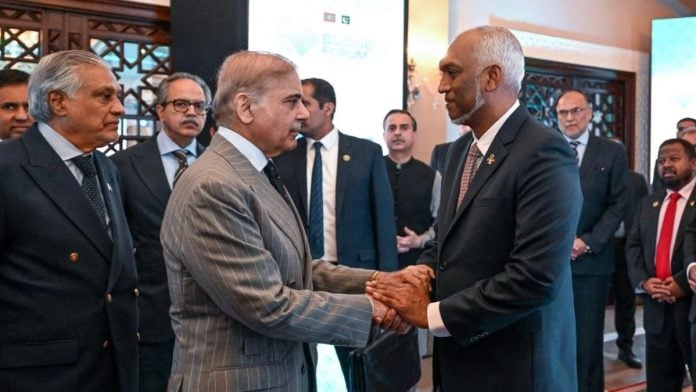

Last week, South Asia saw an important diplomatic event: a visit by the Maldives to Pakistan. Maldivian President Mohamed Muizzu travelled to Islamabad for three days, from 20-22 October, for his first state visit to Pakistan since taking office in 2023. Muizzu’s three-day itinerary in Islamabad included high-level meetings with Prime Minister Shehbaz Sharif, President Asif Ali Zardari, and Army Chief Field Marshal Asim Munir, as well as an address at the Maldives-Pakistan Business Forum.
More interestingly, Muizzu became the first president to break an 11-year hiatus in such high-level visits. President Abdulla Yameen — the 2nd democratically elected president of the Maldives — visited Pakistan in 2015. In their six decades of formal diplomatic ties, the bilateral partnership has remained inconsequential in many ways, and for an island country like the Maldives, it has not moved beyond religious and educational ties.
This visit seems prompted by Islamabad’s insistence on expanding its diplomatic outreach to countries where some level of political discomfort toward New Delhi is visible. Throughout his 2023 presidential campaign, Muizzu ran a strong ‘India-out’ campaign in the Maldives, heightening tensions between Delhi and Male. After becoming President, Muizzu also avoided India for his first state visit and went to China, signalling a symbolic diplomatic distance from Delhi.
For South Asia watchers in Delhi, Muizzu’s visit to Pakistan — a key country harbouring terrorism against India — certainly raises questions, particularly from a security angle. Undoubtedly, Islamabad remains accused of exporting radical ideology and has a proven record of using territories in other countries to fuel instability in India; therefore, such a diplomatic event warrants Delhi’s diligence.
However, beyond the India angle, Muizzu’s visit to Islamabad should be assessed for its bilateral value.
Ambitious economic agenda
Reaching a target of US$ 200 million in bilateral trade over the next two years could be the most important highlight of Muizzu’s visit to Islamabad. Currently, the bilateral trade between the two stands in the early double digits at US$ 13 million, with goods traded — dried fruits, packaged medicaments, processed food, wood fiberboard, scrap iron — and the signed MoUs reemphasising the trading of “agricultural commodities, food and other commodities.”
With a limited trade basket and limited capacity for expansion on both sides, one wonders what could be traded to reach the US$ 200 mark in bilateral trade, and that too from US$ 13 million — almost 19 times the current trade. Back to the question again, what will be traded? Could high-volume currency products be defence exports from Pakistan to the Maldives?
Of the 20 MoUs signed during the visit, two were in the defence and security sector. MoU 06 was “Defence Cooperation between Maldives and Pakistan”, and another was on “Maritime Security Cooperation”, but neither provides further details. Defence exports from Pakistan could still be considered a high-volume trade good, but does the Maldives really need an upgrade? The other sector could be medical, but questions about Islamabad’s capacity to produce remain.
The US$ 200 million trade target over the next two years seems more symbolic than practical, and even if it were possible, one could still doubt Pakistan’s capability.
The contrast in cooperation
Other areas of cooperation between the Maldives and Pakistan, as per the signed MoUs, include technology, combating trafficking and the abuse of narcotics and drugs, the health sector, technical and vocational education, and environment. While everything else has limited scope given Pakistan’s capabilities in areas like technology, health could be a key area for expanded cooperation. With only one key hospital in the Maldives built with India’s assistance, many people travel to India for specialist treatment.
While India remains a reliable and trusted healthcare partner, a small number also travel to Pakistan for medical services. Can health-sector cooperation expand, and can Pakistan provide world-class facilities? Doubts remain. Meanwhile, education may still appeal, but in Pakistan, it carries heavy implications, especially the religious one.
A 2013 report by the Counterterrorism Center at West Point points to the “foreign madrasas” as “core means of radicalising Maldivians locally.” The report cites former President Maumoon Abdul Gayoom saying that “Maldivians are influenced by what is happening in the world. They go to Pakistan, study in madrasas and come back with extreme religious ideas.”
While the Maldives has largely been peaceful, it has seen episodes of rising radicalisation and a strong presence of terrorist organisations like the Islamic State of Iraq and Syria (ISIS) has been found in the country. A 2019 United States Department of State report adds that between 2015 and 2019, “the government claims that 188 cases related to ‘religious extremism’ were reported. Of these, 14 were brought forward for prosecution.”
Finally, in 2015, the Maldives passed its Anti-Terrorism Act.
It remains to be seen what holds in the medical and education sectors for the Maldives and Pakistan, but it remains beyond doubt that Pakistan will make no efforts to export radical ideologies and will try to harbour propaganda against India.
Invoking SAARC yet again
During his visit to Pakistan, President Muizzu emphasised the South Asian Association for Regional Cooperation (SAARC). In his joint press conference with PM Sharif, Muizzu added that Maldives “firmly believes in the value of SAARC…firmly committed to playing a constructive and proactive role in revitalising SAARC.”
He further said, “Maldives stands ready to work closely with all SAARC Member States towards creating the necessary conditions for convening the next SAARC Summit at the earliest possible opportunity.”
Earlier this year, in his Independence Day address to the nation, Muizzu offered to be a “mediator” between SAARC members to address the “current impasse”, without naming India or Pakistan.
Interestingly, Pakistan is supposed to host the next SAARC Summit (if that ever happens), and Islamabad finds it easy to point at Delhi for the delay. For Muizzu to advocate for SAARC from Pakistani soil comes loaded with pointed fingers — something that Muizzu’s foreign policy advisors may want him to be subtle about to maintain regional balance.
While terrorism was a complete miss at the joint press conference, the real culprit in SAARC’s failure, the discussion about reviving the organisation was no less than a political deal that Malé and Islamabad tried to strike on regional issues.
Also read: ‘Revolutionary’ Latin America is going right-wing. It’s not as ideological as it seems
Criticism at home of Muizzu’s Pak visit
President Muizzu’s visit to Pakistan did not go unnoticed and drew some interesting criticism from locals. One notable source of criticism reportedly came from Maldivians living in Pakistan, who “expressed their frustration after a scheduled meeting with President Mohamed Muizzu was cancelled at the last minute.”
Even more interesting, Maldivians in Pakistan reportedly “voiced their indignation over the fact that First Lady Sajidha Mohamed found time for an exclusive interview with a Pakistani fashion and lifestyle magazine, yet the President could not find the time to meet his own citizens.”
In addition, back in the Maldives, former President Yameen, once a strong proponent of the Maldives’ ties with Pakistan, criticised Pakistan for awarding Muizzu an honorary doctorate.
Yameen said, “I am deeply saddened by this. I am lodging my protest. Looking at Pakistan’s reasoning regarding socio-economics, I fail to understand how they recognised Muizzu with an honorary doctorate. Do they even research what is happening in the Maldives?”
While Yameen’s criticism of Pakistan’s honorary doctoral degree for Muizzu largely targeted the President, it also underscored the deepening political divide between the two leaders and the growing fissures within the Maldives’ leadership that have strongly contributed to the ‘India-out’ campaign.
At the same time, former President Mohamed Nasheed, the first democratically elected President, criticised Muizzu’s visit to Pakistan. Accusing him of “recklessly” conducting the Maldives’ foreign policy, Nasheed added, “While the risks faced by small nations, especially the Maldives, are significant, President Muizzu visited Pakistan without due consideration, once again bringing the Maldives into the middle of the disputes between India and Pakistan.”
To conclude, under President Muizzu, Maldivian foreign policy has tried to drift away from India and has made no bones about raising issues with New Delhi. At the same time, foreign policy has seen a strong imprint of religious ideologies and hence, strong ties with Türkiye and now with Pakistan are sought. While this may signal politically and benefit some leaders, it risks the country’s future; as an Island country the size of the Maldives, it needs reliable partners who can deliver.
Rishi Gupta is a commentator on global strategic affairs. The opinions expressed in this article are those of the author alone and do not reflect the views of the author’s current or past affiliations in any form.
(Edited by Aamaan Alam Khan)