





A political change has been underway in revolutionary Latin America, which long commanded admiration from quarters outside the continent. Che Guevara’s face travelled much farther than the revolution to university walls, T-shirts, cinema, theatre and political art. Fidel Castro’s fatigues, Salvador Allende’s final radio address from La Moneda, the Sandinistas of Nicaragua, Pablo Neruda’s eternal melancholia, Octavio Paz’s poetic beguilement and Victor Jara’s songs became part of something larger than Latin American politics. For generations, Latin America acquired a romantic connection with revolution — with peasants and guerrillas, anti-imperialism, resistance to oligarchies and the promise of a more equal society.
The romance outlived its revolutions as ground realities changed. One look at Latin America’s political map shows how the imagery now appears almost inverted.
Javier Milei governs Argentina. Jose Antonio Kast has taken Chile to the right. The Movement Toward Socialism has lost power in Bolivia. The right has returned in Colombia and Peru. Now, the ongoing elections in Brazil— the largest country, economy and electorate in Latin America—could deepen the hues of the blue tide engulfing the continent.
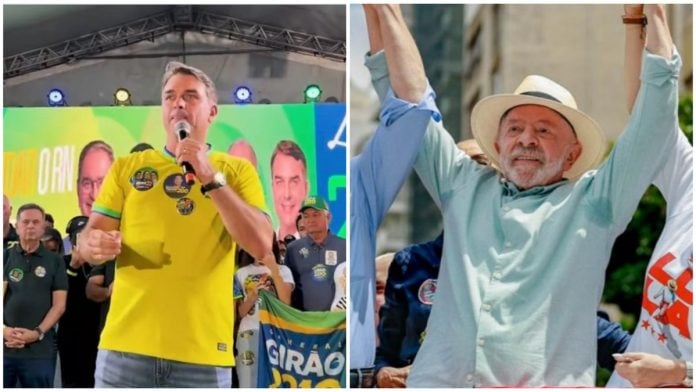
In the first round of Brazil’s presidential election on 4 October, Flavio Bolsonaro, eldest son of former President Jair Bolsonaro, secured 47.03 per cent (56,104,268 votes). President Luiz Inacio Lula da Silva received 45.16 per cent (53,876,617 votes). Neither crossed the majority required to win in the first round, and Brazil will vote again on 25 October.
What is surprising is that the final pre-election surveys had generally placed Lula slightly ahead. On 3 October, Reuters reported a series of polls showing Lula narrowly leading Flavio before the vote. The official result reversed that order.
If one borrows from the old discourse, Latin America’s revolutionaries appear to be giving way to the counter-revolutionaries. However, sweeping generalisations don’t do justice to the political, economic and social complexity of its vast lands.
The pink and blue maps through which Latin America is so often understood have unwittingly become instruments of international political romanticism. They make ideological movements appear far more coherent than they are and elections far more ideological than they often turn out to be.
That is not to deny that Latin America is moving to the right. Whether Brazil joins that trend will be decided on 25 October. For now, a nuanced understanding of the region’s plights and mights, including decades of unfulfilled socialist promises that withered into narco-states and hollowed-out autocracies, should help onlookers re-learn an important lesson — the agency of its people.
Also Read: Brazil shows women’s votes can’t be taken for granted after cash transfers
Brazil has not turned blue — yet
Brazil elects its president through a two-round majoritarian system. If no candidate receives more than half of the valid votes in the first round, the two leading candidates contest a runoff. Blank and null ballots are excluded from the valid-vote calculation.
It is important to note that the first-round numbers cannot simply be projected onto 25 October. In the first round, Brazil recorded more than 33 million abstentions, while millions of voters backed candidates eliminated after the first round. Analysts have pointed to abstention and late ‘useful vote’ migration toward Flavio as important reasons he outperformed the final polls.
The first major post-first-round Datafolha survey, released on 8 October, shows that Flávio has retained his momentum. He leads Lula by 49 to 45 per cent among all voters. Among valid votes, that becomes 52 to 48 per cent. This marks a shift from the final runoff polling before the first round, when Lula had been slightly ahead. It also reinforces the surprise produced by the 4 October result itself, when the pre-election surveys underestimated Flávio’s performance. Furthermore, Augusto Cury, who finished third, has endorsed Flávio Bolsonaro, adding to the broader consolidation of conservative support around him.
What can be said already is that Brazil’s right did substantially better than expected — and not only in the presidential contest. There are two main factors to watch out for in this regard.
First, the more important Bolsonaro result may be in Congress. The right-wing Liberal Party emerged from the congressional election with the largest representation in both chambers. Reuters reported that it increased its Senate strength from 15 to 28 seats and was projected to hold 121 seats in the 513-member Chamber of Deputies, up from 98.
That is not an outright parliamentary majority. Brazil is a presidential rather than a parliamentary system, so there is no coalition government in the Indian or European sense. The president and Congress derive separate mandates.
The political reality, however, is that Brazilian presidents generally need broad multiparty alliances in Congress to legislate and govern. The strengthened right therefore matters regardless of which candidate wins the presidency. Lula’s victory would still leave him facing a more assertive right-leaning legislature. But Flavio’s victory would combine the presidency with a substantially strengthened Liberal Party and a wider conservative congressional bloc.
So even before 25 October, Brazil is already becoming politically bluer in one important sense.

Second, Bolsonarismo without Bolsonaro Sr. There is another reason the first-round result deserves attention. Jair Bolsonaro himself was not contesting. Yet the political formation built around him has proved capable of surviving his removal from electoral politics.
Political scientist Lucio Renno, in the 2026 Cambridge volume The Far Right in Latin America, treats Bolsonarismo not simply as personal devotion to one charismatic politician but as a far-right formation with durable electoral strength. The 2026 election makes that distinction especially relevant for understanding its ground politics.
Evangelical networks, social conservatives, sections of agribusiness, hard-line security voters, anti-Workers’ Party sentiment and a powerful digital mobilisation infrastructure have created a constituency that can easily switch from the father Bolsonaro to the son Bolsonaro, and perhaps even further.
Whether Flavio wins or loses on 25 October, Bolsonarismo has already shown that it can regenerate itself beyond Jair Bolsonaro.
Fleeting colours of a continent
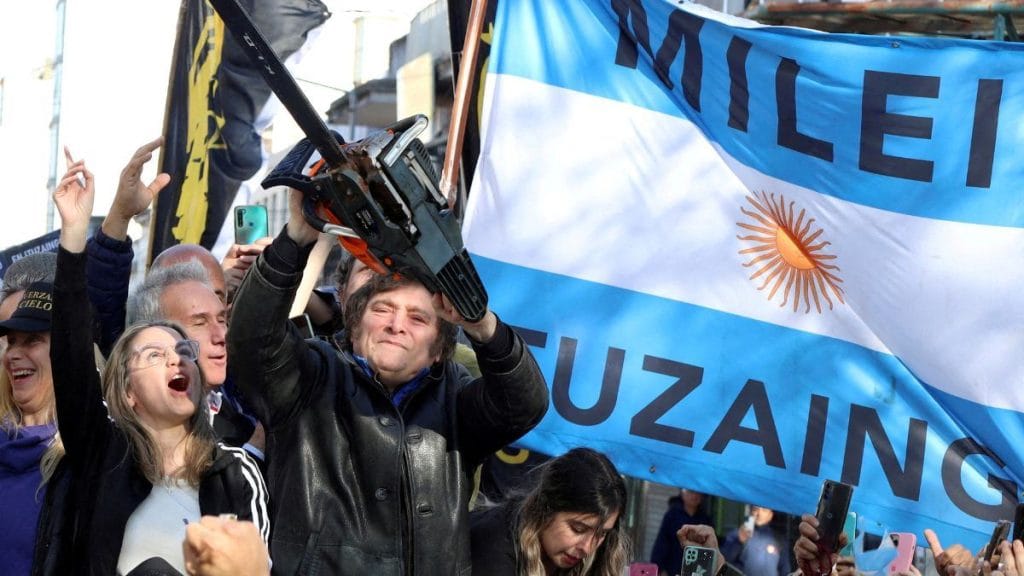
Brazil is hardly an isolated case. Argentina elected Javier Milei in 2023. Ecuador saw Daniel Noboa return in 2025. Rodrigo Paz ended nearly two decades of MAS rule in Bolivia. Jose Antonio Kast won Chile’s presidency with 58 per cent of the vote in the 2025 runoff. In 2026, Abelardo De La Espriella won Colombia’s presidential election, while Peru moved to the right under Keiko Fujimori. In short, Colombia and Peru have been described as part of a broader rightward shift that also includes Argentina, Chile, Ecuador, Bolivia and Panama.
But even this chronology shows why a definitive colour code is insufficient. Bolivia’s Rodrigo Paz is a centrist who defeated a more conservative rival and campaigned on gradual reform while retaining social programmes. Kast’s Chilean conservatism, Milei’s libertarian economics, Noboa’s security-centred technocratic politics and Bolsonarismo are neither identical nor interchangeable.
Calling all of them ‘the right’ is not obviously wrong, but it is insufficient. Pink, therefore, was never one colour for Latin America’s changing politics either.
Lula’s leftist Brazil remains deeply integrated into international markets and private capital. Uruguay’s Yamandu Orsi, elected from the centre-left Broad Front, described his project as a ‘modern left’ and campaigned on growth while ruling out tax increases that could unsettle investors.
Mexico is an even clearer example. Claudia Sheinbaum governs through the Morena party and combines redistribution, public investment and a stronger role for the state in strategic sectors with an economy profoundly integrated into North American manufacturing and trade. The contemporary Latin American left often represents a hybrid political economy: welfare and strategic state intervention operating alongside markets, private enterprise, foreign investment and trade agreements.
‘Pink tide’ therefore conceals almost as much as ‘blue tide’. The colours are useful for electoral mapping but less useful for understanding governments and their functioning.
What is pushing voters right?
If Latin American voters have not suddenly undergone a mass ideological change, something else must explain this electoral chronology.
Start with crime. Organised criminal networks have transformed politics across the continent. Drug routes, cartels and transnational gangs have expanded, while extortion, kidnapping and homicide have penetrated societies that once thought themselves relatively insulated. Ecuador offers perhaps the starkest example. In Chile and Colombia too, security and public order became defining electoral issues.
Then comes the economy. Latin America’s contemporary problem is not uniform hyperinflation or mass impoverishment. It is something slower and politically corrosive: plateaued growth, weak productivity, huge informal and black economies, inadequate investment and insufficient creation of secure employment. A government can improve macroeconomic statistics on paper while households continue to feel that life has become harder.
And underneath crime and economic frustration lies perhaps the most consequential regional phenomenon of all: anti-incumbency.
Political scientists Juan Pablo Luna and Cristobal Rovira Kaltwasser have warned against reading Latin American electoral cycles as straightforward ideological realignments. Their work on the region’s earlier ‘right turn’ stresses that alternation and incumbent punishment can look like ideological transformation when the underlying process is more contingent.
That observation is quite useful. Voters can move left when inequality, exclusion and elite privilege dominate politics. The same electorate can eject that left when growth stagnates, crime rises or governments appear exhausted, and elect the right. And if the right fails to provide security, employment and economic mobility, it can be removed in turn — at least in countries where elections remain free and fair. In cases such as Venezuela, where rigging elections became the new normal under the now-ousted Nicolas Maduro, more variables enter the left vs right conversation.
It suffices to say that today’s resurgence of the blue tide is real without necessarily being permanent.
Also Read: Ukraine’s robotic army is already at work. India must rethink the next battlefield
India should look beyond the colours
For New Delhi there is another reason to pay attention. Latin America has traditionally occupied remarkably little space in India’s strategic imagination, even as commerce has begun to outrun diplomatic engagement. India’s total trade with Latin America and the Caribbean reached $39.19 billion in 2024-25, with $15.17 billion in exports and $24.02 billion in imports.
Brazil is India’s largest trading partner in the region. According to the Indian Embassy in Brasilia, bilateral trade rose by more than 25 per cent to $15.21 billion in 2025 and reached $8.774 billion in the first six months of 2026, almost 37 per cent higher than the corresponding period a year earlier.
The engagement is also widening. In September 2026, India and the Mercosur bloc formally launched negotiations to expand their Preferential Trade Agreement. India is also advancing trade negotiations with Chile and Peru, including discussions covering critical minerals.
Venezuela has made a stunning return to India’s energy security after remaining cut off due to US sanctions in the Maduro years. Reuters reported that Venezuelan oil shipments to India were running at about 253,000 barrels per day in September 2026 with potential to rise further.
Then there is the geopolitics of resources. Latin America holds major reserves of lithium and copper, vast agricultural capacity and important supplies of oil, iron ore and other commodities central to India’s search for diversified supply chains and energy security.
India has engaged Brazil through BRICS for years. But the opportunity now extends much further — from Mercosur to Chile, Peru, Mexico and the region’s Pacific-facing economies.
Perhaps the most overlooked aspect of the India-Latin America conversation is shipping connectivity corridors. Shipping routes from Argentina, almost in a straight line, can bypass the Strait of Hormuz, the Red Sea and the Malacca Strait all at once, as all sides look to build complementarity, redundancy and resilience in trade.
For generations, outsiders romanticised the continent as the land of Che, Castro, Allende, Neruda and revolution. Look closer, and neat ideological colours dissolve into crime and class, religion and inflation, migration and unemployment, institutional distrust and political memory, charismatic leaders and impatient voters. All these dynamics, however, are unifying its people to reassert their agency for a better life.
Swasti Rao is a Consulting Editor (International and Strategic Affairs) at ThePrint. She tweets @swasrao. Views are personal.
(Edited by Asavari Singh)