



A Russian soldier approaches an opposing bunker across grey ash with his gun raised, unaware that the men inside are watching him. They hold their fire. A tracked metal sphere races towards him, its claws spinning. He shoots it; another appears, and then a third and so on. Later, Major Hendricks, an American officer, takes pity on David, a boy he finds in the wasteland. David follows him with a dirty teddy bear. Soviet soldiers fire at the boy, and just as Hendricks thinks they have killed a child, a metal wheel rolls from his small body — the boy was a humanoid.
This was from Philip K Dick’s science fiction novelette Second Variety. Written in 1953, it opened on a ruined battlefield from a prolonged war between the US and the Soviets.
Dick’s story became Screamers, a 1995 English-language Canadian film, followed by the 2009 sequel Screamers: The Hunting. On its war-torn planet, machines made to kill enemy soldiers changed form and exploited human habits of recognition and sympathy.
I came upon the story while researching automation and the human factor in warfare. It quickly made to my reading list that I have been compiling on Russia’s war against Ukraine. Now in its fifth year, the war has officially entered a phase where machines, automation, and the human factor have seen a never-before convergence, with open–ended questions on just how far a story once considered sci-fi could evolve.
After the army of drones
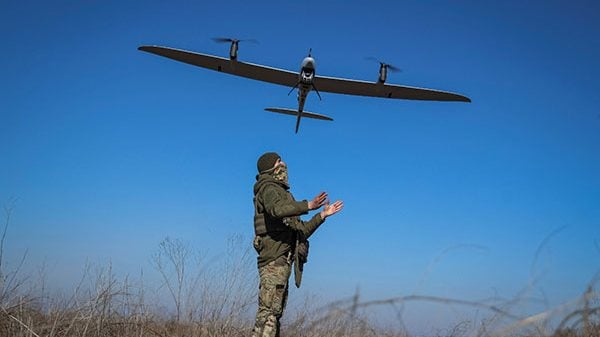
On 26 September, Ukraine’s former defence minister Mykhailo Fedorov announced an “Army of Robots”, the successor to the Army of Drones he helped launch in 2022. While this is not a newly raised military formation, it is a reinforced push for automation. Working from the private sector, Fedorov proposes a venture fund, new defence-tech companies, and an R&D arm to do what Ukrainians have been doing already: identify a problem with soldiers, back a team, test its machine at the battle-front, scale what survives, and adapt as the adversary catches up. Applications are open to engineers and firms, and he is currently recruiting a technical lead.
Beyond ground robotics, his wider technology plan includes sensors, cheaper missiles against jet-powered Shahed drones, and AI-enabled strike weapons.
The immediate question to ask is — what changes with Fedorov’s announcement since Ukraine has already deployed ground robots?
The immediate step is a quantitative leap: making bigger and faster deliveries, evacuation, clearing and laying mines, and armed support across more formations. But the broader story will be of a qualitative leap — enabling moving from ground vehicles currently serving the infantry to robots taking the most dangerous part of an assault before infantry arrives. Fedorov wants a humanoid-like robot to produce a battlefield result within six months and a robotic assault group without an accompanying infantry within a year. While these are promises, considering the operational details of the ongoing Operation Vivaldi, where air-dropped (by drones) ground robots with guns and grenades assaulted Russia’s defense rears, as the infantry barged in from the front — an army of robots is already taking shape.
The numbers are impressive. Ukraine’s defence ministry counted over 1,00,000 ground-robot logistics and evacuation missions from January to August 2026, and contracts for over 22,000 ground unmanned vehicles. Many of those are tracked carriers transporting water, ammunition, and wounded soldiers along roads watched by drones. Fedrov’s announcement seeks to turn that hard-won practice into a repeatable production-and-learning cycle, and then press beyond it.
Four seasons near Lyman
Operation Vivaldi offers a glimpse of how such an ambition plays out. North and northwest of Lyman in Donetsk, the Third Army Corps fought in the drone-saturated belt around the contact line, where movement can be seen and struck — aka ‘the kill zone’. Its width varies: Reuters described stretches about 30 km across; other frontline accounts put drone danger as deep as 50 km on one side in some sectors. Vivaldi challenged that lethal geography by attacking Russian eyes, operators, fuel and supply routes while protecting a low-on-human-resources Ukrainian movement with counter-drone fire, electronic warfare, and redundant communications.
In the first ‘season’, Brigadier General Andrii Biletskyi said his corps cleared infiltrators from 75 square km and deoccupied another 10, including the area around Serednie and the villages northwest of Lyman. Deception and an information blackout helped conceal the advance from Russian radars and jammers. Ukrainian mid-range strikes isolated the Russian salient, reportedly first within 50 km and then as far as 120 km behind the front. For now it was the combination — reconnaissance, interdiction, engineers, machines, and infantry — that made space for an attack, rather than a robot assault group winning territory on its own.
The second season took Shandryholove and Derylove and secured Drobysheve, according to Ukrainian sources. Its NC-13 unit had heavy aerial Baba Yaga drones drop explosive ground vehicles as far as 10 km behind Russian lines; these threatened command points and routes and reportedly caused Russian troops to fall into sabotage. Other robots supplied troops, cleared routes, and evacuated casualties. The corps credits robotic vehicles with over 15,700 missions and 3,300 tonnes of cargo; it says its electronic warfare disrupted over 20,000 hostile drone missions in the first phase. Remember that these figures are presented by the Ukrainian side.
In the third season, a feint drew reserves toward Shandryholove and Zelena Dolyna while the main effort took Nove and its heights. The corps says it liberated Nove, Ridkodub, and Katerynivka, restored control over Karpivka and Novomykhailivka, and brought another 51 square km back under Ukrainian control. Ukraine used Converted BTR-60s to drive as explosive robots against fortifications and its infantry entered later. By now, a cumulative 176 square km has been cleared and liberated.
Biletskyi has not confirmed whether reaching the Chornyi Zherebets river is the goal in Vivaldi’s fourth season.
Ukraine’s drone chief, Robert ‘Madyar’ Brovdi, has separately called for his Unmanned Systems Forces to work closely with Biletskyi’s formation, shortening the path from sensor to shooter. Ukrainian personnel told The Wall Street Journal that Russia had offered $20 million for information on Brovdi’s whereabouts. All these details point to one direction —Vivaldi is unlike an operation done before and its successes have created an adaptation challenge for Russia.
The war is still replete with tactical surprises and automation-innovation where the side with better situational awareness and faster feedback loop can perform better on the battlefield’s kill zone.
DELTA: the less visible nerve
Such coordination has not appeared overnight. Plagued by a crunch of human resources, Ukraine has spent years fusing drone feeds, sensors, electronic warfare, target assignment and battlefield reports into decision-making across different echelons. DELTA is the digital ecosystem that helps this work travel seamlessly across its drone units, battalions, and brigades. Its four modules require specific attention — Monitor is the shared map; Vezha receives and analyses battlefield video; Target Hub assigns and deconflicts fire missions; and Mission Control plans and records unmanned-system activity. Ukraine’s defence ministry said the ecosystem integrates aerial and ground systems, satellites and radars, and has reduced detection-to-engagement times from hours or days to few minutes.
But DELTA is also a feedback system for robots: it verifies ground-vehicle supply and evacuation missions, while Mission Control turns operators’ reports into dashboards available across command levels. Vezha’s AI-assisted analysis can hasten detection but so far it is the human who still decides whether or not to engage a target. This helps explain how Ukraine can connect sensing, action, feedback, and improvement while the human element remains on the loop.
However, Russia adapts and not all is sorted in Ukraine’s sci-fi universe.
The Rubikon test
Russia’s Rubikon Centre has a mixed, consequential record. In 2025, Rob Lee and Dmytro Putiata had credited its well-resourced aerial-drone teams with helping reverse Ukraine’s Kursk incursion and disrupting supply and drone crews around Pokrovsk and elsewhere. It also has a ground-vehicle test detachment, but so far, its documented combat strength is predominantly in the air. Their assessment also identifies a cost attached with rapid expansion: weaker recruitment standards, strained support and the danger of drawing skilled operators away from regular units.
What Vivaldi has exposed is more of exploiting a local vulnerability and not a strategic breakthrough. Ukraine’s Third Corps says strikes on Rubikon’s launch sites, operators and logistics forced its detachment away from the Lyman-Borova sector. For its part, Russia’s Glaz/Groza software too can reportedly shorten targeting to minutes in selected units but its proposed Svod situational-awareness system has yet to show DELTA’s breadth. The contrast is therefore an uneven integration and adaptation under pressure as innovation on the battlefield evolves fast. Rubikon may still be able to exploit any exposed Ukrainian vulnerability or supply route under conducive conditions. The key takeaway is that technology is evolving faster than human cognition can wrap its head around its pace.
Also read: The most important lesson of drone and missile warfare in Iran & Ukraine is economic
What comes now
The startling speed of change has taken the onlookers by storm. Back in 2004, the US Defense Advanced Research Projects Agency, or DARPA, challenged driverless ground vehicles to cross 142 miles of Mojave Desert. None finished; the best travelled only 7.5 miles. Cut to 2026, the Russia-Ukraine war has turned each failed mission and every mistake into an urgent feedback loop, with some Ukrainian design-to-field cycles reportedly taking only four to five weeks. Retired US Marine bomb-disposal operator Jorge Rivero remembers needing almost 40 minutes to steer a robot through an Afghan ravine because its cameras hid the ground beneath its tracks. His lessons from Ukraine are communications, repair, and integration. US Navy veteran Jeffrey Wells adds that evacuation robots, a genuine game changer for warfare, must also be cheap enough to lose and replace.
US Secretary of War Pete Hegseth on Wednesday announced the creation of Autonomous Warfare Command stressing on the indispensability of robotic capabilities across the Joint Force.
Europe has begun to respond too. An EU-Ukraine defence-innovation programme is testing equipment against Ukrainian battlefield needs, and Estonian company Milrem and Dutch firm VDL have opened a Netherlands line for THeMIS ground vehicles intended for Ukraine. China’s robot-wolf demonstrations also deserve attention for its industrial capacity. It’s substantial even if Beijing cannot boast of battle-tested technology like Ukraine does, unless direct classified military lessons from Russia are accounted for.
Everyone watching the Russia-Ukraine war is drawing their lessons. Even if the direction of technological innovation is undisputed, the answers would look different for each context.
Ukraine’s answer is being assembled from imperfect machines, mistakes, rapidly fused and shared information and motivated experts who learn from all of the above.
For India, the writing is on the wall. The question is not just about purchasing more drones and robotic capabilities from diversified sources or encouraging Indian startups alone. The fundamental question is to unlearn its long-held assumptions on what the next war will be like.
The rest will flow from what answer the Indian military strategists draw.
Swasti Rao is a Consulting Editor (International and Strategic Affairs) at ThePrint. She tweets @swasrao. Views are personal.
(Edited by Aamaan Alam Khan)
Always troubled by one thought. How well does the Agnipath scheme gel with these technology dense wars of the future.