





Brazil’s presidential election saw a very tight race last Sunday between left-wing President Luiz Inácio Lula da Silva and Senator Flávio Bolsonaro, son of former far-right president Jair Bolsonaro. As neither candidate was able to get more than 50 per cent of votes to secure an outright majority, the second round of voting will take place on 25 October to decide the winner. The abstention rate was around 21 per cent, the highest since 1998. Bolsonaro came out ahead in the first round with 47.03 per cent of the vote, against incumbent Lula’s 45.16 per cent.
Whatever the tally, one group has dominated the campaign: women. They have reportedly emerged as key swing voters, with a Quaest poll in August showing that Bolsonaro trailed Lula among them by nine points, against three points overall. Women made up nearly 53 per cent of Brazil’s electorate both in 2022 and this year. Undecided voters this year were predominantly women aged 25 to 40.
While central as voters, women in Brazil still remain highly underrepresented in public and political institutions. Their voting patterns have also reflected concerns over gender. Jair Bolsonaro, who has a history of making misogynistic remarks, won in 2018 but his support among women was just 18 per cent in a poll held before the election. In 2022, when Lula won, he led among women at 52 per cent in a pre-election poll, as compared to 41 per cent for Bolsonaro.
That year, Lula promised to re-create the Ministry of Women, which Bolsonaro had merged into a wider ministry, and to appoint women to posts they had never held.
But the gender gap is now narrowing. This time, inflation and other pocketbook issues may give the Bolsonaro family an opening it has lacked, as pointed out in an Americas Quarterly article. A report from the Heinrich Böll Foundation last month also argued that good macroeconomic numbers have not reached daily life, and women feel this most through struggling schools, insecurity, falling purchasing power and inefficient healthcare.
The right has also built an organised effort. Media reports say that more than 72,000 women have joined the women’s wing of Bolsonaro’s Liberal Party, PL Mulher, led by former first lady Michelle Bolsonaro. In the 2024 municipal elections, 995 women backed by it won seats. Research has also found that many conservative Brazilian women reject the feminist label yet back equal pay, protection from gender-based violence and greater political participation for women. Abortion remains a sharp dividing line. The Bolsonaro family is not united, however. Americas Quarterly says a public spat between Flávio and his stepmother Michelle has cost him support among women and independents.
Meanwhile, the left is wooing women too. Lula recently addressed a gathering of 7,000 female Workers’ Party candidates, and his campaign has run ads targeted at women, including on gender-based violence and economic autonomy.
Also Read: Rahul Gandhi is taking on Manusmriti and patriarchy. It’s a new political language
An Indian mirror
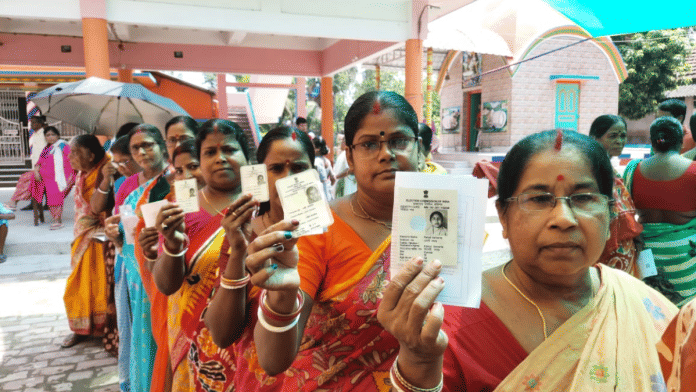
Over the past three years, Indian parties have also stopped treating women as a footnote to caste and class arithmetic and begun courting them as a bloc of their own.
Since late 2023, cash schemes for women have influenced election outcomes in several states where they were introduced.
Bihar in 2025 is the clearest case. Women out-voted men, with turnout at 71.6 per cent against 62.8 per cent. The NDA crossed 200 seats, and opposition leaders credited its cash outreach to women, which put a first instalment of Rs 10,000 into the accounts of over 1.21 crore women. Timing mattered. Analysts noted that when both ruling and opposition parties announce similar schemes, who delivers first becomes critical. The numbers will only grow in importance.
The strategies differ. Indian political parties have built campaigns on direct benefit transfers delivered by incumbent state and central governments. In Brazil, women lean toward the incumbent left, and it is the opposition right that is working hardest to close the gap through family and religious messaging and party women’s wings.
Both countries share a gap between courting women and electing them. Women in Brazil are protagonists as voters but remain underrepresented in political institutions, even though 2022 saw a record number of women elected to the lower house and 2026 brought a new high for the Senate.
In India, too, parties have fielded relatively few women candidates despite women’s growing political influence. Indian analysts also warn that cash schemes stay potent only while they are new. Once rival parties match them, the advantage fades. Brazil’s campaign, fought over prices and services, suggests voters judge delivery, not just promises.
For Indian parties planning the next round of welfare promises, Brazil’s lesson may be that women are not a single vote that can be convinced once. Their concerns over prices, safety, schools and healthcare decide whom they trust, and those concerns do not go away merely after a transfer.
Arindam Kabir is currently working as a researcher with Sanjay Kumar on the project “Women in Indian Politics” based at the Centre for the Study of Developing Societies (CSDS). Sanjay Kumar is a Professor at CSDS and an election analyst. Views are personal.