



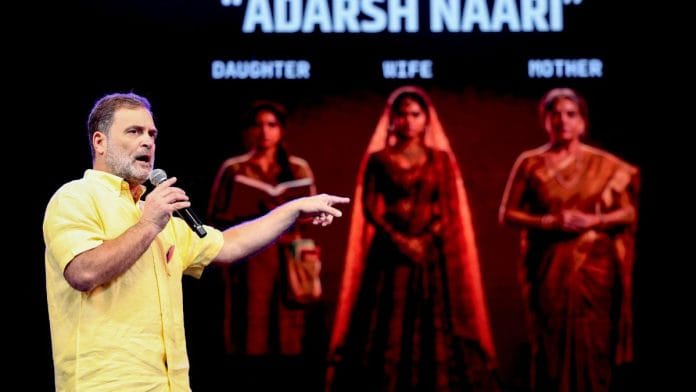

Addressing a large gathering of young women in Pune during a student outreach programme called ‘Chhatron Ki Goonj’ on 22 August, Congress leader Rahul Gandhi said that an “adarsh naari” — an ideal woman — in India is “put in three boxes”. She is seen only “as a daughter, as a wife, or as a mother.” Gandhi added that there was “nothing wrong with being seen as one of these, but it cannot be your only identity”.
Many women are brilliant professionals whose ambitions and dreams stretch beyond these traditional roles, but their pursuit of professional goals is often riddled with obstacles that the Indian society and its governing mindset impose. Those obstacles and that mindset must be fought and overcome. With the female audience roaring in appreciation, Gandhi’s concluding message was: “Break the Cage,” “Smash the Patriarchy.”
By now, these formulations and arguments are a constant refrain in academic seminars and conferences all over the world. But as far as I can tell, they have been pulled into India’s political mainstream for the first time.
Rahul Gandhi’s novel move
The academic and political mainstreams are often two distinct realms of social and political life. MAGA finds little to no reflection in America’s Ivy League. In India, JNU has often been viewed as a bubble. Other than in Kerala or West Bengal (when the state was under CPM rule), JNU’s dominant political culture has shared little alignment with the national mainstream. The Delhi School of Economics (and Sociology) has had a roughly similar record—its role in mainstream politics has rarely rivaled its intellectual sparkle.
Rahul Gandhi’s anti-patriarchy act is, therefore, novel and original. To ensure the call to “smash the patriarchy” was not viewed as an intellectual imposition from above, which presumably had no relevance for the routine lives of women, Gandhi’s strategy of communication in Pune was quite unique. He imagined it as a mass event, not as a political speech derived straight from the ivory towers of a university.
On the stage were invited several young women, nearly all students or recent graduates. They spoke about their educational and other ambitions and narrated the obstacles they faced. They were both urban and rural. Some were fluent speakers of English, others of Hindi, still others of Marathi. Some came from upper-middle-class backgrounds; one was Adivasi; and another was the daughter of a sanitation worker from small-town Maharashtra. The latter had studied at Delhi’s Jamia Millia Islamia and wants to be a journalist, but is repeatedly told that someone from her background either could not or should not be one—and that she should think of marriage instead.
All spoke in ways that reflected the baneful influence of patriarchy in everyday lives. They recalled how going to schools beyond the village was difficult; how public transport was unsafe, regardless of whether the buses were full or empty; how social media was used to shame and pressure them, not only via textual trolling but also by manipulating images and videos; how, guided by the assumption that female lawyers were inferior, legal cases were handed over not on the basis of merit, but on the basis of gender; how FIRs were filed to attack the freedom of expression they wished to have as citizens, but were not supposed to have as women.
But the purpose of the event, of course, was not simply illustration of a concept. The aim of the exercise was deeply political. After its West Bengal victory, the BJP was massively ascendant. The Cockroach Janta Party (CJP) movement, especially the Jantar Mantar protest, broke the BJP’s control over the national political discourse.
Leveraging the political opening, Rahul Gandhi is seeking a discursive upper hand, putting the BJP as a ruling political party and Hindu nationalism as a political ideology on the defensive and hoping it would bring electoral dividends, with multiple Assembly elections scheduled for 2027. He is focusing on students, and now perhaps women in general, as key constituencies.
Also read: Rahul Gandhi finally has an audience that isn’t laughing at him
Attacking the ‘Manusmriti mindset’
Nothing demonstrated this political drive more than two interrelated instances of the Pune event. His first political attack was on Manusmriti, a Hindu text that the BJP has often, and the RSS traditionally, supported. It is also a text BR Ambedkar hated and the Congress party kept generally quiet about. Rahul Gandhi is breaking from this tradition.
He argued that the roots of patriarchy lay in Manusmriti. He cited one of its key passages: “In childhood, the female must be subject to her father; in youth, to her husband; and when her lord (that is, the husband) is dead, to her sons; a woman must never be independent.”
He called these words a “shame”, adding emphatically that “you have a relationship with your father… a relationship with your husband…a relationship with your son, but you do not belong to them, you only belong to yourself.” The crowd roared.
Next, citing them as exemplars of patriarchal thinking, he concentrated his attack, among others, on Prime Minister Narendra Modi and RSS chief Mohan Bhagwat.
He played the video of Modi, in which he had said that he was pained and shocked by how shamelessly the young women, hamaari betiyaan (our daughters), hurled abuses at him at Jantar Mantar, ignoring that young men also did so, which apparently caused him no pain or shock.
So, according to Rahul Gandhi, Modi thinks men can abuse but women can’t, for the latter violates the core precepts of Indian culture. He then castigated Bhagwat for saying that rapes took place in India (the anglicised and deracinated parts of the country), not in Bharat (the authentic and rooted parts of society), which is obviously not true. Gandhi also referred to the remark made by BJP leader and former Haryana chief minister Manohar Lal Khattar that for most rapes, women were at fault, given how they dressed and spoke.
Going forward, a critically important issue is whether the Congress party’s discursive upper hand will yield electoral benefits. Will the BJP be hurt?
In large part, the answer depends on how women, as voters, will themselves react. Progressive women have often been thwarted by the more traditional women who internalised patriarchy, accepting it as a historical truth. In 2016, Donald Trump, despite his wholly undisguised misogyny, received many more votes from older women than the younger ones. In India, will older and/or rural women vote against the BJP?
An equally, if not more, important electoral issue is whether the dominant narrative will change. The BJP would ideally wish that some other narrative—national security, nationalism, development, welfare—overwhelmed the rising narrative about education, employment and patriarchy, as elections came closer. Political narratives are not given; they are constructed. Almost certainly, the BJP will make an attempt to re-establish dominance over the national narrative? Will it succeed?
No one can say, with confidence, how these questions will be answered in upcoming months. But as of now, BJP’s narrative dominance is severely injured.
Ashutosh Varshney is Sol Goldman Professor of International Studies and the Social Sciences and Professor of Political Science at Brown University. Views are personal.
(Edited by Prashant Dixit)
Hatred for hindus is difficult to hide for Raga. So it comes out in one way or other way.
What an absolute jokeshow of a PR piece. Do Ashutosh Varshney or Rahul Gandhi even know how many Smritis actually exist? There are over 18 major ones. Basic classical tradition explicitly states that “Manusmriti” isn’t even prescribed for this era (“Parasara Smriti” is for *Kali Yuga*)! Ok??
So, why bother reading actual books when you can just grab one convenient punching bag to score cheap political points and sell desperate PR fan fiction? Imagine taking history lessons from people who couldn’t even name three Smritis if you offered them a million bucks! Real Indian tradition has dozens of legal texts that changed over time, but these PR columnists reduce thousands of years of internal reform to one manufactured buzzword.
Stop peddling lazy strawmen because you ran out of real arguments. This blog has Zero substance, and is a pure fluff. Is there nobody at Print to take this garbage PR and throw it out?
New political language? One has heard all this from CPI already.