




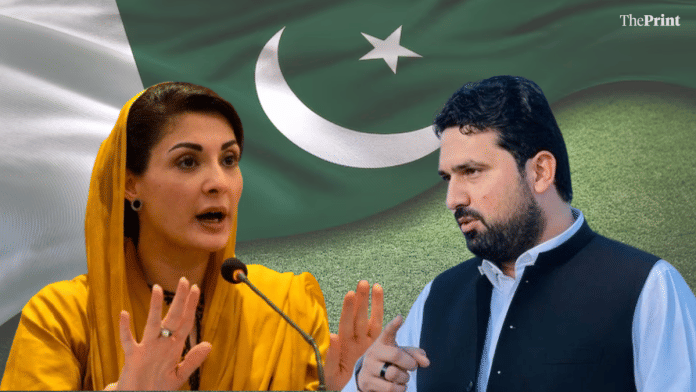

On 11 October, the last thorn in Field Marshal Asim Munir’s side was removed, and with it, the only remaining thorn in the long wilted rose that is Pakistan’s democracy. That prickly thorn was Khyber Pakhtunkhwa’s elected Pakistan Tehreek-e-Insaaf government, which was a stumbling block on Munir’s path to consolidating power across the board. Munir has now picked the rose apart, thorn included, and flicked it away. Khyber Pakhtunkhwa has been placed under both governor’s rule and a state of emergency, on the stated ground that Chief Minister Sohail Afridi had not done enough to contain militancy.
If militancy were truly the concern, the same measures would have been invoked in Balochistan, a province perhaps worse hit by terrorism. The latest data testify to this. As per the Islamabad-based Center for Research and Security Studies (CRSS), Balochistan overtook Khyber Pakhtunkhwa as the most terror-affected province in the third quarter of 2026. Balochistan and Khyber Pakhtunkhwa together accounted for 98 per cent of all violence-linked fatalities in the country, with the former accounting for 59 per cent and the latter for 39 per cent. But the only difference is that Balochistan is headed by a pliant Chief Minister, Sarfraz Bugti, who is more than happy to play second fiddle to the establishment.
The real motive, then, was political. The establishment feared the street power Afridi could muster as he headed toward Islamabad, with the long march he initiated on 4 October, demanding the release of Imran Khan – the former prime minister and PTI founder, who remains incarcerated. The emergency was only an excuse to stop Afridi’s march from resonating with the public with every mile. The Army acted before the street could show the limits of its power; before the incidents of May 2023 could be repeated when Khan’s arrest triggered his followers to target multiple military installations and government buildings.
Back in November 2024, PTI’s nationwide “final call” march was called off after a massive crackdown on its supporters. This time, too, the establishment stopped the march before it could make further headway. The march has since fizzled out, with the two main mobilisers, Afridi and Junaid Akbar, PTI’s provincial president, taken into custody, along with many party workers.
History of dismissals
This is not new. It is a page from Pakistan’s old playbook. Whenever the establishment has felt threatened by a provincial premier’s powers, or by a province exercising its own autonomy, it has used a pretext, whether law and order or otherwise, to dismiss that government. The ruling Pakistan Muslim League-Nawaz (PML-N) and its coalition partner, the Pakistan People’s Party (PPP), would be rejoicing that their common opposition is no longer in power. It was PML-N leader Shehbaz Sharif who advised the move and PPP’s Asif Ali Zardari who signed it. Let this not, though, be mistaken for unity.
In the past, PPP governments have dismissed provincial governments led by the PML-N. For instance, in February 1994, then-Prime Minister Benazir Bhutto directed President Farooq Leghari to suspend the provincial government led by Pir Sabir Shah, who was backed by PML-N. Though not in Khyber Pakhtunkhwa, another stark example is Zardari’s dismissal, as president, of Punjab’s provincial government in 2009, which was then led by Shehbaz Sharif.
In fact, it is only recently that the two parties were at odds over the much-speculated 28th Amendment, which could divide existing provinces to create new ones — a prospect that PPP feared for what it would do to its traditional bastion of Sindh. Decimation of the PTI and fragmentation of Imran Khan’s base have been a source of unity between the two parties. But if the PPP believes that backing the PML-N and the establishment will lead them to settle its own grievances, it is mistaken. They can turn on the PPP, just as the latter can pull the plug on the coalition should it serve its interests.
History shows what follows when the centre dismisses an opposition-led provincial government. In 1973, after Zulfikar Ali Bhutto dismissed Balochistan’s provincial government headed by National Awami Party, the Baloch insurgency spread like wildfire. This phase of the insurgency lasted until 1977, and an estimated 80,000 troops or more were deployed against roughly 55,000 Baloch, of whom 11,500 were organised combatants. Khyber Pakhtunkhwa today is already on the front line of militancy. What happens to it now?
KP needs a healing touch
Though all of Pakistan’s provinces have witnessed governor’s rule or emergency rule, Khyber Pakhtunkhwa, in particular, has inherited the legacy of having its governments dismissed right from Pakistan’s inception. On 22 August 1947, Khan Sahib’s ministry in what was then known as the North West Frontier Province was dismissed on the instructions of Muhammad Ali Jinnah himself, who sought to install a Muslim League cabinet. Since then, the province has had three spells of governor’s rule (1975, 1994 and 1999), with the fourth beginning in 2026.
Critics say that the PTI government was elected with a two-thirds majority and had a stronger mandate than an ‘unelected’ federal government. PTI supporters feel that their government in Khyber Pakhtunkhwa was the only genuinely elected ‘Form 45’ government after the February 2024 general elections. And so, they argue, only the province’s voters had the authority to remove it from power. Whatever the motive, the security concerns cited by the establishment are not entirely without merit. Centre-province friction had hindered coordination on how best to counter militancy in the province, and militants sought to exploit the gap.
Now that the establishment is fully in charge, it can launch as many kinetic counterterrorism operations as it likes without resistance from the PTI, which has often protested such actions because of the large-scale displacement they could cause. The province is essentially under covert martial law. This is what Ayesha Siddiqa calls “constitutional militarism” – military control exercised through the façade of constitutional, parliamentary and legal mechanisms. The military will be able to come to the aid of civilian authorities under Article 245 of Pakistan’s constitution, with the XI Corps in Peshawar possibly playing a greater role in shaping counterterrorism measures in the province.
Moreover, the establishment can exercise firmer control over Pakistan’s Afghanistan policy and prevent a separate provincial track from emerging on the issue. PTI leaders had opposed the establishment’s approach to strong-arm the Taliban into reining in the Tehreek-e-Taliban Pakistan (TTP). Former chief minister Ali Amin Gandapur had openly said he wanted to talk to the Taliban, at a time when the establishment preferred kinetic measures over dialogue.
But what happens after the army has launched military operations? It can clear the province of militants. It can also hold territory for a while. Then it will return to the barracks. The more important question is whether it can ‘build’. For long, even after it became clear that a ‘Pakistani Taliban’ had taken root in the country, the Army resisted adopting a counterinsurgency doctrine. At best, it has been more successful at clearing territory than holding it
Effective holding and building will require empowered civilian authorities and law enforcement agencies. After all, it is the provincial police that serve as the first line of defence against militants. Improved coordination between the police and the military has been a frequently recommended measure by experts. It is hard to see it working in a province where the political environment remains unstable.
The PTI is not blameless either. It had been in power in Khyber Pakhtunkhwa for thirteen years. Though it claims that a rise in terrorism is due to the centre’s policies, it cannot completely absolve itself. Following the 2021 Taliban takeover and the TTP’s subsequent resurgence, it was Imran Khan’s government that negotiated with the TTP, a process that led to the release of hundreds of TTP prisoners. Khan also proposed relocating thousands of TTP fighters from Afghanistan into Pakistan.
One thing is probable. The TTP will be watching those in KP who have lost faith in the constitutional machinery to resolve their grievances, including many who stood behind the PTI. It will try to persuade them to take up arms against the state to fight for their rights, and will attempt to use this argument to bolster its recruitment efforts. Shut down the legitimate political outlet and the militants stand ready to offer an illegitimate one – an outlet based on violence.
No party has clean hands. It is the province and the people that have paid the price. So far, the people of Khyber Pakhtunkhwa have not come out on the streets to protest the dismissal of the government elected by the majority of them. Is it the calm before an impending storm, or does it reflect a population that has grown accustomed to military control?
Bantirani Patro is a staff writer at ThePrint. She tweets @bantirani_patro. Views are personal.
(Edited by Prashant Dixit)