



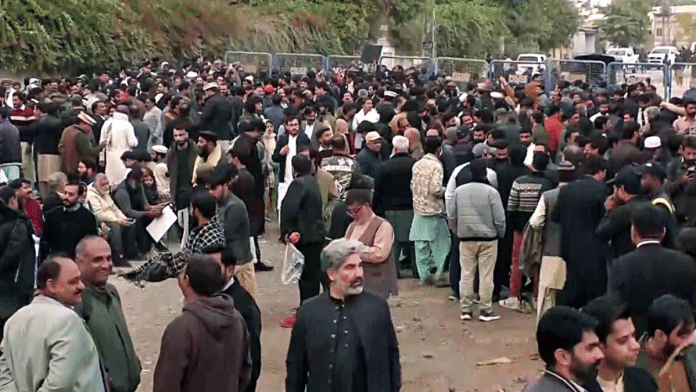
New Delhi: As Pakistan’s former prime minister Imran Khan continues to be incarcerated in Adiala jail, his party Pakistan Tehreek-e-Insaaf (PTI) and Sohail Afridi—chief minister of PTI-ruled Khyber Pakhtunkhwa (KP) province—are planning a long march on 4 October in what is yet another bid to secure Khan’s release. Jailed since August 2023, Imran will turn 74 the next day—October 5.
Initially scheduled for 27 September, plans of the march had resulted in Islamabad becoming a ‘container city’, with the federal capital’s police requesting PKR 827 million for containers, accommodation, food and transportation for police personnel and anti-riot equipment.
Ahead of the long march for Imran Khan’s release, reports have surfaced of the federal government contemplating the imposition of governor’s rule or emergency in Khyber Pakhkhtunwa. This is not the first time federal ministers have remarked or hinted at the possibility of governor’s rule to contain pro-Imran Khan protests.
Last year, Minister of State for Law and Justice Barrister Aqeel Malik—had remarked ahead of planned protests that governor’s rule was being “seriously considered”, adding that it was a “Constitutional measure”, to be undertaken in case of “absolute necessity”.
This time round, federal ministers such as Law Minister Azam Nazeer Tarar, Kashmir and Gilgit-Baltistan Affairs Minister Amir Muqam, Information Minister Attaullah Tarar, and Minister of State for Interior Talal Chaudhry, have all indicated this possibility.
Following a meeting between Prime Minister Shehbaz Sharif and President Asif Ali Zardari Thursday, the government decided to hold talks with the PTI today.
“PTI Chairman Barrister Gohar Khan received a message from the government yesterday for a meeting, which he has accepted in light of the decisions made in today’s opposition meeting. God willing, a meeting will take place between the opposition and government delegations in the office of National Assembly Speaker Sardar Ayaz Sadiq tomorrow at 12 pm,” a post on Gohar Khan’s X account said.
The first round of talks between the PTI-led opposition and the ruling coalition concluded Friday, with both sides agreeing to resume the dialogue Saturday—a day before the proposed march.
Centre-province tensions
The long march for Imran Khan is being planned against the backdrop of growing tensions between the KP government and the federal government over the deteriorating security in KP; the imposition of emergency is being touted as a security measure, and have, in effect, threatened to send the PTI government in KP packing.
In late September, the ruling Pakistan Muslim League-Nawaz (PML-N) even issued a white paper criticising the performance of the PTI-led government in tackling the deteriorating state of law and order in KP, alleging underutilisation of funds allocated for counter-terrorism, among others.
Sohail Afridi bagged the provincial top slot after former Chief Minister Ali Amin Gandapur stepped down from his post in October 2025. Since assuming the role of KP CM, Afridi has time and again opposed the federal government’s counter-terrorism policies, not least its military operations, and has asked the centre to take provincial stakeholders in confidence while drafting counterterrorism frameworks.
Meanwhile, the governor of Khyber Pakhtunkhwa, Faisal Karim Kundi, has said that governor’s rule could be imposed if the federal government deemed it necessary to save the province, as per Dawn.
“I advise the provincial government to postpone their long march due to the law and order situation, call all stakeholders and political parties to discuss peace in the province, and fight terrorism on the frontline,” Kundi added.
What does the Constitution say?
Part 10 of Pakistan’s constitution contains emergency provisions and comprises six articles from Article 232 to 237. Two of these articles, 232 and 234, are particularly noteworthy.
Under Article 232 of the Constitution of Pakistan, the President can issue a proclamation of emergency if he is satisfied that “a grave emergency exists in which the security of Pakistan, or any part thereof, is threatened by war or external aggression, or by internal disturbance beyond the power of a Provincial Government.”
If an emergency is to be pronounced because of internal security conditions of a province, then a resolution from the concerned provincial Assembly is required. But “if the President acts on his own, the Proclamation of Emergency shall be placed before both Houses of Majlis-e-Shoora (Parliament) for approval by each House within ten days”.
Article 234, on the other hand, deals with the power to proclaim an emergency in case of “failure of constitutional machinery in a province”. The imposition of this emergency may happen after the President receives a report from the provincial governor and the President is satisfied that “a situation has arisen in which the government of the province cannot be carried on in accordance with the provisions of the Constitution”.
Either the President himself can assume functions of the provincial government or direct the governor of that province to do so on his behalf. A proclamation issued under Article 234 has to be laid before a joint sitting of Parliament and is valid only for two months, unless the joint sitting before the expiration of that period extends the validity for a further period of two months.
However, the maximum validity of such a proclamation is six months.
KP’s history of governor’s rule
Since 1947, each Pakistani province has experienced governor’s rule. As far as Khyber Pakhtunkhwa (formerly North-West Frontier Province; NWFP) is concerned, the province has witnessed three spells of governor’s rule: 1975, 1994 and 1999.
In February 1975, the assassination of Hayat Mohammad Khan Sherpao, a former NWFP governor, PPP stalwart and close aide of Prime Minister Zulfikar Ali Bhutto, set off a political crisis. Governor’s rule was imposed and the provincial government dismissed. It was lifted in May 1975.
In February 1994, Prime Minister Benazir Bhutto suspended the opposition PML-N ministry in the province, led by Sabir Shah, and imposed governor’s rule. It was lifted in April 1994.
In October 1999, General Pervez Musharraf overthrew Nawaz Sharif’s federal government in a military coup, declared an emergency and suspended all four provincial assemblies. Military-appointed governors ran NWFP until elections in October 2002.
(Edited by Viny Mishra)
Also read: Khyber Pakhtunkhwa CM alleges ‘abduction’ by Lahore cops as Pakistan’s provincial feud escalates