



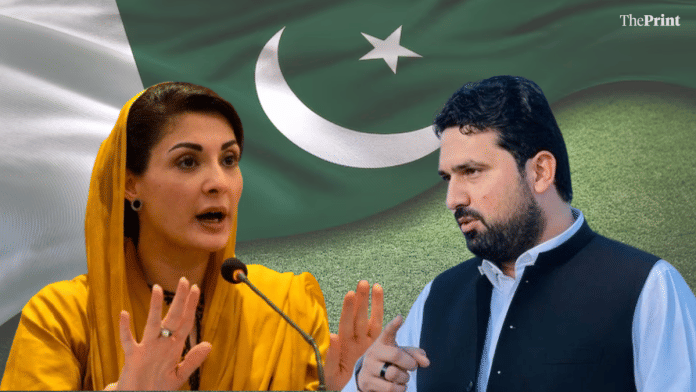

New Delhi: A political confrontation between Pakistan’s provincial governments escalated Monday after Khyber Pakhtunkhwa Chief Minister Sohail Afridi alleged he had been abducted by authorities in Lahore and later left by the roadside without security.
Punjab officials rejected the allegation, saying Afridi had voluntarily boarded a police vehicle during a protest and then refused to get out, Dawn reported.
Adding to the controversy, former Afghanistan vice-president Amrullah Saleh then posted in support of Afridi to assert that Afghans are rooted with the people of Khyber Pakhtunkhwa, only to later delete his statement from X.
Afridi, on his part, described the episode as what he called a conspiracy to abduct the chief minister of a province and warned that such actions could deepen divisions within Pakistan.
The competing accounts emerged after Afridi went to Lahore for a political gathering and to offer condolences to the family of a senior Pakistan Tehreek-e-Insaf, or PTI, worker who had died from burn injuries.
According to a senior Khyber Pakhtunkhwa government official accompanying Afridi, the chief minister had boarded a police van in an effort to secure the release of detained PTI workers. Some of the workers were released, the official said, but others remained inside the vehicle, which lead to Afridi refusing to leave.
The police then drove the van some distance before removing Afridi from the vehicle and leaving him by the roadside, the official said.
Punjab’s Information Minister Azma Bokhari, however, denied Afridi was arrested or abducted. She pointed to the presence of his guards and a cameraman as evidence that he had not been taken into custody.
To Afridi’s claim that he was released because of outside pressure and left without protection, Bokhari responded sarcastically that the only pressure involved was his “low blood pressure.”
The dispute quickly spread beyond the episode, with officials in Khyber Pakhtunkhwa accusing the Punjab government of using the police to intimidate an elected provincial leader.
Condemning the “arrest” of Afridi, the PTI said the episode risked increasing mistrust and resentment among Pakistan’s provinces, and urged its supporters to respond peacefully. Salman Akram Raja, the party’s secretary general, described the alleged abduction as an attack on the country’s federal structure.
Afridi’s visit to Lahore had already become a confrontation with the Punjab government before the dispute over the police vehicle. The confrontation also reflected a widening political feud between Punjab Chief Minister Maryam Nawaz and Afridi.
In September first week, Maryam Nawaz said that she felt threatened by the governments of Pakistan’s other provinces. Afridi responded by saying that he did not consider Punjab’s people a threat. He then vowed to launch a nationwide street movement on 27 September to remove what he calls Pakistan’s “fake rulers.”
Mohsin Dawar, a former lawmaker and president of the National Democratic Movement, also challenged Nawaz’s characterisation of the threat. “The terrorism that you are now describing as a threat to Punjab was, in fact, engineered by your own Punjabi elite,” Dawar said.
Within Pakistan, there is a growing debate, including by Interior Minister Mohsin Naqvi, on governance and whether the country needs new provinces or administrative regions. Naqvi has reiterated his call for what he described as a “reset” of the country’s governance system. Pakistan, according to him, needed to reconsider and restructure an administrative system that had failed for decades to provide basic services adequately.
(Edited by Tony Rai)
Also Read: Pakistan hikes bounty on Masood Azhar to escape FATF. 19 in Red Book linked to 2008 Mumbai attacks