





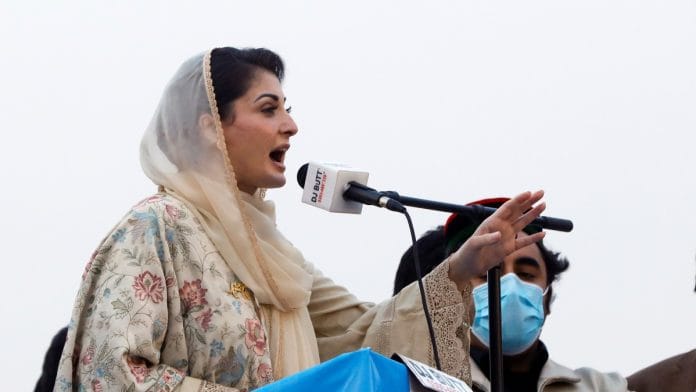

New Delhi: Pakistan’s Punjab Chief Minister Maryam Nawaz said the country’s most populous province faced a greater threat from terrorism within its internal borders than from neighbouring countries.
“Unfortunately, the threat Punjab, a province of 130 million, faces comes less from my neighbouring countries and more from my neighbouring provinces,” she said Saturday at an event in Lahore.
Although she referred generally to Punjab’s provincial borders, her remarks appeared directed at Khyber Pakhtunkhwa, where militant violence has risen sharply in recent years. Punjab shares a border with the province, as well as an international border with India.
The chief minister said the riverine, or katcha, areas had once served as hubs of terrorism and crime, but the state had now re-established its writ there.
“Terrorism enters Punjab from there. Everyone has their eyes on Punjab, but, thank God, Punjab is a safe province. The kind of threats we face come from all our provincial borders,” she said, adding that Punjab faced threats from the tri-border region as well as neighbouring provinces.
Her comments drew criticism from leaders of Pakistan Tehreek-e-Insaf (PTI), which governs Khyber Pakhtunkhwa. Asad Qaisar, the Speaker of the National Assembly and a senior PTI leader, said the “insulting remarks” disregarded the sacrifices made by residents and security forces in his province.
Mohsin Dawar, a former lawmaker and president of the National Democratic Movement, also challenged Nawaz’s characterisation of the threat. “The terrorism that you are now describing as a threat to Punjab was, in fact, engineered by your own Punjabi elite,” Dawar said.
However, her comments came amid a growing debate on how Pakistan should be governed and whether the country needs new provinces or administrative regions. On the same day, Pakistan’s interior minister Mohsin Naqvi reiterated his call for separate provinces.
Naqvi, at a National Policy Dialogue on ‘Devolution of Powers and Good Governance in Pakistan’ at the University of Management and Technology, renewed his call for what he described as a “reset” of the country’s governance system.
Naqvi, who is considered close to army chief Asim Munir, stressed that by “reset” he did not mean replacing the government or a political party. Rather, he said, Pakistan needed to reconsider and restructure an administrative system that had failed for decades to provide basic services adequately.
“New administrative units will eventually have to be created as Pakistan’s growing population and changing needs can no longer be effectively managed through the existing administrative structure.”
After nearly eight decades, he argued, Pakistan was still struggling to provide basic education, health care, clean drinking water and sanitation. The country, he said, would ultimately have to redraw its administrative boundaries.
“New administrative units will have to be created. No one can stop it.”
But Naqvi cautioned that the process could not be dictated by a single leader or party.
“Such a major decision cannot be imposed by an individual or a single political party and should instead be made in accordance with the wishes of the people,” he said. “If the people want new administrative units, they should be created.”
He also insisted that any changes must comply with Pakistan’s Constitution and laws and emerge through political consensus.
Naqvi compared the process to an expanding family that eventually outgrows a single house. “Similarly, as the population grows and its needs increase, the administrative system and structure must also change.”
He further argued that greater devolution of power could take place without violating the Constitution. “Powers can be transferred to the lower levels within the framework of the Constitution. No illegal or unconstitutional measures will be permitted.”
One of his proposals was to consider granting Islamabad the status of a province. The interior minister argued that residents of the federal capital did not receive a share under the National Finance Commission Award, which distributes federal resources among Pakistan’s provinces.
“If new provinces are to be created, Islamabad should also be given the status of a province.”
Defense Minister Khawaja Asif said Friday that the devolution of power was inevitable, while accusing the Pakistan Peoples Party (PPP) of applying different standards to the question of new provinces.
“When there is talk of a Saraiki province in Punjab, the PPP supports it or shows a soft corner on this issue. And when there is talk of multiple provinces or administrative units instead of four, talk of ‘Sindhudesh’ begins,” Asif wrote on X.
“We are first and foremost Pakistanis,” he added. “Devolution was decided as a constitutional principle through the 18th Amendment, which was not respected. Time and circumstance demand that it be implemented with integrity.”
“Provinces or administrative units, whatever label you want to apply,” he said. “The devolution of power is inevitable.”
The proposal has met particularly strong resistance in Sindh, where the PPP has portrayed the prospect of dividing the province as a threat to its autonomy and territorial integrity. The party warned Prime Minister Shehbaz Sharif against allowing such statements to continue and said it could interpret them as part of a “conspiracy against Sindh’s unity, provincial autonomy and the 18th Amendment”.
(Edited by Tony Rai)
Also Read: Pakistan making a colony out of Khyber Pakhtunkhwa, say Pashtuns on new mining bill