



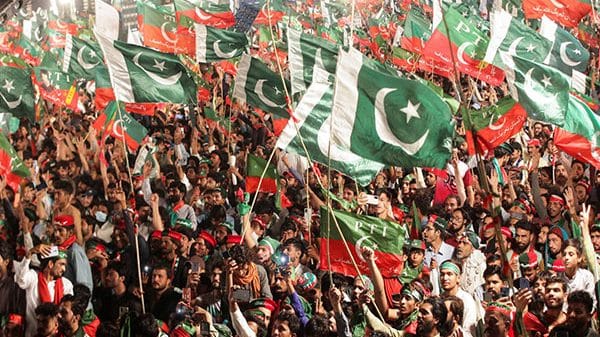
New Delhi: Pakistan’s federal government placed the province of Khyber Pakhtunkhwa under Emergency and Governor’s Rule on Monday, a week after its Chief Minister, Sohail Afridi, kickstarted a long march to Islamabad demanding the release of jailed former prime minister Imran Khan.
The federal Cabinet met on Sunday and reviewed the law and order situation in Khyber Pakhtunkhwa, and proposed to the prime minister that he advise the president of the country to impose an emergency in Khyber Pakhtunkhwa under Articles 232 and 234 of the Constitution of Pakistan. The advice swiftly went from the prime minister’s house to the president’s secretariat, with presidential assent coming shortly after.
According to Dawn, the federal government appointed Dr Muhammad Fakhr Alam Irfan, a Grade 22 officer from the Pakistan Administrative Services, as the chief secretary of Khyber Pakhtunkhwa. This means the provincial cabinet has been dismissed.
Afridi began marching with his entourage from 4 October after talks between the Pakistan Tehreek-e-Insaaf (PTI) and the Centre became deadlocked. ThePrint had reported earlier this month that the federal government was seriously considering invoking these special constitutional measures.
The region that’s called Khyber Pakhtunkhwa today has had a chequered history since time immemorial. Earlier, it used to be known as the North-West Frontier Province, a name given by the British in 1901 after carving out the frontier from Punjab under then viceroy Lord Curzon. Curzon is documented to have remarked in 1904: “No man who has read a page of Indian history will ever prophesy about the Frontier. We shall doubtless have trouble there again.”
Why has this region continually remained defiant from the centre that tries to govern it, be that of British India or Pakistan?
Also Read: Pakistan plans to revive tribal justice system jirga in KPK—‘blatant betrayal of Constitution’
History of the Frontier
Rechristened as recently as 2010, it gets its name from two elements: Khyber Pass (a historically famous mountain pass) and Pakhtunkhwa (loosely meaning Pashtun culture or the land of Pashtuns who are the largest ethnic group of the region). This change was long overdue since each of Pakistan’s provinces, barring NWFP, reflected the ethnicities of their majorities: Punjabis have Punjab, Sindhis have Sindh and the Baloch have Balochistan. The renaming was a welcome change as the colonial name NWFP was a major irritant for the Pashtuns.
One of the north-west’s most accurate descriptions lies in Curzon’s words to the British Parliament: “They are outside the administrative border of India—that is to say, those territories over which we exercise full administrative control, and from which we draw revenue. But they are inside the political border of India—that is, the line drawn by Sir Mortimer Durand… in 1893… That line, ever since known as the Durand Line, was drawn by him, and it constitutes the outer political frontier of the British Empire in that part of Asia”.
The British mainly treated NWFP as a buffer zone to prevent a potential Russian invasion from the north-west, as Russia was expanding its domains through Central Asia, coming even closer to British India. There were two schools of thought on how best to control the Frontier: a ‘close border’ policy and a ‘forward’ policy.
The former was of the view that it was best to have as little to do with the tribal areas as possible, to manage the tribes and mount expeditions against them if they offended. Essentially, treat the area as kind of a buffer.
The forward policy, on the other hand, called for a more active intervention in tribal affairs, since a largely ungoverned zone populated by Pathan tribes without any declared loyalties might be susceptible to Russian blandishments. This approach was followed between the late 1870s and 1900, leading to many forays into the tribal areas. It also caused a full-scale invasion of neighbouring Afghanistan in 1878 (the second Anglo-Afghan war), which further inflamed the border tribes, and brought about the eventual delineation of the border with Afghanistan in 1893.
The close border policy returned in 1900 as the government became unwilling to expend more resources in the frontier. And as relations with Russia improved, the threat it posed also receded from the minds of British policymakers. Although there was vacillation between the two schools, it is the close border policy that prevailed for the better part.
The British launched multiple punitive expeditions into the region to subdue tribal uprisings.
From Gandhara to Frontier Gandhi
Though the cartographical name NWFP suggests it was a periphery, geographically marginal and a no man’s land, in actuality, the Frontier was “everyman’s land”, as Mukulika Banerjee argues in her book The Pathan Unarmed: Opposition and Memory in the North West Frontier. This is because the area for millennia was a melting pot of several expeditions and conquest attempts by empires across the world, most famously Alexander the Great.
The frontier has also been home to the Gandhara civilisation. Banerjee quotes William Dalrymple in her book who had written that it is “difficult at first to understand how the warlike Pathans of the NWFP could be descended from the gentle Greek philosophers who created the notably peaceful civilisation of Buddhist Gandhara”.
Banerjee, during her fieldwork, felt it is possible that some of the inspiration for the non-violence of Khudai Khidmatgars during their freedom struggle against the British came from the awareness of the area’s earlier Buddhist inhabitants. The Khudai Khidmatgars could have drawn upon the “long-accumulated cultural deposit of unremembered events”.
The Khudai Khidmatgars (Servants of God) movement in NWFP was led by Khan Abdul Ghaffar Khan—also known as Badshah Khan or ‘Frontier Gandhi’—against the British in a non-violent manner. Members of the movement were known as Red Shirts for the red uniforms they wore. This movement blossomed when the Civil Disobedience Movement was launched in 1930, drawing inspiration from the Indian National Congress and Mahatma Gandhi’s leadership and teachings.
The British sought hard to clamp down on this movement, and committed atrocities in the process, the most infamous one being that of the massacre at Peshawar’s Kissa Khani Bazaar, where hundreds of unarmed protestors were killed in 1930. Even then, their principle of non-violence prevailed. The Khudai Khidmatgars movement was in its own way “a rather wonderful cultural bricolage and synthesis worthy of the Frontier kingdom of Gandhara”, intuitively observed Mukulika Banerjee.
The Khudai Khidmatgars allied with the Indian National Congress, with the latter winning the 1937 provincial elections. From then, the NWFP government was mostly headed by Ghaffar Khan’s brother, Khan Sahib, until 1947. In 1947, a referendum resulted in NWFP becoming part of the newly independent Pakistan.
Jawaharlal Nehru wrote in June 1947 that “the choice is either to contest the referendum with vigour or to boycott it”.
“In any event the result of a boycott is to ensure the victory of the Muslim League in the referendum. That necessarily leads to the inclusion of the N.W.F.P. in Pakistan. It becomes part of the new State. This will not be liked by a very large number of Pathans and they may start movements, nonviolent or violent, against the new State. But it will be no easy matter to get the Frontier out of Pakistan once it is definitely attached to it”.
Nehru deliberated on what it would mean if NWFP joined India and what help could be offered. He further observed: “There is no doubt that in case Western Punjab is separated from India, the N.W.F.P. will be completely isolated from India. There will be a barrier between the two. Even if the N.W.F.P. joins the Union, it will have to do so on a basis somewhat different from the other provinces. It will be in a real sense a buffer State. Thus it deserves special treatment. It should have the fullest autonomy and it is possible that the tribal people may join it”.
On 22 August 1947, days after Pakistan’s inception, Khan Sahib’s ministry was dismissed on Muhammad Ali Jinnah’s instructions. Dismissing a ministry that held a majority and then asking someone else from the Muslim League to form a ministry, hoping the latter would soon produce a majority, set a precedent that made political instability inevitable. This lesson appears to be lost on Pakistan as it once again attempts to centralise power at the cost of provincial autonomy.
Also Read: 2025: Pakistan’s deadliest year in over a decade
FATA Merger
Khyber Pakhtunkhwa is, in many respects, Pakistan’s youngest province—still in a state of constant churn.
Even after Pakistan’s creation, the Federally Administered Tribal Areas (FATA) in the north-west, abutting Afghanistan, remained semi-autonomous areas and not a part of the mainstream state. They were governed through a set of draconian colonial era laws called the Frontier Crimes Regulations (FCR).
Only as recently as May 2018 through the passage of the 25th Amendment that they were merged, alongside the Provincially Administered Tribal Areas (PATA), with Khyber Pakhtunkhwa. The erstwhile FATA areas are now re-designated as Newly-Merged Districts (NMDs).
The merger held out the promise of equal rights, access to courts, regular policing, improved infrastructure, and civic inclusion –basically rights and privileges available to the rest of Pakistan. Eight years later, these promises remain unfulfilled, with calls for reversing the merger growing amid slow reforms and a resurgence in militancy.
For more than a century, successive centres, British and then Pakistani, have governed the region through exception: special regulations, dismissed governments, military operations. What they are yet to fully learn is to govern the region based on what its history demands, as well as the special culture and character of the people it inhabits. Today’s emergency is different from the earlier clashes. But in more ways than one, it is a continuation and reinforcement of the frontier’s entrenched pattern of political negotiation and contest with the Centre.
(Edited by Nardeep Singh Dahiya)
Also Read: Pakistan’s militants are changing. Is the State?