




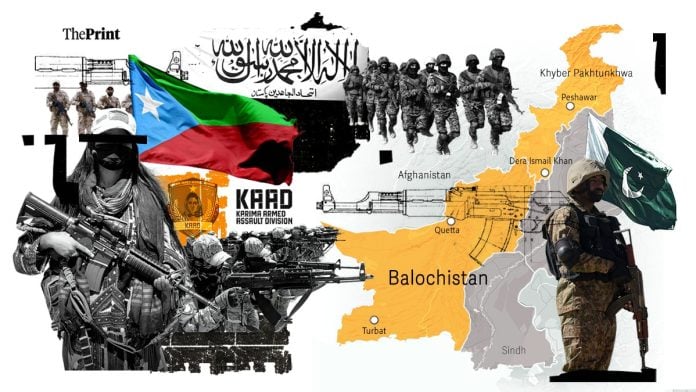

The nature of Pakistan’s armed insurgencies is morphing in ever-more menacing ways, but Islamabad’s security establishment has failed to keep up. These threads may seem separate, but they are combining into one large, looming threat. Militant groups are becoming more organised, adaptable and ambitious, while Rawalpindi remains wedded to its raw power.
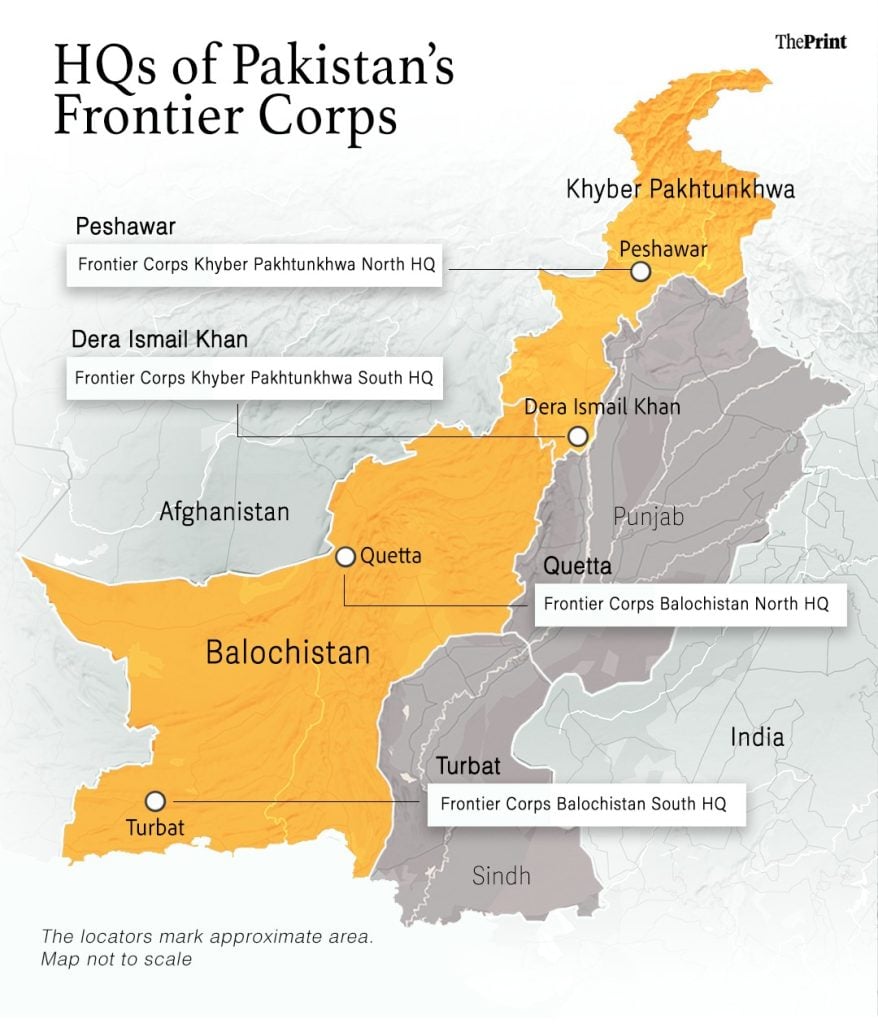
There are different strands to this story. Since it was formed last month, a new women’s wing of the Balochistan Liberation Front, the Karima Armed Assault Division, has claimed a series of attacks on Pakistani forces. Up north in Khyber Pakhtunkhwa, jihadist factions are consolidating under the Ittehad-ul-Mujahideen. And in the direct line of fire are the paramilitary Frontier Corps (FC), under the Interior Ministry, and other local forces, which are absorbing much of the toll. All this even as tensions along the western border with Afghanistan and conflicts in Saudi Arabia and the Gulf put new demands on Pakistani troops.
Pakistan is in a predicament that it doesn’t seem to have quite grasped itself. The state has spent years getting better at using force, building intelligence networks and deploying increasingly sophisticated security capabilities. What it has been less good at recognising is that militant organisations are learning too.
Baloch insurgent groups are becoming more coordinated, using road blockades, convoy ambushes and attacks that can tie down the security forces over a wider area. In KP, Islamist factions are doing much the same in their own way, consolidating previously fragmented groups, experimenting with drones and other asymmetric tools, and putting increasing pressure on the police and other forces that operate closest to the ground. The problem for Pakistan is no longer simply that militancy has survived. It is that the militants are adapting to the way the state fights them.
Also Read: Another Baloch woman activist handed life imprisonment in Pakistan. The case against Gulzadi Baloch
A new role for women in BLF’s KAAD
In September, the Balochistan Liberation Front (BLF) announced a new all-female combat formation, the Karima Armed Assault Division, or KAAD, named after Baloch activist Karima Baloch. Within days, the BLF began attributing armed activity to the unit.
On 22 September, it said KAAD fighters ambushed a Pakistani military convoy near Jusak, outside Turbat in Kech district, along the CPEC highway. On 25 September, it attributed another operation to the unit in Mangocher, Kalat, where its fighters reportedly established a highway blockade, conducted snap checks and attacked military reinforcements. The BLF subsequently claimed that nine Pakistani military personnel had been killed across the two operations. These casualty figures could not be independently verified.
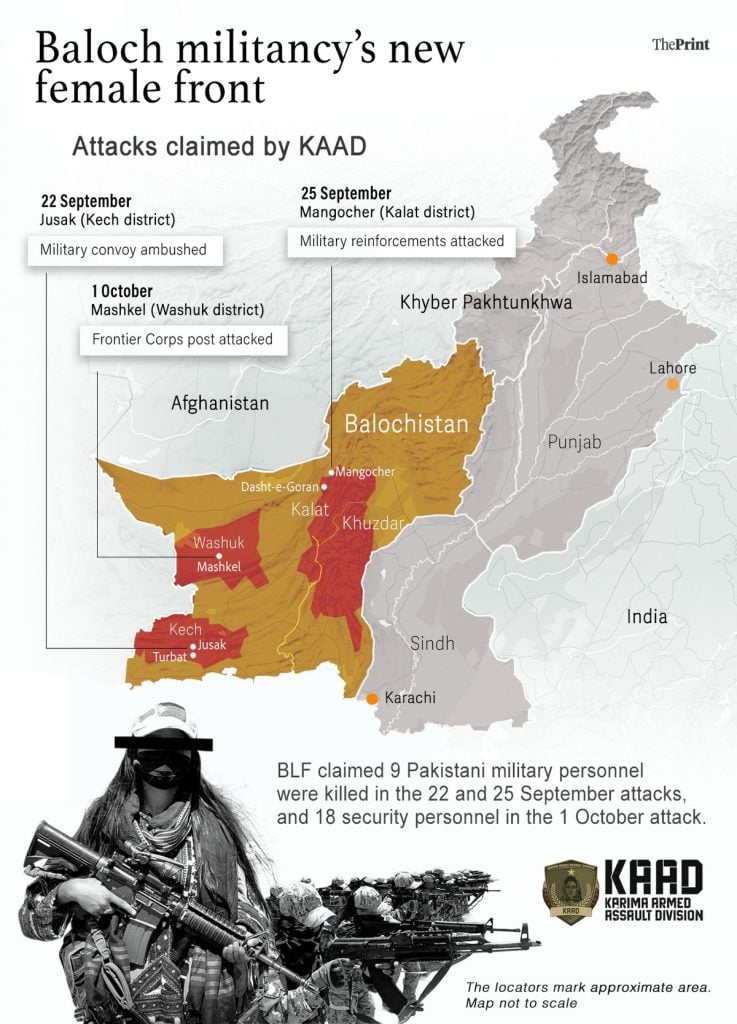
The formation’s activity has since expanded. South Asian Terrorism Portal (SATP) recorded KAAD-attributed roadblocks and vehicle searches on the Quetta-Karachi highway at Lakhorian in Khuzdar on 26 September and Dasht-e-Goran in Kalat on 29 September. The BLF has also claimed that KAAD, alongside its Qurban Unit, took part in a 1 October armed assault on the FC’s Gorinder post in Mashkel, Washuk, in which it claimed 18 security personnel were killed. The claim is at odds with the subsequent account of Pakistani security sources, which said six militants were killed after an attack on a security checkpoint in the area.
Though significant, these incidents still do not constitute a substantial operational record for KAAD. But they do show that the formation is not just symbolic. They suggest an organisation testing how a newly formalised female unit can be incorporated into its wider insurgent machinery.
This is what makes KAAD consequential. The development is less about women suddenly entering Baloch militancy than about the form their participation is now taking.
Women have been part of Baloch militant operations before, including some of the most high-risk ones. The BLF itself used Zareena Rafiq, alias Tarang Maho, in a suicide attack on an FC installation in Nokundi in November 2025. The Balochistan Liberation Army (BLA) had gone down this road earlier too, with Shari Baloch, Sumaiya Qalandrani Baloch, Mahal Baloch and Mahikan Baloch all used as female suicide operatives. What is different about KAAD is that the BLF is now giving this participation an organisational home. It is a small but meaningful step from using individual women for particular operations to creating a structure in which women can be recruited, trained and deployed as part of the insurgency. KAAD therefore represents an acceleration and institutionalisation of an existing trend.
A dedicated female combat formation also gives the BLF something it did not have before: a structure around which women can be recruited and used for different purposes, not just as one-off operatives. Some could be involved in reconnaissance or intelligence, communications, logistics or medical support, while others could be sent into combat.
There is a psychological and political value to this as well. An insurgency that can put women forward as organised combatants can project itself as something more akin to a grassroots movement, rooted in the experience of a population that sees itself as having suffered years of serious human rights abuses. It also gives the Baloch insurgency a more secular and modern face, particularly in a country like Pakistan where much of the militant landscape is dominated by Islamist groups. This image may be as important to the BLF as the immediate tactical utility of the formation itself.
Whether KAAD can actually make a battlefield difference is another question. It has barely begun operating, and it is too early to know how well the BLF can recruit, train and protect such a formation. But the decision to give women a unit of their own is telling.
The BLF’s own record tells you something about how much the insurgency has grown. SATP counted 284 BLF attacks in 2024. The following year, according to the BLF’s own account, it carried out 581 armed operations. In July 2025 alone, the group claimed 84 coordinated attacks under Operation Baam. In June this year, it claimed another 25 armed operations across 14 areas. The last three figures are BLF claims, so they need to be read with that caveat. But even then, the scale and spread are difficult to ignore.
This is no longer an insurgency confined to occasional attacks in a handful of pockets. The BLF is increasingly capable of putting several operations together across a much wider geography.
Who is really in the line of fire?
There is also something interesting in who is actually taking the casualties. The Pakistan Army is the institution most closely identified by many Baloch civilians with the coercive power of the state. Enforced disappearances, extrajudicial killings, collective punishment and military operations have made the Army the face of the state in the public imagination. Yet when the insurgency hits back, it is often the Frontier Corps, the police, the provincial Levies force and other locally deployed personnel that find themselves in the line of fire. They are the ones manning checkpoints, guarding roads and district installations, escorting convoys and moving through the areas where the insurgency is most active.
This creates a peculiar imbalance. The institution that Baloch civilians see as the principal instrument of coercion is not necessarily the one bearing the greatest tactical cost of the insurgency. And that matters politically. It is easier for a state to persist with a hard-security approach when the institution making the strategic decisions is not the one absorbing most of the casualties.
I would not pretend to know what Asim Munir thinks when he looks at this balance, but it does help explain the confidence with which Pakistan’s military leadership has continued to speak about defeating the insurgency through force and dismantling what it describes as foreign-sponsored proxies. Munir has repeatedly framed the Baloch insurgency in precisely these terms, including in his recent interactions with Balochistan’s political leadership.
There is a revealing history to this confidence. In August 2024, Interior Minister Mohsin Naqvi said there was no need for a grand operation in Balochistan because the militants could be dealt with through “one SHO”. He later said the remark was meant symbolically and had been taken out of context.
But the line was instructive nonetheless. It reflected how easily the scale of the problem could be underestimated in Islamabad, even as the insurgency was becoming more organised and more ambitious.
‘One SHO’ to ‘emergency’ in KP
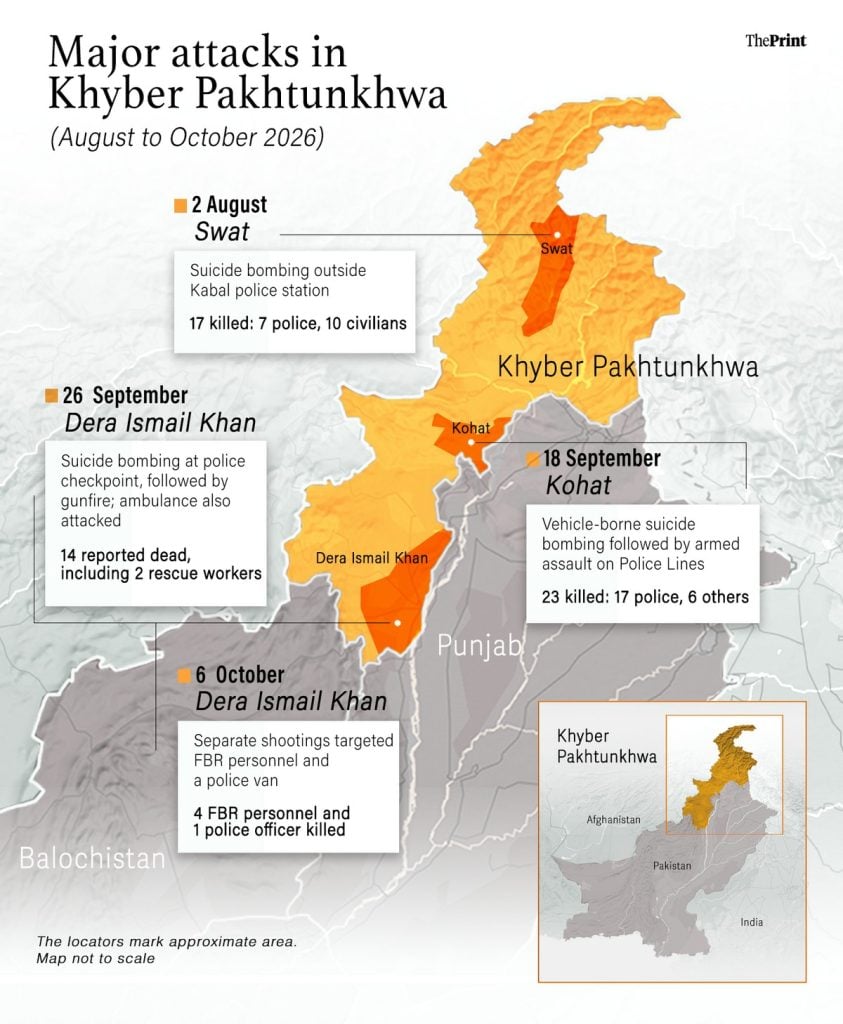
Two years later, that confidence looks considerably harder to sustain. The problem is no longer confined to Balochistan. In Khyber Pakhtunkhwa, the security situation has deteriorated to the point where Islamabad is now openly discussing an emergency in the province.
On 30 September, Parliamentary Affairs Minister Tariq Fazal Chaudhry said the federal government was “seriously considering” such a step. Four days later, Interior Minister Naqvi met KP Governor Faisal Karim Kundi, with the possibility of governor’s rule or an emergency again coming up for discussion. The Governor House said the move could be considered if necessary to “protect the province from terrorism and destruction”.
Taken together, the statements suggest how far the security problem has moved beyond the sort of localised law-and-order challenge that Naqvi’s “one SHO” remark had implied just two years earlier.
The militant landscape in KP has undergone its own organisational evolution. The Ittehad-ul-Mujahideen Pakistan, or IMP, has nothing in common with the BLF in ideology or political objective. Yet its emergence points to something similar about where militancy in Pakistan is headed.
Formed in April 2025 by the Hafiz Gul Bahadur Group, Lashkar-e-Islam and Harakat Inqilab-e-Islami Pakistan, IMP brought several jihadist factions that had operated separately into a more coordinated structure. Its operations have included ambushes, IED attacks and assaults on security installations, alongside increasingly sophisticated forms of asymmetric warfare.
In other words, the militant groups operating across Pakistan’s two very different theatres may be responding to very different circumstances, but they are showing a strikingly similar instinct: to become more organised, more adaptable and more willing to experiment with how they operate.
The Kohat Police Lines attack in September was a particularly stark example. At least 23 people were killed, including 17 police personnel and six civilians, when a vehicle-borne suicide attack was followed by an armed assault. IMP claimed responsibility. A police installation being hit in this manner says something about the changing nature of the threat in KP. As in Balochistan, the forces most exposed are often those closest to the ground, manning checkpoints, guarding installations and moving through areas where militants have the advantage.
More troubling still, these developments in Balochistan and KP are no longer quite separate threats. They are beginning to feed into one another. Every checkpoint that needs more protection, every convoy that needs a larger escort, every police station that requires additional security and every district where resources have to be diverted adds another burden to a security apparatus already stretched across several theatres.
Also Read: PoK is fighting to escape the ‘freedom’ Pakistan has imposed on it
Too many fronts, not enough force
Pakistan’s strategic problems do not end at the western border. It is trying to manage a difficult relationship with the Afghan Taliban even as the militant threat increasingly spills across that same border. At the same time, its security commitments are stretching further into the Gulf, with thousands of Pakistani troops deployed in Saudi Arabia and Islamabad increasingly drawn into tensions between Riyadh and the Houthis.
There is an odd breadth to the security burden Pakistan is taking on. It is dealing with insurgencies in Balochistan, an increasingly difficult militant environment in KP, a worsening relationship with the Taliban government in Kabul, and now a much more direct stake in the security politics of the Gulf. There have also been claims and counterclaims about Pakistani efforts to work with elements of the anti-Taliban resistance in Afghanistan, though these reports remain unconfirmed. Each challenge is different. The difficulty is that they are all competing for the same state capacity, the same security institutions and, ultimately, the same political attention.
This may be the more interesting question about Pakistan’s current predicament. It has become very good at projecting power and very willing to use it, at home and increasingly beyond its borders. But power has a cost, and the bill is coming due in several places at once. The challenge for Rawalpindi may therefore be less about whether it can defeat one more militant group or contain one more theatre. It is whether a state already fighting on so many fronts can keep taking on new commitments without eventually having to confront the consequences of its own strategic overreach.
Sonam Mahajan is a strategic affairs commentator and columnist specialising in Pakistan, Afghanistan, terrorism and the geopolitics of South Asia. Views are personal.
(Edited by Asavari Singh)