







Three thousand people, perhaps more, had fled east across the burning hills of Pakistan-occupied Kashmir, escaping the freedom that had descended upon them. Teenage boys of the village of Soon-Patochi, as leaders of the All-Jammu and Kashmir Muslim Conference recorded in a complaint to Pakistan’s constituent assembly, had been “subjected to unnatural vices” by the Punjab Police. The women were “not only been raped, but in some cases, their breasts and secret parts have been bitten,” the complaint further alleged.
Elders and notables, soon-to-be Prime Minister Sardar Abdul Qayyum wrote, were flogged, then marched through Palandri Bazaar tied with rope: “Some of them were ordered to bark like dogs and the others were compelled to mew like cats.”
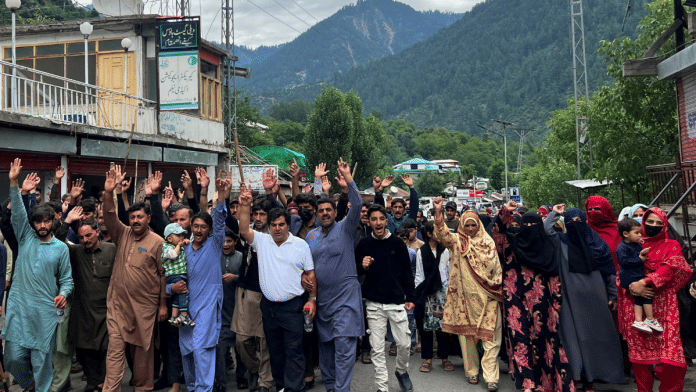
For more than eight weeks, the villages and towns torn apart by the violence of 1955 have been under attack—again. More than 87 people, journalist Haris Qadir has reported, have been shot dead by central and provincial police since protests broke out seeking democratic reforms and control over economic resources. The group spearheading the protests, the Jammu Kashmir Joint Awami Action Committee, or JAAC— has been declared a terrorist group in June.
The decade of savage violence Islamabad has unleashed in Pakistan-occupied Kashmir (PoK) has drawn little attention across the world, or in India. Ever since 1951—the same year Jammu and Kashmir held its first democratic elections—leaders who had fought to join Pakistan found themselves at war with the new nation they had embraced. The peoples of Poonch in PoK found themselves vassals of a new master, as brutal as the hated Maharaja Hari Singh they had rebelled against.
Five years before the savage violence at Soon-Patochi, cheering villagers and brass bands had gathered at Rawalpindi railway station to greet the Lashkars who had murdered and raped their way to the gates of Srinagar, before being beaten back by the Indian Army. The holy warriors would, a British diplomat recorded, “acknowledge the honours paid them by merry feux-de-joie,” firing their guns in the air.
Then, the guns of the liberators were turned to point at the people they had just liberated.
Fighting for a nation
Even though the PoK protests have been cast as a rebellion against Islamabad’s authority, they began as a simple assertion of citizenship. Formed in September 2023, the JAAC brought together traders, transporters, lawyers, students and civil society groups to demand subsidised grain and cheaper electricity generated from the region’s hydropower, as severe inflation roiled Pakistan.
The protesters based their demand on the fact that the territory had long been denied royalties on the Mangla Dam, on the grounds that PoK is not a province of Pakistan. Though royalty-like payments were granted to the region by military ruler General Pervez Musharraf in 2002, they were lower than the royalties paid to Pakistan’s four provinces. The protests of 2024 were met with lethal force by police; one police officer was killed in the violence that followed.
The ongoing protests gradually expanded to wider issues of democratic representation and accountability. Among the core issues were twelve seats reserved in the PoK assembly for descendants of residents of Jammu and Kashmir who migrated to Pakistan after 1947. Those descendants are distributed across Pakistan’s four provinces—and their seats are seen as allowing Islamabad to impose its will on the region.
Little understood in India, this issue goes back to 1947. Long before ethnic-Pashtun irregulars and Pakistan Army personnel invaded Kashmir that year, Poonch had rebelled against Singh’s administration. The reasons were several, but included resentment against the diminution of regional autonomy—the ruler of Poonch, Raja Jagatdev Singh, having been reduced to a vassal of Singh in 1936—which opened the way for extortionate taxation—including, as one observer wryly noted, “a widow’s tax; a tax on every wife after the first; and a tax on sheep and goats.”
These resentments were worsened by the lack of representation of Muslims in the military and government service.
Local leaders like Muhammad Ibrahim Khan—a London-trained barrister, a political rival of Sheikh Muhammad Abdullah and the National Conference, and key leader of the powerful Sudhan clan—seized on the chaos which erupted in the build-up to independence. Ibrahim Khan worked with Major-General Akbar Khan, the commander of Pakistan’s 1947-1948 bid to seize Kashmir by force, to make volunteers available from the large pool of demobilised British Indian Army veterans in Poonch, along with some former Indian National Army personnel.
Ibrahim Khan’s key rival, Abdul Qayyum Khan, meanwhile, launched a low-grade insurgency against the Maharaja’s forces. Kashmir’s armed forces responded with reprisals against local Muslims, which in turn fuelled resentment. The conflict would soon escalate, with tragic consequences: Kashmir state forces, allying with the private armies of Sikh princes in Punjab, would initiate a campaign of savage ethnic cleansing in the Hindu-majority belt south of the Chenab river.
Also read: Remembering Kargil is not enough. India must learn the war’s unfinished lesson
False dawn of freedom
To the Poonch rebels, the war of 1947-1948 was a victory: Even if Pakistan had failed in seizing the Kashmir valley, as well as much of Jammu, Ibrahim Khan now ran a de facto independent government in the Sudhan lands. The federal government in Karachi, though, had other plans. The supreme leader of the Muslim Conference, Chaudhary Ghulam Abbas—closely tied to Pakistan’s ruling elite, and seeking greater integration with the new nation-state—fled from India in 1949, and soon emerged as the dominant political figure in PoK. Ibrahim Khan, who was well-embedded in the clan politics that prevailed to the west of what is now called the Line of Control, responded with insurrection.
Late in 1949, Indian military intelligence reports seen by ThePrint recorded that the interim government ruling PoK had disintegrated in the Sudhan lands, and that Kashmiri Muslims who had migrated to Pakistan were disillusioned by their less-than-warm welcome in the Sudhan lands.
The death of Pakistan’s founding Governor-General, Muhammad Ali Jinnah, and the assassination of Prime Minister Liaquat Ali Khan interrupted this crisis, forcing both factions to arrive at a ceasefire. The relentless centralisation of authority, however, proceeded apace. The Rules of Business for the PoK government were rewritten in 1952, handing effective power to the bureaucrat MA Gurmani, who was appointed by Pakistan.
For more than 17 months, the Sudhan rebels fought the combined forces of the Punjab Police and the Murree-headquartered 12 Brigade of the Pakistan Army.
“The army and the constabulary were brutal in their methods,” Usman Khan Yusufzai has written. “Entire villages were burned,” and many of those who showed sympathy for the rebels were killed on the spot; others were prosecuted with little to no trial. New legislation, the Pallandri Disturbances Tribunal Act, gave the state the power to conduct trials with special rules, like allowing evidence from persons absent or dead, as well as denying convicts the right to appeal.
General Ayub Khan’s military coup in 1958 led to the crushing of the democratic impulse in PoK, just as it did in Pakistan’s four provinces.
Also read: India’s new Integrated Battle Groups are the right move against Pakistan, not China
Pakistan’s incomplete citizens
The 1950s rebellion was not PoK’s last effort to escape from its subordination to Pakistan. Following the tragic drowning of 50 members of a wedding procession in 1973, sociologist Roger Ballard recorded, villagers stormed the offices of the local magistrate and police, and flew the Indian national flag as a gesture of protest. Eventually, elite Pakistani troops were parachuted into Dadyal to free the government.
The introduction of Islamist organisations like the Hizb-ul-Mujahideen, Lashkar-e-Taiba and Jaish-e-Muhammad by the Inter-Services Intelligence after the Kashmir jihad in 1989 further strengthened the Pakistani state’s authority in the region.
Faced with an explosion of anger in PoK, journalist Areeba Fatima writes, establishment politicians and the military seem to have decided to escalate repression. Khwaja Asif, the country’s defence minister, has ruled out negotiations.
“I put them in the same category as India and consider them as enemies of Pakistan,” Khwaja Asif said.
The Pakistani military believes that, as in the past, it will be able to crush this rebellion. That it might well do—but it’s clear state terrorism won’t extinguish the rage of people condemned to incomplete citizenship in the name of their own freedom.
Praveen Swami is Contributing Editor at ThePrint. His X handle is @praveenswami. Views are personal.
(Edited by Saptak Datta)