






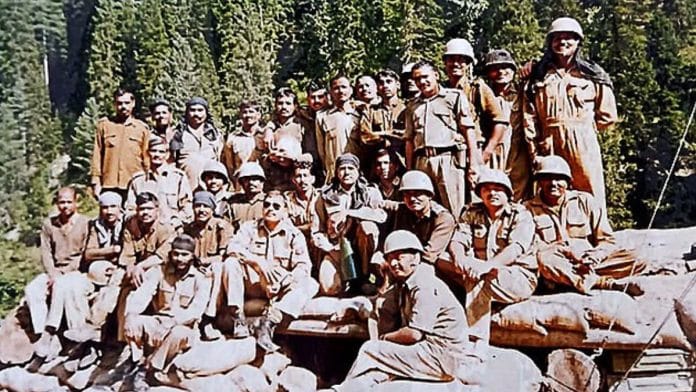


In the summer of 1999, beneath the Kargil sky, some of the most difficult battles in India’s military history were fought across bare, forbidding heights. The 27th Kargil Vijay Diwas will be officially celebrated on July 26, a tradition since 1999.
It must, however, first belong to the 527 Indian soldiers who did not return, and to the many more who carried the trauma home, in wounds both visible and unseen.
Yet, remembrance is more than a ceremony. Wars move us because they reveal what human beings will endure for one another. They also teach us how to prevent the next war—and if prevention fails, how not to be surprised.
That remains Kargil’s unfinished lesson, which I will turn to in a bit, but first let’s revisit the valorous summer of 1999.
Victory with restraint
India entered the conflict with Pakistan barely a year after the Pokhran-II nuclear tests. American sanctions under the Glenn Amendment prohibited foreign military sales, financing and licences for items on the US Munitions List, while restricting certain dual-use exports.
While India was not without friends or equipment, the episode exposed how quickly peacetime dependencies turned into wartime vulnerabilities.
The solution came through improvisation and diversified partnerships. Star-performer Swedish Bofors 155-mm guns delivered devastating fire at extreme elevations. South Africa’s Denel Corporation provided thousands of 155 mm shells under emergency procurement. In the air, French Mirage-2000Hs were rapidly upgraded with Israeli-made Litening targeting pods and American Paveway-II laser-guided bombs. By June 12, they were ready for precision operations and on June 24, Mirages struck Pakistani command-and-control bunkers on Tiger Hill. Operation Safed Sagar became an unprecedented air operation that re-wrote high altitude air warfare in the subcontinent.
Benjamin Lambeth, the American air-power scholar, later called Kargil a “milestone event in Indian military history” and a prototype for India’s likely future combat challenges. In the years after Kargil, dozens of books and hundreds of analyses have drawn lessons from moving accounts.
Indian diplomacy played its part, while reinforcing military restraint. India chose not to cross the Line of Control (LoC) even when that made operations harder. Pakistan’s attempt to disguise regular troops as irregulars eventually collapsed. When Nawaz Sharif reached Washington on July 4, then US President Bill Clinton insisted that Pakistan unconditionally withdraw its forces to its side of the LoC. American security expert Bruce Riedel, present in the room, recalled that Sharif “very reluctantly agreed to withdraw.” Kargil was won on the heights, but India’s conduct ensured Pakistan also lost the diplomatic face.
As luck would have it, the two countries embarked on different political reckonings. India held general elections, prime minister Atal Bihari Vajpayee returned for a third term and publicly investigated the failures that led to the war. Whereas in Pakistan, the blame game between prime minister Nawaz Sharif and then army chief Pervez Musharraf culminated in the famous military coup of October 12, 1999.
India proved its strength not by claiming infallibility, but by examining error—a lesson that remains relevant to this day.
Also Read: Kargil War anniversary is the time to finish an incomplete task–overhaul defence ministry
From surprise to reckoning
On July 29, 1999, only three days after the war formally ended, the Vajpayee government constituted the Kargil Review Committee (KRC) under K. Subrahmanyam, with Lt Gen K.K. Hazari, B.G. Verghese and Satish Chandra. It was a remarkable decision.
Its mandate was to reconstruct the events leading to the infiltration, and recommend safeguards against another such failure.
India had won, yet the government accepted that victory must not ignore the failures that allowed Pakistani troops to occupy the heights undetected. The committee consulted more than a hundred officials and public figures. Its report was completed in December 1999, tabled in Parliament on February 23, 2000 and released with limited omissions on nuclear weapons. The value of the KRC report was not merely in its insights, it was also in its transparency.
Unlike the still-classified Henderson Brooks–Bhagat report on the 1962 India-China war, a part of which was later leaked by an Australian journalist in 2014, citizens could access and discuss this reckoning from the get go.
The KRC report found weak intelligence collection, poor assessment and no institutionalised mechanism connecting agencies on matters of intelligence. Its recommendations led to a wider ministerial review—the first comprehensive examination and overhaul of India’s national-security grid.
Much followed. The Defence Intelligence Agency was created in 2002 and the National Technical Research Organisation followed in 2004. A full-time National Security Adviser became embedded in the national security grid. Further, India improved satellite surveillance and inducted unmanned systems. The first Defence Procurement Procedure arrived in 2002 and was revised repeatedly in the years that followed, until the modern–day Defence Acquisition Procedures (DAP) of 2016 and 2020.
An updated DAP 2026 now seeks still faster acquisitions and stronger domestic participation with renewed calls for atmanirbharta or self-reliance. The Chief of Defence Staff, a key recommendation of the committee finally became a reality in December 2019—nearly two decades later.
This is the glass half full. The other half is harder to ignore.
Theatre commands remain unfinished and genuine integration among the three forces remains far-fetched despite some progress. Intelligence agencies have multiplied but the fusion of intelligence remains incomplete.
The long drawn process of procurement has hardly improved and emergency purchases continue to compensate for delayed planning.
India still has no publicly articulated national security strategy. The argument that structures, processes and policies already in place make a written strategy unnecessary, remains unconvincing. A security strategy does not catalogue national secrets, it establishes priorities, connects threats to resources and articulates a national security vision — putting together all elements of national power coherently and cogently.
In the absence of that, interpretationism, ad-hocism and file movement thrives and will continue to thrive. Numbers reveal a part of this chronic problem.
India has underspent on defence acquisition for decades, not in net numbers but in proportional terms. This has been true, especially under the Narendra Modi-led NDA governments since 2014. For instance, the 2026–27 Budget allocated a record Rs 7.85 lakh crore to the Ministry of Defence, which is not even 2 per cent of India’s GDP.
Further, capital expenditure within that allocation constitutes only 27.95 per cent of the total—once pay, pensions, operational revenue and civil organisations are taken out. On the narrower comparison of capital outlay with defence services revenue, the ratio is approximately 28:72—closer to, but still below, the desirable 40:60 benchmark recommended by the Parliamentary Standing Committee on Defence.
The larger question remains: are budgets, procurement, indigenisation, technological advancements and doctrines following a common long-term purpose, keeping in mind the lessons learnt from the wars of today?
Also Read: ‘Some of us survive to tell the stories’—honouring Kargil war heroes and their lives
The next surprise will look different
Surprises have not remained confined to conventional wars. The Parliament attack of 2001, Mumbai in 2008, Uri in 2016, Pulwama in 2019 and Pahalgam in 2025 differed in scale, method and consequence.
Yet each exposed Pakistan’s ability to find seams between intelligence, policing, border management and political response. Tactical retaliation may punish an attacker and has been steadily doing so until now, but only institutional learning steadily closes those seams.
Kargil’s lessons, articulated by the KRC therefore belongs as much to counter-terrorism as to warfare in general. Kargil was also India’s first intensely televised war. Today, every smartphone can become a sensor, every satellite image a clue and every social-media post either intelligence or deception—creating layers within the fog of war.
Open-source intelligence (OSINT) helped expose Russian buildup and preparations before the invasion of Ukraine and now tracks weapons, units and battlefield losses almost in real time. AI can fuse enormous volumes of data at mind boggling speed — but it can also generate convincing falsehoods aka informational warfare fogs at industrial scale.
Today’s battlefield has therefore become more transparent and more obscure at once. Drones, cyber operations, autonomous systems, precision missiles and information warfare have compressed decision time.
Pakistan’s deepening access to Chinese sensors, weapons and networked systems adds another layer to an already difficult two-front challenge with perpetual grey zone ops and exponential advancement of Chinese defence capabilities.
India needs joint commands, civil–military fusion, timely procurements, and genuine indigenous production. It must also spend more on capital outlays and invest in systems that connect space, air, land, sea, cyber and the information domain with an eye on the future war.
Platforms acquired without optimal integration are inventory, not capability — and the lessons of the recent wars have underscored the centrality of an optimally integrated network in unambiguous terms.
US armed forces’ think tank RAND Corporation’s post-Kargil study made an important observation — India must possess the capabilities to “thwart surprises and to win even if surprised”.
No review, however thorough like the KRC, can guarantee no surprises. The purpose of reform is to ensure that one warning missed by one institution does not become a national failure, which will be a work in progress.
On 26 July, the bugle will sound again in Dras. Wreaths will be laid, brave hearts will be remembered, old photographs will return to social media. But the truest tribute to those who climbed into enemy fire is not only to say that India will never forget. It is to re-affirm time-bound commitment for building comprehensive national power with sincere inquiry, course correction and accountability.
(Edited by Aakriti Handa)
Swasti is somthing special…the wayshe connects Kargil with the challenges India is facing today,,, reminds us why the Kargil Review Committee still matters
and brings up policy debates that most people simply ignore…
It’s not just about remembering our heroes, it’s about asking whether we’ve actually learned from their sacrifice.
That’s what makes her content feel different. Respect. 🇮🇳
The Editor was called to testify before the Subrahmanyam Committee, that was probing Kargil lapses. If memory serves one right, his submissions, some of which did not show the authorities in a good light, were gently modified. Governments generally do not appreciate the truth on such occasions. Better to stay with the myths.