






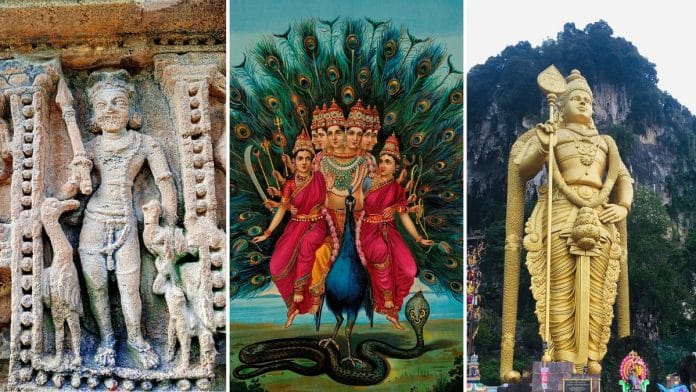


The first poster for an upcoming Telugu film, with film dynast NT Rama Rao Jr playing the war-god Murugan, was recently embroiled in controversy. The actor’s post on social media was accompanied by the text, “Born in the North, forged in the heartland, worshipped in the South”.
Tamil pride groups, such as the NTK, spearheaded a backlash insisting that the god is Tamil, and Tamil alone, sparking an online war with NTR Jr’s fans. Each side is arguing over where the god “comes” from, as if a cultural, religious, and political phenomenon extending over 2,000 years could have a single point of origin.
The divine warrior-god is known by many names in many lands. Both sides forget that Tamils and Telugus have a shared medieval history of devotion to Murugan—and a parallel modern history of revering film stars. Yet, over the course of the 20th century, these impulses—divided by regional, caste, and media interests—have produced distinct, warring cultures of citizen-devotees. One focused inward, on hardline Tamil exceptionalism. The other looked outward, on the scions of film dynasties, bringing them Bollywood and Hollywood trends. Neither remembers who they once were.
From warrior-god to Brahma’s teacher
First, the all-important question: Where was the god “born”? In an earlier edition of Thinking Medieval, I examined one strand of this process: the evolution of a spear-wielding warrior god called Mahasena. He was worshipped by the Kushans, a Central Asian people who conquered portions of North India and traded with the Romans in the early centuries CE. In his academic monograph The Rise of Mahasena (2011), art historian Richard Mann argued—based on an analysis of texts, coins, and sculptures—that Mahasena came to be linked with an older north Indian divinity called Skanda. The latter was eventually identified as the son of the great god Shiva and his consort Parvati, herself the daughter of the personified Himalayas.
The other strand: Around the same time (possibly earlier), Tamil poems of the Sangam period describe a warrior-god of the hills—Murugan or Ceyon, the Red One. He was a god of the hunt and of war, the slayer of a demon, worshipped with frenzied dancing and the blood of a ram offered under a tree. There is none of the rich mythological texture of the Sanskrit Skanda Purana, no six-headed infant, no daughter of the mountain king, no Himalaya. In The Many Faces of Murukan (1978), religious historian Fred Clothey uses a comparative study of the Sri Lankan hill-god Gale-Deviya of Kataragama to argue that Murugan may have been a god of great antiquity. He was likely worshipped by megalith-builders in the late centuries BCE, if not much earlier.
Nuancing this conclusion, other Sangam poems indicate an awareness of North India. Some texts mention Brahmins and shrines to minor gods; archaeology also suggests that India’s coasts were fairly well-connected in the late centuries BCE–early centuries CE. No god or culture is ever hermetically sealed. Even in fairly early poems, Murugan is associated with roosters, with which Skanda-Mahasena was linked in the north. The possibility of an early fusion (or borrowing) has been used by the Hindu Right to argue that there was never an independent Tamil deity. This is an extreme position. What we can say, based on the evidence, is that there are clearly two distinct mythological and ritual systems: one for Mahasena-Skanda-Karttikeya and another for Ceyon-Murugan. But we don’t have all the evidence needed to say which one came earlier, or trace the earliest links, appropriations, or borrowings.
Over the next centuries, however, Murugan came to be identified unambiguously with Skanda, very often by Tamil kings themselves. As architectural historian Padma Kaimal writes in Opening Kailasanatha (2020), the eighth-century Pallava dynasty of Kanchipuram built several temples identifying the king with Shiva, the queen with Parvati, and the crown prince with Murugan-Skanda. Ceyon’s red skin, sung of by so many Sangam poems, became wheatish and golden, more in line with the medieval aristocrat and the divine warrior of the Sanskrit Puranas.
It is as the warrior-companion of kings that the god became famous across the east coast, both in the Chola kingdom and in Andhra. Several of Murugan’s most important Tamil temples today underwent extensive Chola-era expansion. In the Golingeshvara temple at the heart of the Krishna-Godavari delta, inscriptions refer to him as Vijayeshvara Mahadeva, the Great God, Lord of Victory. Archaeologist S Nageswara Rao dates the temple to the 11th century, when the region was warred over by the Cholas, their vassals and rivals.
Simultaneously, while retaining his warrior iconography, Murugan became linked to Brahminical learning in both Tamil and Sanskritic traditions. From around the eighth and ninth centuries, Clothey writes, the martial boy-warrior was reworked into Subrahmanya the guru-murti, the teacher-form. He became the child ascetic who has conquered desire, the preceptor who instructs even Brahma, even his own father Shiva, in the meaning of the sacred syllable Om. His lance became a symbol of discriminating wisdom. At Palani, a medieval shrine now especially sacred to the god, he stands as the renouncer who gave up the world. This is a long way from the ancient hill-god with ram’s blood on his sacrificial stone.
Also read: Ayodhya isn’t new. Chola kings were probing temple scams a thousand years ago
God of Tamil
Murugan also became the god of the Tamil language itself. According to Clothey, in Shaiva Siddhanta, the ritual framework of Tamil Shaivism, Subrahmanya-Murugan is sometimes read as the perfect embodiment of the divine: the guru who imparts liberating insight and severs the soul’s bonds. Other works, such as the Kallatam, made Murugan the teacher who gave the legendary sage Agastya both the Vedas and Tamil grammar.
A beloved legend narrated by Dravidologist Kamil Zvelebil in The Smile of Murugan (1973) concerns Arunagiri, a 15th-century wastrel who attempted suicide from the Gopuram tower at Tiruvannamalai. As he fell to the ground, he was caught in the arms of an elderly man—Murugan in disguise—who thrust desires out of his heart with the point of his lance, touched his tongue, and commanded him to sing. Over his lifetime, the historical Arunagiri went on to compose over 1,367 poems in praise of Murugan, called the Tiruppukal. Here is one of his poems (translated by Zvelebil):
“O Guha, master of Shiva,
lover of Valli, your bride!
You dwell in Tiruverakam
on Kaveri’s northern shores
with fully-grown shady groves,
sweet child of Uma, Ganesha’s brother,
great hero, destroyer of demoniac pride!”
To Zvelebil, Guha is a Sanskritic name; Valli is Murugan’s consort in Tamil tradition. Tiruverakam and the Kaveri are from the Tamil mindscape, yet the links with Uma and Ganesha both emerge from the Sanskritic tradition. Was Arunagiri’s Murugan “born” in the North, or was he solely Tamil? Zvelebil puts this conundrum beautifully:
“Several streams converge and merge in his work: the hymnic tradition of Shaiva and Vaishnava bhakti, the reflective stream of Shaiva Siddhanta philosophy, the ancient inheritance of bardic poetry… the vast resources of Aryan[/Sanskritic] mythology, the deep wells of indigenous Tamil myths and legends connected with the cult of Murukan, and, last but not least, his [Arunagiri’s] own shattering life-experience.”
The god’s popularity further took off under the Vijayanagara Empire, a Deccan-based polity whose ruling class was multilingual, multiethnic, and came from across southern India. Vijayanagara’s viceroys in Tamil Nadu were frequently of Telugu descent, and one of these dynasties—the Madurai Nayaka—was a patron of Tiruparankunram, one of Murugan’s six sacred abodes. When Virappa Nayaka built a colossal seven-story Gopuram for the temple in the 17th century, he issued a foundation inscription both in Tamil and Telugu. Murugan’s popularity only continued to grow thereafter, linked to pilgrimage circuits and popular devotion. According to Clothey, the legendary bhakti poet Sambandhar was considered Murugan’s incarnation; a mute child at Tiruchendur, drowning in the sea, was said to have opened his mouth only to sing Murugan’s praises. Names such as Murugan and Subramaniam, popular among Tamils to this day, increasingly appear in epigraphy and literature from this time.
Gods on the screen
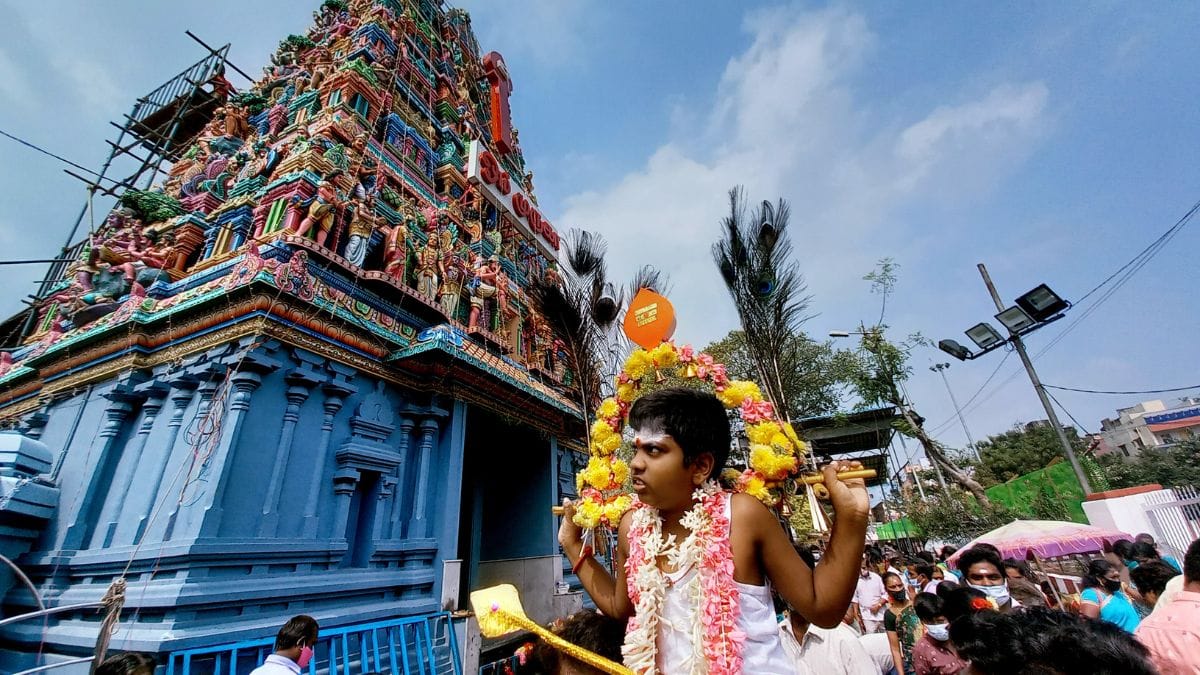
Murugan’s journey to today’s culture wars necessitates a brief pit-stop in the 20th century, when the Telugu and Tamil regions took divinity—and the sacred, more broadly—in parallel directions. Anthropologist Uma Maheswari Bhrugubanda argues in her book Deities and Devotees (2018) that mythological Telugu films developed as an engine of linguistic nationalism—a way of calling a people into being through Puranic storytelling or biopics of legendary devotees. Dialogue was typically in sonorous Sanskrit-infused Telugu, the coastal Andhra dialect of land-owning dominant castes. Voiceovers, prologues, and extensive documentary footage of real temples brought sacred myth into the present. Bhrugubanda describes the intended audience as ‘citizen-devotees’: someone for whom the god on the screen is not a performance but a presence.
The summoning of the citizen-devotee developed into a political technology that landed caste coalitions learned to wield. NTR—the towering figure who played Krishna in 17 films over 20 years—founded the Telugu Desam Party on the Kamma caste’s agrarian wealth and a promise of Telugu self-respect, sweeping to power within a year. When the Kamma caste’s dominance in the industry grew controversial, the Kapu caste found their own star in Chiranjeevi, a swaggering hero of humbler origin; he too would launch a party. Film theorists have interpreted the blockbuster RRR (2022), starring both NTR Jr and Chiranjeevi’s son Ram Charan, as effectively a ‘truce’ between the castes, allying both with the Hindu Right.
This brings the wheel back to NTR Jr’s God of War, latest in the tradition of the pan-Indian blockbuster pioneered by Baahubali (2015): a Hollywood-scaled, computer-generated, Hindu-civilisational epic pitched at a national and global market. The citizen-devotees, it seems, are being called to a larger project: no longer to vote for landlords in the name of Telugu self-respect, but instead to secure film dynasties’ lieutenantship in the pan-Indian Hindutva mythos.
Also read: Mock the Indian uncle. Don’t turn him into a glib theory of India
Divine language vs divine film star
Tamil Nadu did something else with the same impulse to adore the silver screen. The Dravidian movement was rationalist, anti-Brahmin, contemptuous of Puranic religion—yet it recast the Tamil language as Tamil Tai, Mother Tamil. The language became the focus of a devotion described by historian Sumathi Ramaswamy, in Passions of the Tongue (1997), as tamiḻppaṟṟu: a love of language fierce enough that men set themselves alight for it. In this mythos, contact with the north—whether Sanskrit, Hindi, or Telugu—was often interpreted as ‘imposed’ upon a progressive Dravidian past. As Dravidian leaders came to political power, they also adopted more pragmatic positions on religion, largely validating popular devotion to gods such as Murugan or kings such as the Cholas, who became icons of Tamil exceptionalism. Indeed, though the Cholas loom large in the Hindutva mythos today, Murugan’s connection to Tamil hearts is older and more powerful. A claim that he was “born in the north” was destined to be explosive. It is akin to saying Rajendra Chola was born in Delhi.
So, the quarrel over God of War is not about where Murugan was born. It is about who owns him—and on that question, two nationalisms are shouting past each other. One would dissolve him into a pan-Indian, Hindu-civilisational spectacle, a mascot for a market and an exclusionary mythos. In fact, the Bharatiya Janata Party launched major communal mobilisation around Murugan’s temple at Tiruparankunram just last year, seeking to light a lamp near a historic dargah that shares the hill. On the other hand, hardline Dravidian nationalism would see Murugan as Tamil alone, turning him into an icon to be guarded against the north—whether Telugu or beyond. Both nationalisms need Murugan to be one thing, cleanly, so that their community can be one thing, cleanly.
But Murugan’s own history defies both. After all, he grew out of exactly this kind of borrowing and quarrelling, as is only appropriate for a war-god: the red hill-hunter assigned a Gangetic birth; the Tamil war-god endowed by Telugu kings; the invincible peacock-rider, spear-wielder, teacher of poets.
Anirudh Kanisetti is a public historian. He is the author of ‘Lords of Earth and Sea: A History of the Chola Empire’ and the award-winning ‘Lords of the Deccan’. He hosts the Echoes of India and Yuddha podcasts. He tweets @AKanisetti and is on Instagram @anirbuddha.
This article is a part of the ‘Thinking Medieval‘ series that takes a deep dive into India’s medieval culture, politics, and history.
(Edited by Prasanna Bachchhav)