






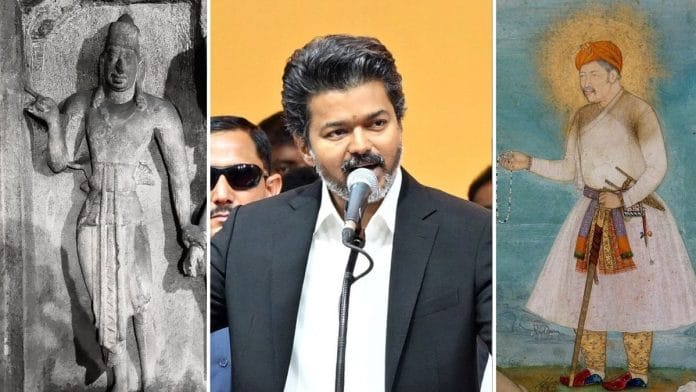


Tamil film star C Joseph Vijay led his newly formed Tamilaga Vettri Kazhagam to victory in Tamil Nadu last week, routing the much more established Dravida Munnetra Kazhagam. But the appeal of a star-politician is by no means limited to South India.
Indian politics today is focused on carefully-cultivated personas. Narendra Modi’s brand is that of an ascetic strongman. Rahul Gandhi is a mohabbat marathoner; Mamata Banerjee is a cotton sari-clad ‘Didi’; and Pinarayi Vijayan is a communist boss in a crisp white shirt. The received wisdom holds this to be evidence of democratic immaturity, a failure to vote for policy over personality.
However, the preference for the performing ruler over the governing one is not just a pathology of today’s democracy. It is an unacknowledged inheritance: ingrained into our politics, by politicians great and small, for nearly one and a half millennia.
The king and the aristocrat
In the late sixth century CE, a dynasty formerly based on the Andhra coast—the Pallavas—arrived with their armies in present-day Tamil Nadu. In the region, especially the Kaveri delta, powerful peasants of the Vellala caste controlled most agricultural land, and were not interested in these new kings handing property out to their loyalists. And so, the early seventh-century king Mahendra-varman I, a playwright, aesthete, and patron of rock-cut temples, invested in a new mode of semidivine political branding. In his temple to Shiva at the Trichy Rock Fort, for example, he claimed that when he “made a stone figure in the wonderful stone abode on top of the King of Mountains, this ruler, ‘Vidhi’ [the creator], made Sthanu [Shiva] true to His name and became himself sthanu [fixed, immortal] together with Him, on earth.” Sanskrit puns of this sort could not be read by the average subject or devotee. Mahendra’s audience was other landed aristocrats, over whom he claimed preeminence through his proximity to Shiva.
What followed, as historian Manu Devadevan demonstrates in his paper, ‘From the Cult of Chivalry to the Cult of Personality’ (2017), was a wholesale reinvention of royal identity. Temples were named after the king’s personal titles—for example, Mahendra-Vishnu-Griha, Mahendra’s Home for Vishnu. Cities were renamed: Mahallapuram, after king Mahamalla (“Great Wrestler”).
Pallava court poet Dandin, whose Kavyadarsha or “Mirror of Poetry” shaped literary practice from Sri Lanka to Tibet, made explicitly urban and elite recommendations for good Sanskrit, maintaining a careful theoretical distance from the rural and the rustic. The infrastructure of Pallava kingship was calibrated to dazzle an audience of urban, literate elites. The eighth-century Pallava king, Narasimhavarman II, left a catalogue of 233 personal titles inscribed at Kanchipuram, celebrating his courage in battle, his beauty, his erotic energy, and his generosity to Brahmins. Not one of them meant anything to the effect of “he who built schools and hospitals”.
Such political techniques were not unique to the Pallavas. As historian Ronald Inden argues in his book Imagining India (2000), the paramount medieval sovereigns—the Rashtrakuta emperors of the Deccan—presented themselves as descendants of the Moon, bringing order to the decadent Kali Age. Their prashastis catalogued military campaigns against recalcitrant kings, and described their lustrous fame expressed in jewels, royal parasols, and captured insignia. The Rashtrakuta imperial formation was a hierarchy of ranked kings and lords, bound to the Maharajadhiraja, the Great King-of-Kings, through the distribution of titles, honours, and symbolic privilege. The king’s subjects were other aristocrats, the only individuals with the resources to actually challenge him. Political energies were directed toward keeping them in line, through architectural, literary, and occasionally, military manifestations of power.
Also read: History of Indians in the Arab world—port builders, Jat governor, translators, and slaves
A medieval broadcast
The Cholas (c. 850-1280 CE) gave the medieval royal persona its most durable and sophisticated form. Philologist Whitney Cox, in Politics, Kingship, and Poetry in Medieval South India, studied the meikeerthi, a Tamil verse eulogy which prefaced every Chola royal inscription from the reign of Rajaraja I (r. 985-1014 CE) onward. Cox writes that this was directly adapted from Pallava and Rashtrakuta antecedents. But rather than embracing the florid, literary quality of these Sanskrit prashastis, the Chola meikeerthi was composed in a simplified version of the old akaval meter, the dominant measure of the Sangam poetic anthologies, dating to the early centuries CE.
Akaval was “a conservative, classicising register, evidently meant to appeal not to a group of avant-garde connoisseurs but to a wide Tamil-speaking social elite”, namely the Vellala gentry of the Kaveri floodplains. This was the social class from which the Chola military and bureaucratic leadership were drawn. Meikeerthis, quite tellingly, have little to say about administration, tank excavation, or public works. Instead, as Cox puts it, “the field of kingly action is made into a stage for a small cast of aristocratic heroes and villains, the martial celebrities of the time.” The Chola king is depicted as a resplendent hero, effortlessly routing rivals of the Kalyana Chalukya, Pandya, and Chera clans.
Unlike earlier royal eulogies, Chola meikeerthis do not appear only on royal gifts and grants. Their martial charisma, perfectly pitched to a wide audience, was irresistible—everyone wanted to be a part of it. Over the next century or so, the Tamil gentry would use royal meikeerthis as prefaces for their own temple gifts, and would seek to obtain Chola court titles for themselves, such as Rajaraja-Brahma-Maharaja (“Rajaraja’s Great Brahmin King”) or Araiyan Rajarajan (“Rajaraja’s Little King”). Even military groups would seek Chola-linked identities, such as the Rajaraja-Jananatha-Terinja-Parivaram (“The Select Retinue of People’s Leader Rajaraja”). The parallel to contemporary Indian youth groups and political cadres is striking.
Featured in hundreds of grant inscriptions across dozens of temples, year after year, the meikeerthi was effectively a medieval broadcast. It appeared in temples across the Coromandel coast, was legible to a broad swathe of society, and presented the Chola court as the primary fount of honours for ambitious members of the landed peasantry. The king was a martial, masculine superstar, and the closer you were to him, the more important you were.
The sacred Indo-Persianate king
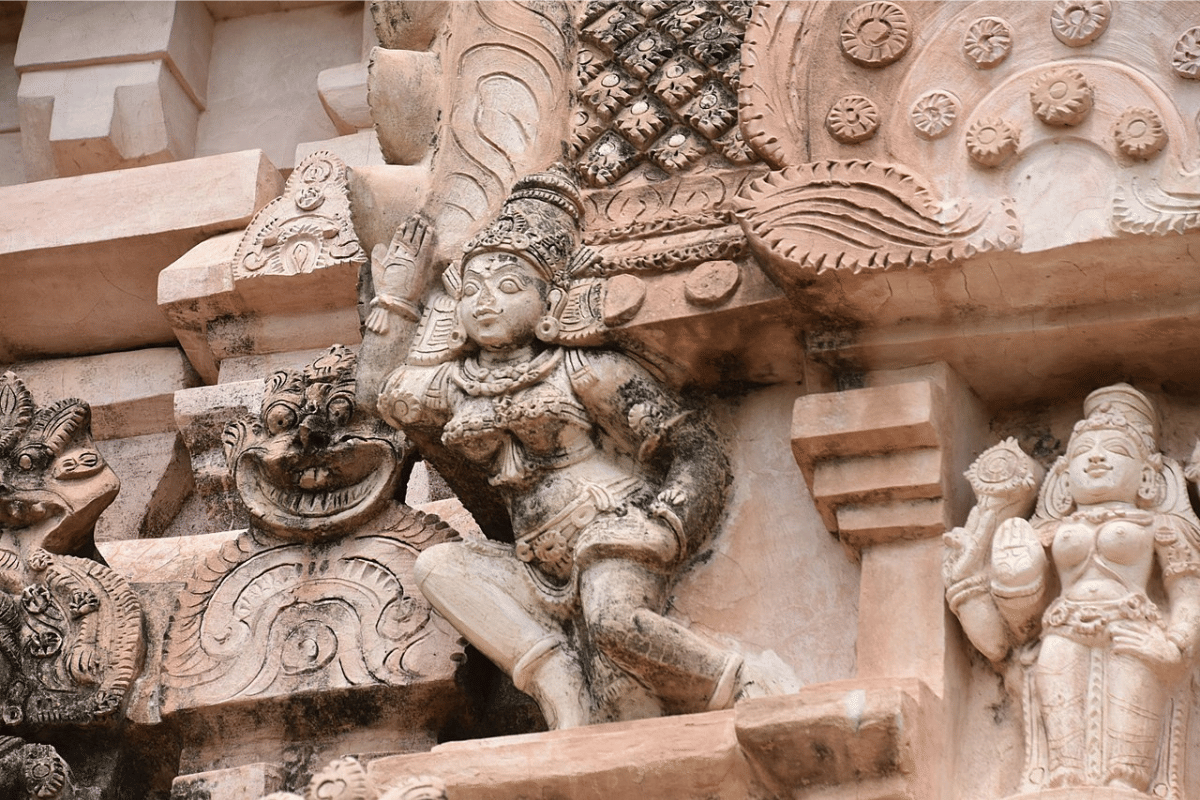
The Turkic and Persianate rulers who entered India from the 11th century onward carried a different theory of kingship. Jihad against the infidel was profoundly valuable in their self-presentation, but so too was submission to the authority of Sufi saints, and the notion of providing justice to all subjects. In India in the Persianate Age (2019), Eaton cites the 12th-century scholar Ibn Balkhi, who conceived of the king’s justice as the binding principle of the political world. To Balkhi, it was a quality of the ruler’s person, explicitly detached from religious obligation. Effectively, though, that was still personality politics under a new name.
The Persianate and Indic cults of the royal persona fused quickly. By the 13th century, Delhi residents were already praising the Sultan Balban, in Sanskrit prashastis, as having subdued the rulers of the entire subcontinent—very much in the style of Rashtrakuta eulogies. Eaton also discusses the Sanskrit poet Udayaraja, who, in the 15th century, wrote a court epic portraying the Muslim sultan Mahmud Begada of Gujarat as a chakravartin: a universal emperor, a kshatriya descended from the Sun, his court blessed by Saraswati and Lakshmi.
By the late 16th century—the end of the first Islamic millennium—Mughal emperor Akbar commissioned the Tarikh-i-Alfi (The History of One Thousand Years) to position himself as a millennial sovereign whose authority derived from his remarkable personal qualities. From the time of Akbar’s successor Jahangir, Mughal manuscript paintings included imagery derived from Hindu cosmic notions, such as sacred bulls, fish, and rishis. Very much in the tradition of earlier Indic kings, Mughal emperors made multiple grants to Brahmins and temples just as they did to Sufi shrines.
While these were elite cultural traditions, they seem to have landed on fertile ground in India. Many Mughal subjects, Hindu and Muslim, saw the emperor as divine. Large crowds attended rituals such as the jharokha darshan, when the emperor appeared on a balcony to the acclamation of his subjects. Ironically, the only serious Mughal attempt to substitute institutions for personality was made by the emperor Aurangzeb Alamgir. He commissioned the Fatawa-i–Alamgiri—a comprehensive legal compendium of Hanafi Sunni Islam—to govern the empire through the rule of law, rather than the mediation of a sacred king.
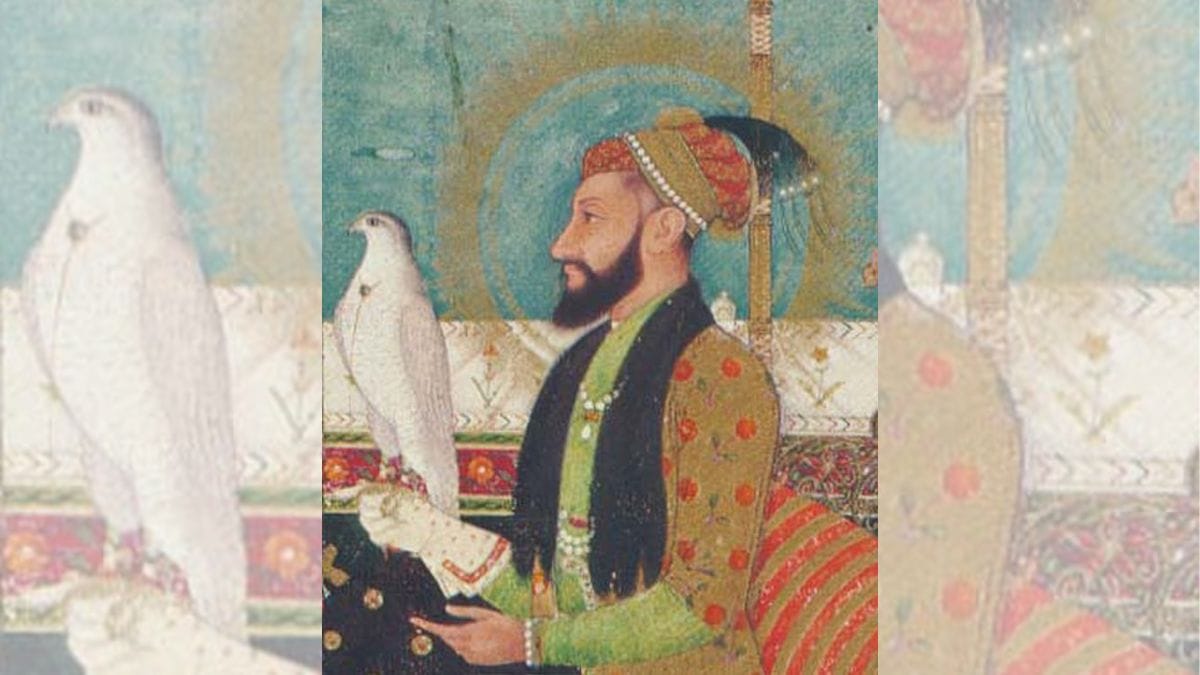
Eaton observes, pithily, that Aurangzeb was sawing off the branch on which he sat: Mughal subjects wanted distant, divine kings, not all-too corruptible bureaucrats and qazis. Indeed, Aurangzeb himself saw the political utility in being considered divine, at one point calligraphing magical banners for his army to use in putting down a rebellion. Several sources attest that he was considered a living saint—Alamgir, zinda pir—despite his much murkier memory today.
Also read: How pragmatic calculations shaped Mughal rule in medieval West Bengal and Tamil Nadu
Divine politicians in a modern democracy
The Indian interpretation of sacred rulership—a medieval solution to a world of landed aristocrats and limited state capacities—has proved to be one of the most enduring political traditions in the world. It was still alive and kicking in the 20th century, when the Indian National Congress embraced the branding of MK Gandhi as an ascetic mahatma, whose spiritual authority sanctified the party’s politics.
In subsequent decades, while filmstars-turned-politicians such as MG Ramachandran arguably set the trend, perhaps the most successful example of the pipeline was Telugu actor Nandamuri Taraka Rama Rao or NTR. For over three decades, starting in 1949, NTR played Rama, Krishna, and Duryodhana with equal conviction for audiences across South India. When he entered politics in the 1980s, he seems to have instinctively understood what 14 centuries of political culture in the subcontinent had worked out before him.
SV Srinivas, in Politics as Performance: A Social History of the Telugu Cinema (2013), examines how NTR’s 1982-83 campaign translated the personality broadcast into the grammar of modern mass democracy. The star leaned heavily into the semidivine imagery of “Telugu Talli” or Mother Telugu, accusing the Congress high command of giving the Telugu state “step-motherly treatment”. His stage presence was bombastic; his promises were grandiose, delivered from a cavalcade of cars, and not limited to the realm of the possible. Favourable coverage from Eenadu, a newspaper-turned-media corporation, allowed NTR to brand himself at a scale that would have bedazzled Rajaraja Chola. And it worked. NTR’s version of theatrical politics—and welfare branded as the personal gift of the elected leader—continues to thrive and evolve across India in 2026.
His opponents had labelled him, rather pithily, as ‘Drama Rao’—naming, without quite realising it, what Indian rulership had always been about in some form.
Anirudh Kanisetti is a public historian. He is the author of ‘Lords of Earth and Sea: A History of the Chola Empire’, and the award-winning ‘Lords of the Deccan’. He hosts the Echoes of India and Yuddha podcasts. He tweets @AKanisetti and is on Instagram @anirbuddha. Views are personal.
(Edited by Prasanna Bachchhav)
“Public” historian sounds like a self-adorned and self-proclaimed title by this blogger. The irony did escape his awareness while he was blabbing sorry blogging about the ancient dynasties native to Bharat.
All our ‘hero’ leaders are utter flop. M K Gandhi and J Nehru should have been jailed for failing to prevent violence and loss of lives during partition. Nehru and his ilk ensured India remains a shithole and corrupt socialist country. Except C Rajahopalachari, almost everyone was/ is a pukeworthy socialist including Modi.