







It has been a little over half a millennium since a battle at Panipat changed the subcontinent’s destiny forever, in ways that seem strangely relevant in the aftermath of recent Assembly elections across India. Over the past decade, the Mughal Empire’s legacy has shaped public discourse both online and in voting booths, with Indian Muslims often held accountable for the perceived sins of long-dead emperors and the destructions and conversions they are believed to have ordered. But the silent testimony of architecture often complicates the shrill proclamations of propaganda.
Construction, destruction, and politics
In West Bengal, the last few years have seen an unprecedented (and arguably successful) attempt to portray Bengali Muslims as “infiltrators” from Bangladesh siphoning Hindu resources from a Hindu land. How accurate is this view? In an earlier edition of Thinking Medieval, we examined the origins of Bengal’s Muslim populace. Mughal court documents suggest that agrarian growth in Bengal saw the involvement of Hindu Bania finance and the voluntary conversion of forest-dwelling communities to Islam and agrarian lifestyles — among other factors.
The Hindutva view of this period, in contrast, casts Mughal expansion into Bengal as a violent process marked by forcible conversions and the widespread destruction of temples, as Muslim invaders had ostensibly done since the 1200s. This view, too, can be drawn from Mughal court documents, such as firmans from Shah Jahan and Aurangzeb ordering the destruction (or halting construction) of temples across the empire.
How might architecture enlighten this picture?
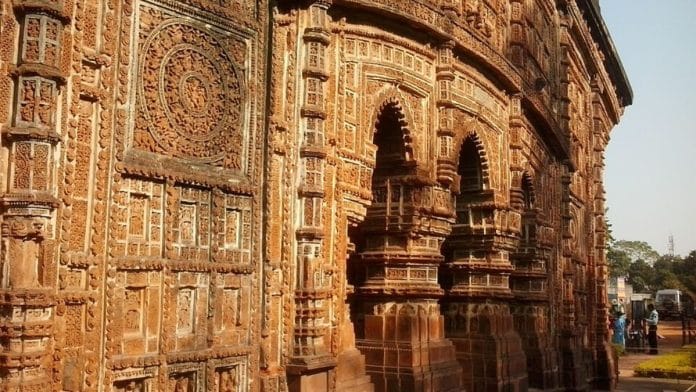
A new volume, Beyond the Mughal Arch: Temples in Early Modern Hindustan, offers a rich and thought-provoking contribution to public discourse on the Mughals and, more broadly, on post-16th century temple architecture in North India. In his essay in the volume, historian Samuel Wright counts 118 temples built in Bengal during the 16th and 17th centuries—102 of them in the 17th century alone, as Akbar, Jahangir, Shah Jahan, and Aurangzeb extended Mughal administration across the region.
The Malla kings of Bishnupur, who accepted Mughal overlordship and became mansabdars (members of the imperial aristocracy), emerged as the most prolific temple builders of this period. Loyalty, devotion, and ambition are all apparent in their temples and inscriptions. For example, Wright presents a 1615 inscription from a Malla patron, claiming to erect a temple “in the auspicious rājya of Shri Shah Salim [Jahangir]”, while also naming the Mughal governor, Raja Kalyan Mal.
The Malla dynasty’s spectacular terracotta shrines helped spread Gaudiya Vaishnavism and introduced several innovations to Bengali temple architecture — they even influenced Mughal design sensibilities. The curved Bangla roof form, inspired by rainproof thatched huts, was later adopted by Shah Jahan for the imperial jharokha in Delhi. This was not a one-sided exchange: Mughal design components, such as multicusped arches, “onion” and “lotus” domes, and others, would also be integrated into Hindu temples.
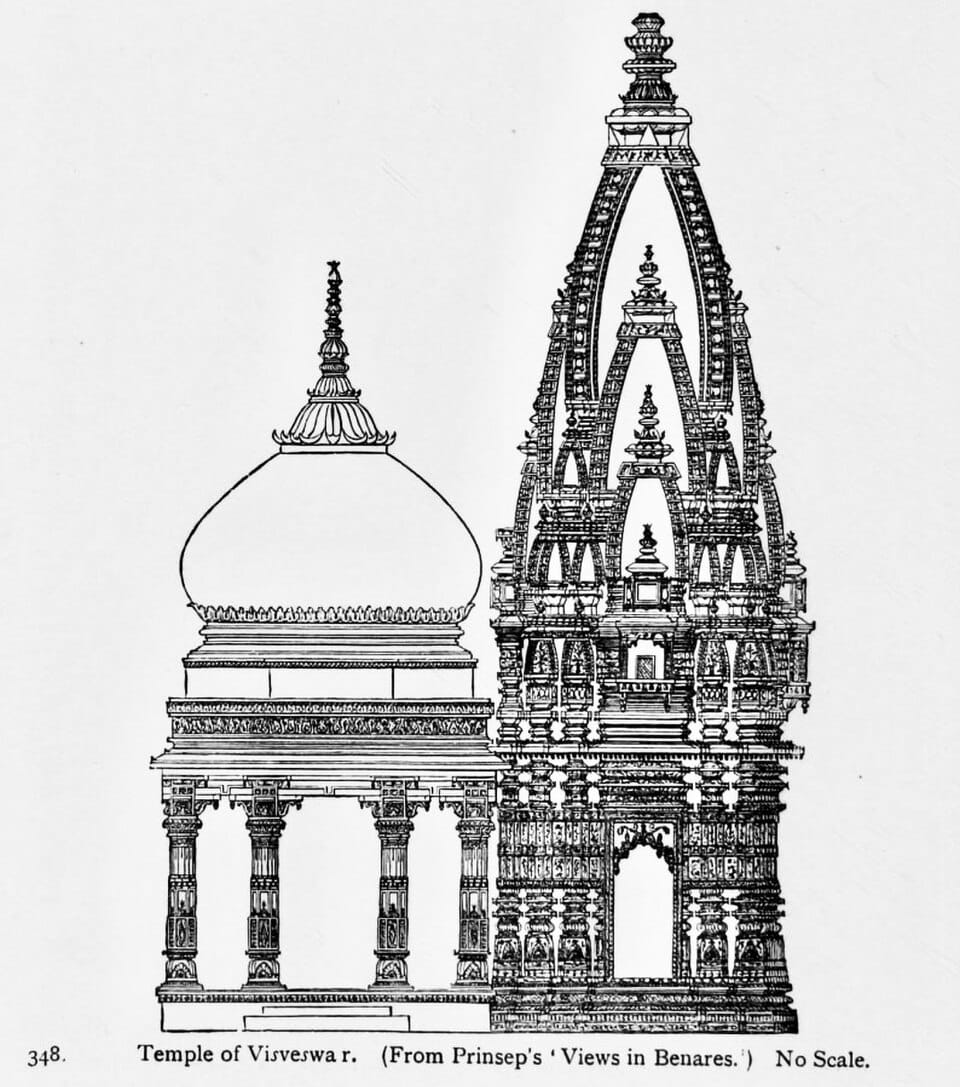
As editors Naman Ahuja and Sam Dalrymple note in Beyond the Mughal Arch, art and culture across this period demonstrate a deliberate attempt to find common ground. Under the Mughals, temple construction and destruction were very much part of the same political calculus.
In Odisha, for example, a Mughal mansabdar rode in the Jagannath rath yatra, demonstrating that the emperor was the temple’s ultimate protector. When Aurangzeb ordered the temple’s closure, local administrators actually faked the demolition because they could not afford to forgo the revenue it generated. Not coincidentally, the Mallas, with their terracotta temples and proclamations of loyalty, also ruled within an exceptionally wealthy province.
Power and patronage within the Mughal imperial apparatus did not operate according to modern notions of “tolerance” or “Islamic bigotry”. Instead, they obeyed the much more realistic — and enduring — calculations of pragmatism.
Also read: History of Indians in the Arab world—port builders, Jat governor, translators, and slaves
A view from the south
We can see similar dynamics at work in a Mughal successor state far to the South, in another state that delivered an electoral upset this week (though without communal rhetoric). During Shah Jahan’s reign in the late 17th century, a South Indian dynast attempted to use a temple to strengthen his bargaining position.
The man in question was Sriranga III (r. 1642–1678), the last emperor of Vijayanagara. This was entirely a titular position; by this point, the once-great metropolis had been a ruin for nearly a century, and Sriranga ruled a tiny dominion centred on Vellore in present-day Tamil Nadu. And the temple in question? The great complex of Tirupati.
Historian Sanjay Subrahmanyam discusses Sriranga in Penumbral Visions: Making Polities in Early Modern South India. According to a 1657 letter, Shah Jahan’s ambassador, along with the local ruler Krishnappa Nayaka, promised to make a “good agreement” with Sriranga “if His Majesty would give over all the stolen jewels from Tirupati into their hands.” Subrahmanyam interprets this letter as an indication that Sriranga was using the temple treasury as a negotiating tool, aiming for the status of an autonomous chief with a jagir.
However, the then viceroy of the Deccan, Aurangzeb, was preoccupied with a war against his brothers. Nothing came of it.
Several decades later, after Aurangzeb’s death, ex-Mughal officials established a new state at Arcot, near Vellore. Much like the Mughal emperors had done in Braj about a century earlier, the Nawabs encouraged loyal Hindu courtiers to make gifts to important temples. In the early 1600s, Rajput and Bundela vassals of Akbar and Jahangir had offered the same at Vrindavan and Varanasi.
In the early 1700s, a certain Lala Todar Mal — a Khatri courtier serving Sa’adatullah Khan of Arcot — offered gifts at the Varadaraja Perumal temple at Kanchipuram and Tirupati. He also commissioned statues of himself with “beard, dress and turban in the Muslim fashion”, along with images of his wife and mother. Subrahmanyam notes that the 16th-century Vijayanagara emperor Krishna Raya had left similar self-portraits at Tirupati, though it’s not clear whether Todar Mal was seeking to imitate him.
Again, in Mughal fashion, the Nawabs seem to have seen the Tirupati temple as essentially state property in times of expediency. In 1740, for example, after a serious defeat at the hands of marauding Marathas, Nawab Dost Ali Khan ordered the temple treasury to hand over Rs 50,000 to the general Baji Rao, whose mother and wife visited the temple. Twenty thousand was then distributed by the Marathas as charity. But some decades later, when the Nawabs bounced back, the state again became a benevolent patron, in the interest of maintaining good relations with its subjects.
Historian Richard Davis discusses this in his paper ‘A Muslim Princess in a Temple of Viṣṇu.’ Nawab Muhammad Ali Walajah (r. 1749–1795) lavishly endowed the Nathar Wali dargah at Tiruchirappalli and Shah Hamid Shah’s dargah at Nagore. He also helped restore Srirangam after French forces had damaged it during the Carnatic Wars and adjudicated disputes over temple honours.
As per historian KD Swaminathan (‘Two Nawabs of the Carnatic and the Sri Rangam Temple’), the Nawabs even intervened at the great Shaiva complex in Chidambaram to restore worship at the Vaishnava shrine of Govindaraja Perumal. The Nawab Muhammad Ali coordinated the festival calendars of the Nathar Wali shrine and Srirangam to prevent clashes between processions, and shared his royal accoutrements — the markers of sovereignty itself — with both.
This seems a studied reconstruction, in the distant Coromandel Coast, of Akbar’s policy of suhl-i-kull, “universal peace”, with the ruler (in theory) a benevolent patron of all subjects. It was also, by then, simply what it meant to hold ultimate political power in a diverse subcontinent. In the 21st century, it remains to be seen if such a view will endure against the odds.
Anirudh Kanisetti is a public historian. He is the author of ‘Lords of Earth and Sea: A History of the Chola Empire’ and the award-winning ‘Lords of the Deccan’. He hosts the Echoes of India and Yuddha podcasts. He tweets @AKanisetti and is on Instagram @anirbuddha.
This article is a part of the ‘Thinking Medieval‘ series that takes a deep dive into India’s medieval culture, politics, and history.
(Edited by Ratan Priya)