





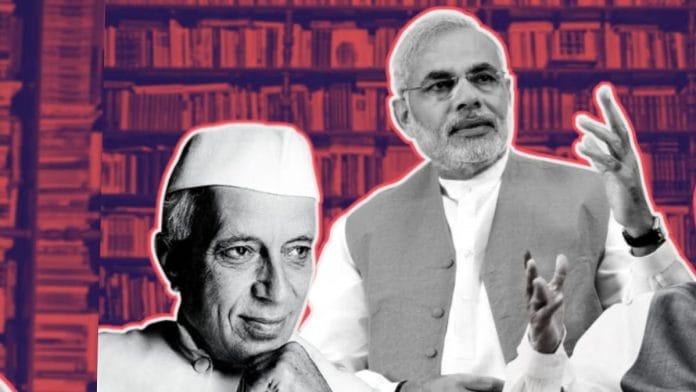


The BJP is commemorating a new political “milestone”. On 10 June, wrote Ram Madhav, an important Hindu nationalist ideologue, Prime Minister Narendra Modi “will complete 4,399 consecutive days in office, overtaking Jawaharlal Nehru’s record of 4,398 days after the first general election”. To underline the political significance of the occasion, the BJP officially celebrated the occasion under the leadership of the party’s National President Nitin Nabin and Home Minister Amit Shah at Bharat Mandapam. Modi ruling India longer than Nehru is an iconic moment for the party and its ideology, Hindu nationalism.
For scholars and political analysts of India, however, the point of Modi’s greater ruling longevity, compared to Nehru, is puzzling. Nehru, after all, was Prime Minister from 15 August 1947 to 27 May 1964. That amounts to nearly 17 years, not just over 12, which is how long Modi has been Prime Minister.
The puzzle is partly resolved if we see how the index of ruling longevity has been constructed. The clock, Madhav said, must begin with Nehru’s first day as Prime Minister after the first national elections (1952), not 1947, when he was first sworn in. The oft-repeated claim of Hindu nationalists, contested in scholarly circles, is that Vallabhbhai Patel would have been India’s Prime Minister after Independence, had MK Gandhi not intervened and chosen Nehru.
One should perhaps not quibble too much with the Hindu nationalist index of ruling longevity. Whatever the exact statistics say, Modi has ruled India long enough, and the comparison of Modi and Nehru is conceptually and politically significant. If Nehru played the biggest role, along with BR Ambedkar, in founding a constitutional, secular democracy in India, Modi has been at the forefront of a systematic attempt at constructing a Hindu nationalist polity. Hindu nationalism is not yet constitutionally legitimated, something that might have happened if the BJP had two-thirds of the Lok Sabha seats in 2024. But politically, it has come quite far. The BJP’s ruling umbrella today covers 75 per cent of India’s total population.
The question of vote share
Before we examine the political differences between Modi and Nehru, let us quickly deal with one more statistical matter. Nehru’s years in power were supported by more than 40 per cent of the popular vote for the Congress party: 45 per cent in 1952, 47.8 per cent in 1957 and 44.7 per cent in 1962.
In those years, Bharatiya Jan Sangh, BJP’s predecessor, received 3.1 per cent, 5.9 per cent and 6.4 per cent of the national vote, respectively. These small beginnings have now been transformed into a fairly mammoth electoral performance. But the BJP is still to reach 40 per cent share of the popular vote, which the Congress repeatedly crossed right until 1984 (except 1977). As dominant as the BJP is, it is still not electorally as gigantic as the Congress used to be.
But, ideologically, the BJP’s dominance is hugely noteworthy. Modi is an antithesis of what Nehru stood for. They could not be more dissimilar. That is why the contrasting fortunes of Modi and Nehru say something meaningful about where India’s polity and society are headed.
In the 1940s and 1950s, the intellectual mainstream did not see Hindu nationalism, represented by the Hindu Mahasabha, RSS or Jan Sangh, as a form of nationalism. It was termed “Hindi communalism”. The same argument was made about Muslim nationalism, led by Muhammad Ali Jinnah and the Muslim League. It was called “Muslim communalism”.
Nehru famously defined communalism as “a narrow group mentality basing itself on a religious community, but in reality concerned with political power and patronage for the interested group”. Nehru’s definition also became the conventional scholarly and political wisdom.
By contemporary social science, however, Hindu nationalism as well as the earlier Muslim nationalism are simply forms of religious nationalism, constituting mirror-images of each other. In the well-known words of Ernest Gellner, a leading scholar of nationalism, a nation means “to endow a culture with its own political roof”. Religious nationalism seeks a political roof over its religious head, equating religion with culture. Such nationalism tends to be exclusive, not inclusive. It seeks political bonding within a religious community; it does not build bridges across religious boundaries.
Also, religious nationalism seeks political rights and privileges on religious grounds. In the process, doctrinal or theological arguments stemming from religious traditions often take a back seat. And a religiously defined community becomes a political community more interested in power, position and public resources, less in piety or faith.
Starting in the 1920s, VD Savarkar became the founder of this view for Hindu India. He also added an important historical dimension to his conceptualisation. He argued that pre-British India was ruled by Muslims, who dominated Hindus through their control over state power. Following the same path, Hindus can reverse their fortunes by establishing control over the state and dominating non-Hindus – Muslims, in particular.
In contrast, secular views of nationhood tended to be religiously inclusive. Those espousing such views see religion and nationhood as fundamentally different. It is an irony of history that some of the deeply religious figures of the Indian freedom movement, Gandhi and Maulana Azad, also became exponents of secular nationalism. For Modi, it is not just Nehru who is an adversary. Azad and especially Gandhi also are.
“If the Hindus believe that India should only be peopled by Hindus, they are living in a dreamland. The Hindus, the Muslims, the Parsis and the Christians who have made India their country are fellow countrymen,” Gandhi, a devout Sanatani Hindu, had said.
Azad, a deeply religious Muslim, opposed Jinnah and the Pakistan movement. “I am Muslim and proud of that fact. In addition, I am proud of being an Indian. I am part of the indivisible unity that is Indian nationality. … Our languages, our poetry, our literature, our culture, our art, our dress, our manners and customs, the innumerable happenings of our daily life, everything bears the stamp of our joint (Hindu-Muslim) endeavour…This joint wealth is the heritage of common nationality,” said Azad.
Also read: The Modi paradox in 2026. Complete political domination alongside worsening economic slide
Politics in Modi’s India
After Independence, India’s Constitution endorsed the secular view of nationhood. The Constitution affirmed two principles cardinal to this debate: equality of all religions and the state’s religious neutrality. The Hindus would not be given any special privileges. In a profound constitutive sense, Nehru embraced this view. Equally constitutively, Modi has internalised the Savarkar view. If Nehru’s politics and statecraft expressed secular nationalism, Modi’s politics and statecraft reflect Hindu nationalism.
Even though the Constitution thus far remains fundamentally unchanged, Modi’s electoral dominance means that, politically, India has stepped away from the original constitutional principles. An important question now is this. Will Hindu nationalist politics finally change the Constitution as well?
Should that happen, it would amount to a complete erasure of Nehru. Modi would ideally want such a rupture and victory. But the vicissitudes of democracy remain unpredictable. In particular, the weapons of the weak have a history of rolling back the plans of the powerful in democratic politics – in India and the world.
Ashutosh Varshney is Sol Goldman Professor of International Studies and the Social Sciences and Professor of Political Science at Brown University. He has taught and researched “Political Economy of Development” for over three decades at Harvard, Michigan, and Brown Universities. Views are personal.
(Edited by Ratan Priya)
In the meantime Author hasn’t learned new term called, pseudo -secularism…. Or he doesn’t want to acknowledge appeasement on the name of cast & faith.
I would have expected more critical analysis from this author.
Nehru was NOT secular. The most secular was BR Ambedkar who opposed Nehru and Gandhi’s ‘convenient’ secularism – convenient because when it came to Hindus, they expected compliance to their wishes. When it came to Muslims, they were compliant to the community’s wishes.
Nehru in not lancing the boil with a Uniform Civil Code left the door open for others to take their initiative. It also meant that the second largest majority in the country, continued to consider themselves different – exactly as Jinnah had told them.
The partition was traumatic – but its root causes continued to be supported by Congress. The pinnacle was the overturning of the Shah Bano case and the rest is history.
Cry harder 😂
What is the point in deciding who is the longest serving PM? India will remain a corrupt, socialist, undeveloped country.
The article appears highly biased and lacks factual accuracy. It claims that Gandhi was a Sanatani, a characterization that is debatable and not universally accepted. The newspaper seems to function more as a platform for propaganda-driven narratives than for objective journalism, reflecting the viewpoints of its authors rather than presenting a balanced analysis.
The strongest evidence for selective secularism is the personal law asymmetry. Nehru spent enormous political capital pushing the Hindu Code Bills through the 1950s — reforming Hindu marriage, divorce, inheritance, adoption — while leaving Muslim personal law entirely untouched, explicitly saying the time wasn’t ripe and reform should come from within the community. Whatever the stated reasoning, the practical result was that the state reformed one community’s religious law by legislation and exempted another’s. That asymmetry is the foundation of the appeasement critique, and it’s not a fringe reading; even sympathetic scholars concede it created a durable double standard that the Shah Bano episode later made explosive. The Somnath temple episode points the same direction for your case: Nehru opposed government association with the reconstruction and publicly disapproved of President Rajendra Prasad attending the consecration, which to many Hindus read as coldness toward a moment of civilizational restoration after centuries of grievance.
Nehru is as much responsible for India’s partition as much as Jinnah is. Lets see if this publication will publish this comment of mine.
Current govt also does does selective secularism. Excluding certain sections of society from UCC in the name of they are not yet ready. Same logic of Nehru still continues.
On the ground, if only congress and others had stuck to being truly secular. It is the policies and practices of appeasement – from looking the other way to outright and blatant favouritism that created the space for the hindutva movement. But dialectical currents have their own rhythm and reasons for existence. This tide shall also turn. And instead of demonising hindutva or pettily comparing days and % ages, an intellectual like Varshney could do well to show a deeper analysis and understanding of the positives and negatives of both , which is hope , can be integrated and eliminated in the next synthesis