





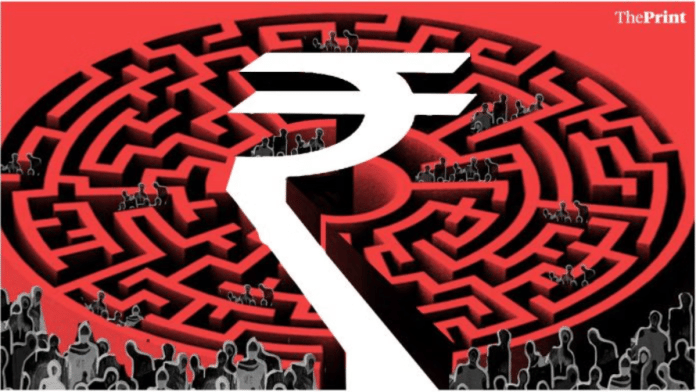


The realm that is the intersection of politics and economics is encountering a weighty paradox in India. The Modi government is exercising mastery over the political domain, but the problems of the Indian economy are growing worse. The chasm between increasing political domination and deepening economic frailties may not be bridgeable without serious reform.
After the recent Assembly elections, the Modi government is now at its strongest since 2019. The conquest of West Bengal means that BJP rules 21 states of India, by itself or in coalition. Only seven states are with Opposition parties.
For all practical purposes, BJP’s decline in the 2024 Lok Sabha elections, when it lost 63 seats, has been reversed. The party’s ruling presence now covers an estimated 75 per cent of India’s population. Politically speaking, the Modi government could not be happier.
But economically, the sliding national fortunes are also becoming markedly clear. This may come as a surprise to those who only pay attention to the economic growth statistics.
Decline in private investments
In recent years, India has had an average growth rate of roughly 6-7 per cent annually, which is among the highest in the world. The crisis in the Middle East will almost certainly bring the rate down, as the costs of energy imports rise. But India has enough foreign exchange reserves to avert a 1991-like external crisis.
Recall that India’s dollar reserves in July 1991 could only cover two months of imports, and the country was exporting very little. An economic stabilisation agreement with the International Monetary Fund (IMF) had to be signed. Even if the war in Iran lasts longer and the Strait of Hormuz remains closed, India is unlikely to go to the IMF for a bail-out package.
What then is the nature of the crisis? It has to do with private investment, both foreign and internal. Only $3 billion of net Foreign Direct Investment (FDI) came in the first nine months of 2025-26. The inflow was $74 billion, and $71 billion the outflow. The situation in the preceding two years (2023-34 and 2024-25) was not substantially different. Indeed, the net inflow of FDI has basically been declining since 2020. It suggests that the FDI tumble began before geopolitics turned against India, especially with the rise of US President Donald Trump and the Iran war.
In retrospect, the so-called China Plus One strategy has not worked for India. Without too much exaggeration, Apple’s investment in Tamil Nadu can be viewed as a lone shining star in an otherwise dim firmament.
But unlike China, FDI, though hugely important for technology and supply chain networks, has never been a very large proportion of India’s GDP. In terms of magnitude, the bigger investment issue concerns domestic private corporate investment.
Depending on what cut-off one picks, the overall investment rate in India since the rise of Modi has basically been quite flat, or has even slightly declined. In 2014, the investment rate was 34.3 per cent of GDP. Ten years later, it was 32.9 per cent, and may have gone down further since then.
Basically, India’s aggregate investment rate has been primarily driven by a large increase in public investment. With the government investing in infrastructure, India’s roads, railways, airports and seaports are much better than before. But unlike China, the infrastructural push has not spurred private corporate investment.
In a widely read article, Abhishek Anand, Josh Felman and Arvind Subramanian show that private corporate investment fell from the high of 17 per cent of GDP in 2007 to roughly half of that in 2025. The plunge no doubt began before Modi, but it continued after his rise as well. The Modi period has not led to a turnaround.
It also means that with private investment going down, the Modi government’s impressive average annual growth rate of 7 per cent has been mostly a consequence of public investment. Much of the public investment is financed by credit, rather than tax revenue, for the simple reason that the so-called new welfarism, including food rations for 800 million Indians, requires a lot of fiscal resources. The government’s debt might become a serious macroeconomic issue if economic growth plummets for some unanticipated reason, such as another consequential war.
The political economy question is this: why haven’t investors been adequately enthused about Modi’s business-friendly image? Why does Modi’s exhortation about “Make in India” or Atmabirbharta (self-reliance) not induce them to invest in India? Several, of course, do invest, but not enough of them do. Private investment remains low. Moreover, many Indian companies also heavily invest abroad.
The underlying problem can best be defined as a certain kind of statism, which does not fully rely on market forces to achieve economic outcomes. To be sure, Modi’s statism does not have a Nehruvian flavour. Nehru believed in central planning, which meant that the Planning Commission told private investors where to invest, how much, with what technology, and where to raise the capital. For all practical purposes, private economic freedom did not exist at the time. Modi does not believe in central planning. Dismantling the Planning Commission was one of his first executive acts as Prime Minister.
But he does not believe in markets either. Rather, he believes in directing markets and instructing private investors. Initiatives such as “Make in India” and the Production-Linked Incentive (PLI) scheme are the best examples. Modi would like to give incentives to businessmen for investments in some key nationally desirable sectors: electric vehicles, smartphones, semiconductors, batteries, renewable energy, etc.
Japan had a similar “national champions” strategy in the 1950s and 1960s, and South Korea during the 1970s-1980s. There is, however, a key difference. National champions in Japan and South Korea – Honda, Toyota, Sony, Hyundai, Samsung, LG – were subjected to the discipline of world markets, which led to their international competitiveness. Modi’s national champions have primarily captured internal, not external, markets. Their financial fortunes are domestically based. With isolated exceptions, their international competitiveness is minuscule. They are not a replica of India’s information software companies that sparkled on the world stage.
The chosen few, prospering on the basis of cozy business-government relationships, also have a negative fall-out for smaller and medium-sized investors. In sectors that do not attract the attention of corporate tycoons, talented entrepreneurs can still thrive. But in the sectors dominated by the giants, competition and new ideas are discouraged.
Also read: BJP’s wins in Assam & Bengal show competitive authoritarianism is knocking on India’s door
Ease of doing business
A final issue is that India’s regulatory rules and laws remain labyrinthine. There is a need for ease of doing business. Nehru overdid the “Inspector Raj”, but Modi has not significantly reduced the role of bureaucrats and inspectors either. If an investor has the capacity to invest big amounts, the headaches of regulation and inspection can be managed. Even legal disputes can be handled. But medium or small-sized investors simply don’t have the financial or organisational bandwidth to set up internal offices that deal only with regulators, inspectors and courts. They would rather concentrate on business and production.
India’s investment crisis cannot be fully resolved until the government reforms the regulatory structure, reduces its many interventions in the economy and relies more on markets, de-emphasises its smug coziness with select industrialists, and makes the playing field more neutral, competitive and attractive for all investors. India will muddle through in any event, but a shining Viksit Bharat (developed India) will be much harder to achieve without serious reform. India right now is going through what earlier political economy scholars used to call an “investment strike”.
Ashutosh Varshney is Sol Goldman Professor of International Studies and the Social Sciences and Professor of Political Science at Brown University. He has taught and researched “Political Economy of Development” for over three decades at Harvard, Michigan, and Brown Universities. Views are personal.
(Edited by Ratan Priya)
Political economy. That is what needs fixing. A clear set of decisions have been taken, or consciously not taken, for over a decade. They have delivered wonderfully well for whom they were intended. Not created a rising tide that lifts a billion tiny boats. How is Vietnam, weighed down on paper by a communist ideology, as China was, doing so well. What prevents Maharashtra itself from being the equal of Vietnam.
Political domination by weakening institutions and using the state machinery like courts, police, civil service, election commission to arrest/incarcerate/falsely implicate most major opposition leaders. This is a hollow victory/domination. This same tactic is followed by Erdogan and Trump. The next generation will pay the price for this act.