







Prime Minister Narendra Modi has made his first stopover in Jakarta, meeting his Indonesian counterpart, President Prabowo Subianto, as part of his three-nation tour to Indonesia, Australia and New Zealand from 6 July to 11 July. The development comes at a time when regional anxieties are paramount on the China threat and questions on Taiwan’s future loom large.
In May, the much-awaited Xi-Trump Summit in Beijing signalled a major reset between the world’s powerful countries.
Trump’s visit, for many, changed the strategic lexicon of ‘US-China rivalry’ to ‘managing the China threat’ through transactional diplomacy. And now, as the two superpowers rearrange the bilateral ties and eventually shape their regional priorities, it leaves a sense of disquiet in the First Island Chain countries like Japan, Taiwan, the Philippines, Malaysia, Brunei, and Indonesia, on the US role in the region, especially in the case of a Taiwan contingency.
Amid this, for a country like India, whose stakes in regional security remain at an all-time high and for whom the China threat challenge is beyond the maritime sphere, what does PM Modi’s visit indicate?
But let’s hold, there is more than just one visit and one answer.
Prime Minister Modi’s visit also overlaps with Foreign Minister S Jaishankar’s six-city tour, with four in the Gulf Cooperation Council (GCC), namely Qatar, Bahrain, Kuwait and Oman, then a visit to New York and Brussels in Belgium. Jaishankar’s 11-day visit from 5 July to 15 July covers West Asia, Europe and the US.
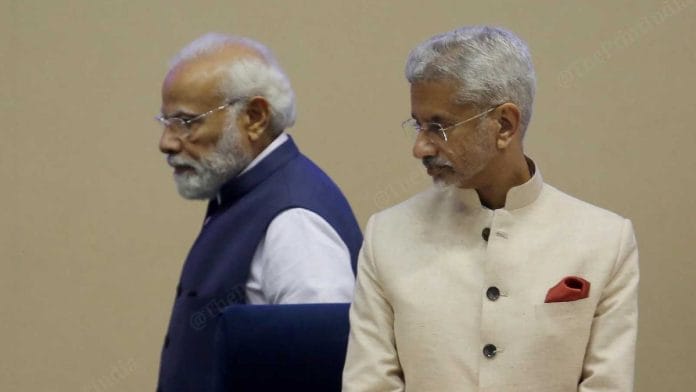
Jaishankar’s visit to three continents—Asia, Europe and America—comes in the backdrop of the crisis in West Asia and the ongoing war between Russia and Ukraine in Europe. While Jaishankar mostly accompanies the Prime Minister on such tours, the two leaders taking separate visits to different locations indicate a well-calibrated strategy that Delhi is adopting after major global churns in Indo-Pacific, West Asia, Europe and the US.
A calibrated strategy
July could be the busiest month for India’s diplomatic establishment as Modi and Jaishankar cover major power centres globally, and all destinations are friendly and welcoming. The visits are fundamentally aimed at outreach, outcome, continuity, and deploying a future strategy.
The two visits are markers of urgency that India faces on the energy front. However, it is an opportunity to explore the markets in the Indo-Pacific, Europe, and also deepen India’s global power status as Jaishankar will be launching Delhi’s official bid for the UN Security Council tenure 2028-29 on 13 July in New York.
To begin with, India’s outreach efforts in the Indo-Pacific, especially in the milieu of a reset in US-China relations, followed by uncertainty that concerns the region and groupings like the Quad, indicate that Delhi’s regional policy and commitment to security and stability in the Indo-Pacific region must not be risked for one’s regional reset. Developments in the Indo-Pacific need urgent attention, and if like-minded partners like the US intend to take a back seat, there are countries like Japan and Australia, which are ready to play a major role along with India in ensuring the Indo-Pacific remains peaceful and stable.
Also read: Piyush Goyal says India is on track for $1 trillion exports. FTA kite has a string problem
Outreach and continuity with prospects
At the same time, this visit is also outcome-oriented, with investments, critical minerals, advanced technologies, securing supply chains, maritime cooperation, and most importantly, making defence cooperation the key highlight of partnerships in the Indo-Pacific. India’s BrahMos deal with Indonesia has been long in the making, and its conclusion will yet be another milestone in Delhi’s ongoing journey as a defence exporter.
This also introduces a ‘hard power’ element of defence cooperation in India’s Act East Policy, which for long was subject to ‘soft power’ considerations involving people-to-people and shared socio-cultural and political ties.
Similarly, continuity of new elements introduced in India’s partnership with Australia and New Zealand provides a strategic boost for the future. With Canberra, a major upgrade began in 2020 following the virtual summit between Modi and then-Australian PM Scott Morrison, where the two leaders elevated the bilateral ties to a Comprehensive Strategic Partnership (CSP).
In 2025, Australian Deputy PM and Defence Minister Richard Marles travelled to Delhi to mark the five years of CSP. With Modi’s next stopover in Australia for the Annual Leaders’ Summit, the ties are expected to see a major boost.
If ties with Indonesia and Australia have seen a continuity, PM Modi’s visit to New Zealand is even more historic as this will be the first official visit of an Indian Prime Minister in “four decades.” Besides a renewed connection, the visit will reflect the Free Trade Agreement (FTA) that Delhi and Wellington signed in April this year, making Indian exports 100 per cent duty-free, along with a commitment of $20 billion investment, addressing sensitivities on dairy and agricultural products, and deepening mobility between the two countries.
Meanwhile, this visit would also help actualise the commitment made in the deal, where business and investment will be key priorities.
Also read: What PM Modi’s three-nation tour tells about India’s changing Indo-Pacific policy
Mapping the new in Indo-Pacific
Beyond the key areas, India is also taking this opportunity to map and discuss options and responsibilities that have emerged following the reset in US-China ties and its implications for the Indo-Pacific region. That said, there is a limitation when the question of China comes, considering almost all three—Indonesia, Australia and New Zealand—since the change of administration at the White House, have worked toward managing ties with China, and their new deals, including trade, concluded with Beijing.
While a shift in the US’s approach to the Indo-Pacific is not new, a change at this juncture, especially Beijing’s military activities in the Taiwan Straits, not only puts Taiwan’s future in question, but also warns the region of disruptions in supply chains and Beijing’s technology monopoly and so on, and hence, such visits provide a timely conversation around strategies to deal with a ‘New World Order.’
Conversely, Jaishankar’s visits to four Gulf member countries, immediately after the MoU between the US and Iran, are aimed at securing energy supplies to India. A country with its growing population and energy needs, and a greater diaspora in the Gulf, not only highlights the urgency that India faces, but also a supporting strategic hand that India extends to the Gulf in bringing peace to the region.
Interestingly, when the conflict broke out in West Asia, India yet again exhibited its ‘comfortable’ position in engaging with all parties and defied any pressures of taking sides, which is key to advocating peace in the region.
Many in the West still wonder how India manages the ‘comfortable position’ between different opposite poles, such as Iran-Israel or with Russia and Ukraine. While India’s “Strategic Autonomy” answers these questions, the shape, foundations and ideology of the former is a work in progress, and events like these test its resilience. Meanwhile, as India’s display of ‘comfort’ in West Asia, Europe and the US grows, it is still a matter of study in the West.
However, what the latter needs to understand is that there cannot be two different treatments for the interests of the West as primary and the interests of 1.4 billion people as less serious.
To conclude, Modi’s and Jaishankar’s multi-city, multi-nation tours are guided by a clear strategic vision and India’s well-calibrated foreign policy, seeking to strengthen partnerships across regions, deepen economic and technological cooperation, reinforce maritime connectivity, and advance New Delhi’s role as a leading voice in an increasingly fragmented world.
Rishi Gupta is a commentator on global strategic affairs. The opinions expressed in this article are those of the author alone and do not reflect the views of the author’s current or past affiliations in any form.
Views are personal.
(Edited by Saptak Datta)