



India’s trade policy often emphasises ceremonial aspects, such as signing agreements, announcing figures, and proclaiming success. However, the subsequent administrative processes, rather than diplomatic efforts, will ultimately determine whether Commerce Minister Piyush Goyal’s projected $1 trillion in exports for this year materialises or remains aspirational.
After the Board of Trade meeting in New Delhi on Friday, Goyal said India was “on track” to achieve this target, and employed a metaphor: “When you fly a kite, you have to hold it tight.”
The same day, the finance ministry issued the Rules of Origin for the India-UK Comprehensive Economic and Trade Agreement (CETA), which is crucial for determining which Indian exporters will benefit from the duty-free access promised by the agreement starting 15 July. Thus, the ambitious target and the intricate details are intrinsically linked.
Also Read: India on an FTA signing spree, but limited utilisation & widening trade deficits temper gains
A two-decade bet
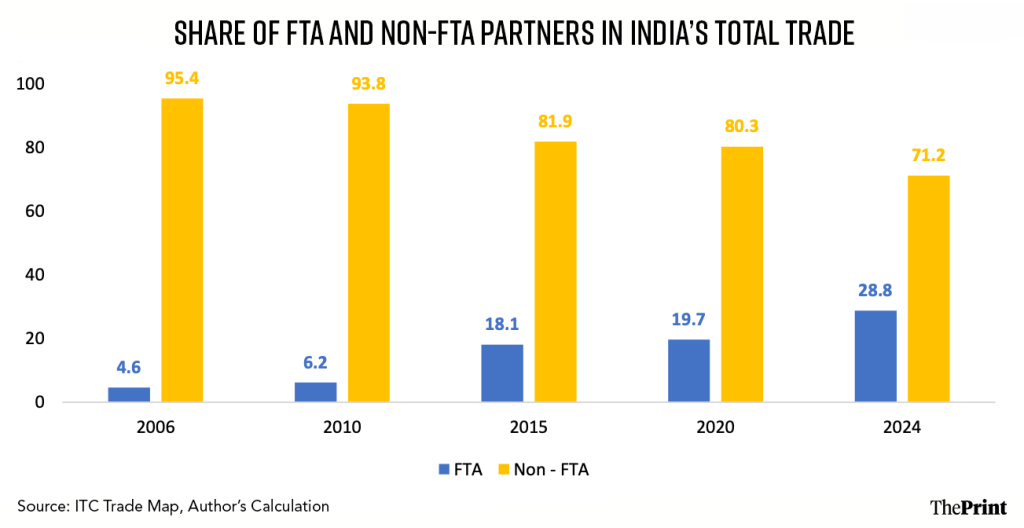
India’s engagement with free trade agreements represents a structural shift that has evolved over the past two decades, rather than a recent development. According to Niti Aayog’s Trade Watch Quarterly, the proportion of India’s total trade with FTA partners increased substantially, from 4.6 per cent in 2006 to 28.8 per cent in 2024.
In this context, India’s expanding FTA network and the implementation of CETA are understandable. However, the same report presents a less prominent but significant statistic: in the most recent quarter, India’s exports to its FTA partners decreased by 7 per cent year-on-year, amounting to $40.26 billion, while imports from these same partners increased by 6 per cent, to $70.98 billion. The investment is substantial, and its effectiveness remains a question for the current quarter rather than a matter of historical analysis.
Growing trade, growing deficits
The extended historical record makes it harder to dismiss the observed pattern as a mere anomaly. India’s three older major Free Trade Agreements with ASEAN (2010), Japan (2011), and South Korea (2010), have indeed led to an increase in exports. When comparing the pre-FTA period (2007-2009) with the period from 2023 to 2025, India’s exports to ASEAN increased by 104 per cent, to Japan by 48 per cent, and to South Korea by 63 per cent.
However, in each instance, imports grew at a faster rate. The trade deficits, measured as the gap between imports and exports, expanded by 381 per cent with ASEAN, 318 per cent with Japan, and 268 per cent with South Korea during the same time frame, in contrast to a 142 per cent increase with the rest of the world, as reported in the Global Trade Research Initiative’s (GTRI) FTA Report Card 2026.
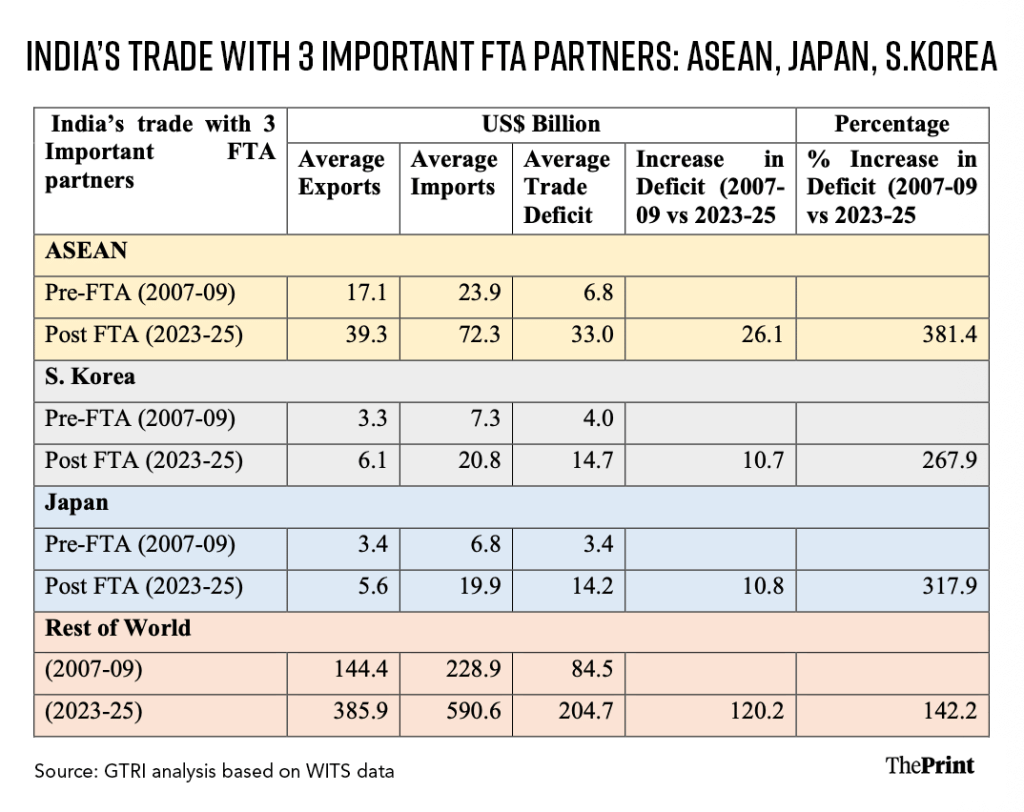
That comparison with non-FTA countries is significant as it highlights the specific changes brought about by the agreements themselves. This perspective is not marginal; it aligns with the concerns that informed India’s decision in 2019 to withdraw from the Regional Comprehensive Economic Partnership. The government cited similar patterns observed with ASEAN, Japan, and South Korea. The data are up-to-date rather than historical: India’s trade deficit under the Korea CEPA alone reached approximately $15.2 billion in FY25, while its deficit with ASEAN under the AIFTA agreement was between $43 billion and $46 billion in FY24.
Also Read: India-UK FTA to kick in on 15 July. What gets cheaper & how Indian exporters stand to benefit
The paperwork tax
The implications of this analysis do not necessarily indicate that CETA will replicate previous patterns. However, achieving the $1 trillion target cannot rely solely on the assumption that duty-free access will automatically translate into export revenue.
The determining factor is procedural, rather than a high-level meeting. The GTRI report clearly outlines the rationale: many of India’s FTA partners already maintained low tariffs prior to the agreements, resulting in minimal advantages for Indian exporters claiming preferences. Conversely, foreign exporters to India encounter a significant average tariff of 12.6 per cent, rendering the associated paperwork beneficial for them. Consequently, only 20-30 per cent of India’s eligible exports utilise FTA benefits, compared to a 60-70 per cent utilisation rate by exporters to India.
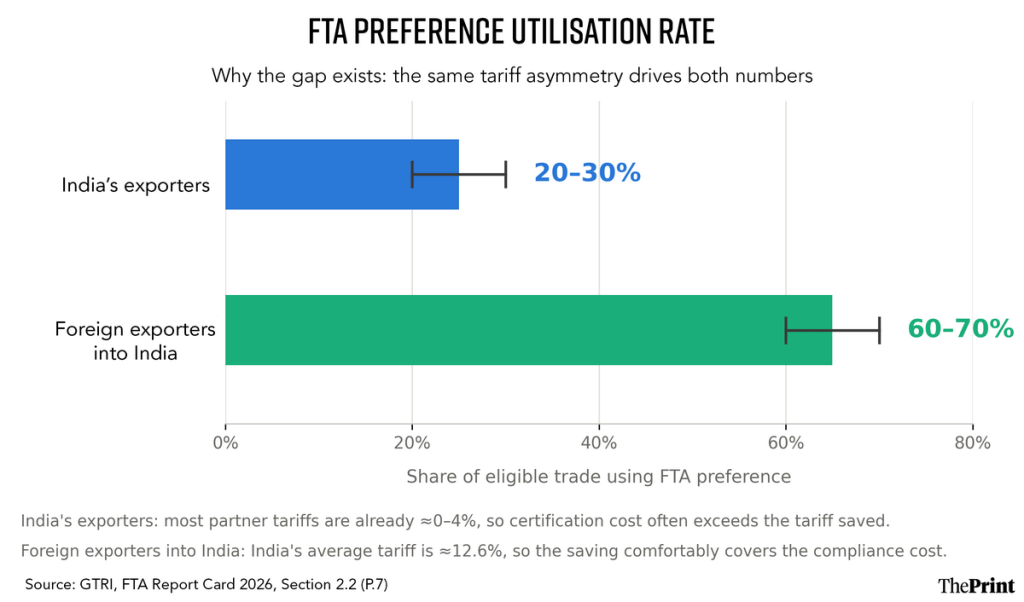
CETA exhibits variability in this regard, presenting an opportunity for intervention. The United Kingdom has maintained significant tariff peaks in labour-intensive sectors, which this agreement aims to support: approximately 8-12 per cent on textiles and clothing and 4-8 per cent on footwear and leather, while engineering goods and automotive components already enter the UK at nearly zero rates. The sectors where preferential treatment is genuinely advantageous are predominantly composed of small and medium-sized exporters, who are least equipped to manage certification costs; conversely, the sectors most capable of handling the necessary documentation have minimal tariff incentives to pursue it.
That represents a resolvable discrepancy rather than a definitive conclusion. The GTRI’s recommendations provide guidance: establishing an FTA Impact Monitoring Authority to oversee utilisation and sectoral benefits, mutual recognition of UK-India testing standards, and simplified compliance for smaller exporters, none of which have been achieved in previous FTA reviews.
Goyal correctly asserts that managing this initiative requires careful oversight. However, it is crucial to acknowledge that the oversight mechanism, in this instance, is a rules-of-origin certificate, accurately filled in by the very small exporters who are least prepared to do so. Whether CETA’s utilisation rate significantly exceeds India’s historical 20-30 per cent within the two or three quarters following 15 July will provide a more accurate measure of this agreement’s success than any duty-free percentage. This is the metric that calls for attention; everything else is just the kite.
Bidisha Bhattacharya is ThePrint Consulting Editor (Economics) and an Associate Fellow, Chintan Research Foundation. She tweets @Bidishabh. Views are personal.
(Edited by Asavari Singh)