





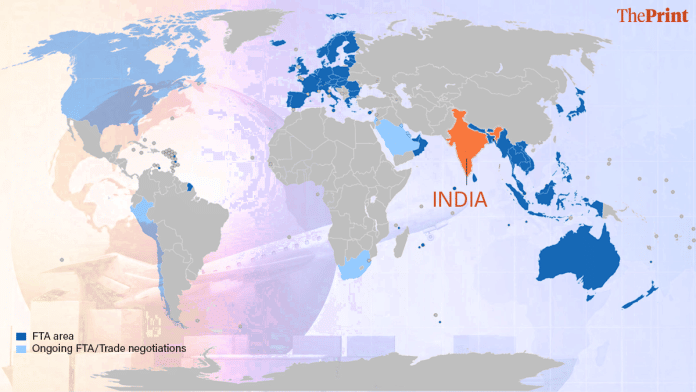


New Delhi: India’s FTA with New Zealand, signed in April 2026, is the latest in a string of Free Trade Agreements (FTAs) the Narendra Modi government has signed since 2021. Modi is expected to make his first-ever official visit to New Zealand in July 2026 to accelerate the FTA’s implementation framework and fast-track ratification.
Earlier FTAs were signed with the United Arab Emirates, Australia, the United Kingdom, and the European Free Trade Association (EFTA) bloc.
This marks a major shift for a country that has long been deeply protectionist.
Data from recent financial years show that exports have increased, but the trade deficit continues. Ministry of Commerce data shows that between FY25 and FY26, India’s cumulative exports grew at 4.22 percent. Imports rose faster, at 6.47 percent.
The trade deficit, as a result, widened from $94.66 billion to $119.30 billion. This highlights continued import dependence.
Also Read: Modi’s political boom is drowning out India’s economic gloom
Opening up the economy, but selectively
Not all trade deals are FTAs. ‘Trade deal’ is an umbrella term with its coverage ranging from limited tariff concessions to deeper economic partnerships.
FTAs are legally binding agreements between two or more countries that reduce or eliminate tariffs and quotas across different sectors. They grant preferential access to boost exports, investments, and economic integration.
Under FTAs, countries can protect sensitive sectors, impose rules of origin, regulate services, and set up investment rules. In practice, FTA negotiations revolve around which sectors open up, as well as to what extent.
India has always approached FTAs cautiously.
For decades after Independence, it followed an inward-looking economic model built around import substitution, high tariffs, and protection for the domestic industry.
Even after liberalisation in 1991, the government remained wary about opening sectors such as agriculture and dairy. That caution continues.
Agriculture remains politically sensitive because millions of Indians depend on farming for their livelihoods.
Dairy is even more protected. India is the world’s largest milk producer, and farmer groups have repeatedly warned that cheaper foreign imports could hurt small producers.
Concerns over rising Chinese imports and widening trade deficits contributed to India’s withdrawal from the Regional Comprehensive Economic Partnership (RCEP) in 2019. The fear was that domestic manufacturing would be overwhelmed by cheaper Chinese goods.
So, while India is signing more FTAs, it is still practising what economists often call “calibrated protectionism”. It means opening up selectively, while shielding vulnerable sectors.
From initial scepticism to an FTA boom
When Modi first came to power in 2014, his government was cautious about trade agreements. Many earlier FTAs were then seen as having widened India’s trade deficits—that is, imports exceeded exports.
Before 2014, India focused on broader, multilateral frameworks. These included ASEAN-centred agreements (AIFTA) and the 2006 South Asian Free Trade Area (SAFTA) between SAARC members. These prioritised regional integration and geopolitical alignment.
However, rising imports—from China, particularly—led to scepticism about their benefits.
These agreements led to a surge in imports, but India’s exports often failed to keep pace.
Under AIFTA, India recorded a US$43–46 billion deficit in FY24. FY26 imports from ASEAN rose 8.6 percent, without a matching growth in exports.
India’s deficit under the South Korea Comprehensive Economic Partnership Agreement (CEPA) reached roughly US$15.2 billion in FY25. Exports to Korea, meanwhile, dipped 9.3 percent between FY24 and FY25.
Under the Japan CEPA, India recorded an approximate US$10.7 billion deficit in FY26, till November 2025.
SAFTA remains an exception, though India’s trade surplus under the agreement has steadily narrowed since FY22.
Policymakers and industry experts argue that Indian manufacturers lack competitiveness. FTAs, they say, benefit foreign exporters more than Indian firms.
This scepticism peaked in 2019. The Modi government withdrew from the Regional Comprehensive Economic Partnership (RCEP).
During this period, India also tightened its approach to foreign investment treaties. Beginning in 2016, India terminated dozens of older Bilateral Investment Treaties (BITs).
A more restrictive model was introduced to protect regulatory sovereignty, which reduced exposure to costly investor-State disputes. In the short term, this reduced legal and financial pressures. But it also contributed to longer-term investor uncertainty.
Beyond goods trade: FTA with ‘trusted partners’
After 2020, experts identified that limited utilisation of FTAs constrained growth in exports and contributed to a persistent trade deficit.
Three developments followed. First, global supply chains started shifting after the COVID-19 pandemic. Tensions between China and Western economies were growing. The West was looking for alternative manufacturing hubs. Second, India was looking to boost exports and attract investment. Investment could support earlier initiatives such as Make in India (2014) and Production Linked Incentive (PLI) schemes (2020).
Third, the Modi government recalibrated its strategy. Instead of joining giant multilateral trade blocs, India began pursuing targeted bilateral agreements with economically complementary countries.
Currently, the newer FTAs focus heavily on services, investment and supply chains, not just goods trade. This helps the overall trade balance, as India has consistently reported a strong trade surplus in services. A surplus is when exports exceed imports, seen particularly in IT, consulting, and business services.
Unlike agreements centred on regional integration, these newer deals are aimed at “trusted partners” and developed markets. The government believes it can secure stronger gains in particular markets.
A snapshot of FTAs & how they are faring
After 2020, India’s FTA push accelerated sharply. In roughly five years, the Modi government concluded or signed the following agreements: India-Mauritius CEPA (2021), India-UAE CEPA (2022), India-Australia ECTA (2022), India-EFTA TEPA (2025), India-Oman CEPA (2025), India-UK CETA (2025), and India-New Zealand FTA (2026).
According to the government, negotiations with the European Union are close to completion. Talks continue with countries and blocs, including Canada, Chile and the Gulf Cooperation Council.
Together these deals reflect a dramatic turnaround from the Modi government’s earlier scepticism about FTAs.
The figures suggest India generally continues to run a goods trade deficit but a services surplus. Overall gains remain uneven. Investment and mobility is yet to be fully realised.
Quid pro quo: Investment as an equaliser
One major feature of India’s newer FTAs is the investment bargain. They are considered crucial “equalisers”.
Older trade agreements focused on tariff cuts. Newer deals increasingly involve explicit or implicit promises of investment in exchange for market access.
The clearest example is the EFTA agreement with the four-member bloc of Switzerland, Norway, Iceland, and Liechtenstein. It’s committed to facilitating USD$100 billion in investment over 15 years.
Similarly, investment commitments and mobility provisions became central to negotiations with the UK and the EU.
India appears willing to offer greater market access where there is a clear pathway to capital inflows, technology transfer, and supply-chain integration. It’s looking for greater mobility to boost service exports, prioritising mobility clauses in FTAs. The FY25 remittance reached US$135.4 billion, far exceeding the FY25 foreign direct investment of US$81.04 billion. This underlines the importance of labour mobility, alongside trade and investment.
This is a significant evolution in India’s trade strategy. FTAs are no longer viewed only through the lens of exports and imports. They are increasingly being used as tools to attract investment, gain mobility, and position India within global manufacturing networks.
Why India still struggles to use FTAs fully
Despite signing more agreements, India’s actual utilisation of FTAs is comparatively low. It’s estimated at 25 percent, compared to 70-80 percent in other developed economies.
Several factors explain this. India’s complex rules of origin complicate FTA implementation. To qualify for lower tariffs, exporters must prove products genuinely originate from India. These compliance requirements are often cumbersome, especially for smaller firms.
Paperwork and certification costs are higher. Many businesses find the administrative burden too expensive relative to the tariff benefits.
There is also limited awareness among small and medium enterprises (MSMEs). They lack information on how to use FTAs effectively.
Then, there are non-tariff barriers to contend with. Even when tariffs are lowered, Indian exporters still face strict standards, regulations, and certification requirements in foreign markets.
Lastly, there is weak manufacturing competitiveness. Indian firms often struggle with logistics costs, fragmented supply chains, and inconsistent quality standards.
Additionally, in some cases, FTAs are not the best trade deal format for India. The case of the US comes as an exception. The US is India’s largest export market, with which India runs a major export surplus. The US is also one of the largest investors in India.
Under Trump, there is pressure on India to reduce its trade surplus by buying more US goods. This gives the US greater access to Indian markets and encourages more Indian investment in the US.
The US has also expressed concerns over intellectual property rights in sectors such as pharmaceuticals. Combined, it makes a comprehensive deal unlikely. A limited, sector-specific, and reciprocal Bilateral Trade Agreement (BTA), focused on incremental gains, is more sensible.
As of May 2026, India and the US are reportedly close to finalising an interim BTA. Following the talks in Washington, DC, back in April, both sides reported “constructive” progress on market access, digital trade, and non-tariff barriers. Broader BTA negotiations continue.
What can improve India’s FTA performance
FTAs work the best when the domestic industry is globally competitive. India’s success will depend less on signing agreements and more on strengthening manufacturing capacity at home.
There are other issues. India needs to improve its logistics and port infrastructure to reduce regulatory uncertainty. Micro, Small and Medium Enterprises (MSMEs) need support in terms of compliance and export parameters. Domestic firms need to be integrated into global value chains. Long-term investment in manufacturing and technology needs to be attracted. Last, productivity improvements are required in labour-intensive sectors.
India’s 2026 budget places manufacturing at the front of its strategy to address these concerns.
(Edited by Madhurita Goswami)
Also Read: The double whammy India faces—External crisis & fiscal strain
Fairly comprehensive. FTAs are a step in the right direction. However till we rapidly develop a manufacturing base, with the private sector investing significantly, we are unlikely to realise the benefits of the FTAs. A judicial overhaul is also critical to encourage investments.
A well researched and reasonably balanced piece, albeit highlights weaknesses without mentioning the steps being taken to overcome many of these. Could have also highlighted how forces inimical to the nation, from outside the nation as well as, unfortunately also, within the nation are also responsible for these.
Great article👏
A very well written article. India under Modi had to carry and reorganize the legacy of past governments. Not an easy task in a complicated country like India.
The article is impartial and without bias.
Socialist India and her socialist PM have made even FTAs a laughing stock.