







New Delhi: India’s free trade agreement (FTA) with the United Kingdom is set to come into force on 15 July—almost a year after it was signed—the two governments announced Wednesday.
The agreement will mark the operationalisation of the first bilateral trade deal between India and a European—or a Western—country. The earlier deal with the European Free Trade Association (EFTA) that came into effect last year was with a multilateral organisation comprising four countries—Switzerland, Norway, Iceland and Lichtenstein.
“The simultaneous enforcement of the CETA and the Double Contribution Convention on 15th July 2026 will open up significant new opportunities for India’s exports. By securing immediate duty-free access on 99% of our tariff lines, we have systematically dismantled long-standing tariff walls. This will effectively level the playing field, allowing our textiles, leather, marine, engineering, and processed food sectors to compete with no disadvantage and supply their world class products,” Union Commerce and Industry Minister Piyush Goyal said in a statement.
“Crucially, this structure is built on absolute economic security; stringent exclusion lists are actively deployed to insulate our sensitive agricultural and rural economies from import volatility,” he added.
“Simultaneously, by exempting our professionals from double insurance contributions, we are protecting the financial interests of our talent pool. This dual breakthrough aggressively expands our global commercial footprint while fiercely guarding domestic sensitivities.”
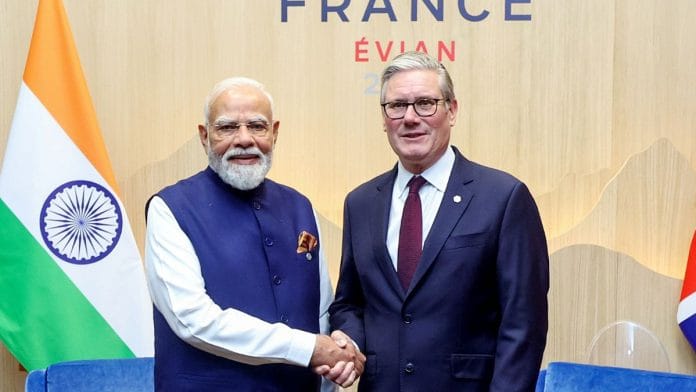
The deal has been successfully ratified by both governments. The date of operationalisation was decided by Prime Minister Narendra Modi and his British counterpart Keir Starmer, following their bilateral meeting on the margins of the G7 summit this week.
After 14 rounds of negotiations, India and the UK had announced the successful conclusion of discussions over the FTA last May. It was signed on 25 July, 2025 in the presence of both prime ministers in London.
The Comprehensive Economic and Trade Agreement (CETA) is set to see the UK cut its tariffs on a number of Indian exports to zero, while protecting New Delhi’s dairy, cereals, oilseeds and vegetable sectors.
According to British estimates, the deal is set to boost the Indian gross domestic product by around £5.1 billion annually, while boosting the UK’s GDP by around £4.8 billion. In the long run, it could see the increase of bilateral trade by around £25.5 billion annually.
What the deal means for exporters
Indian exporters are set to gain in a number of sectors with reduced or complete elimination of tariffs.
Tariffs imposed on Indian exports to the UK, including up to 70 percent on processed food products, 21.5 percent on marine products, up to 18 percent on engineering goods and auto components, up to 16 percent on leather and footwear products, and up to 12 percent on textiles and clothing, will be reduced to zero. Up to 8 percent of tariffs on chemicals and pharmaceutical products will also be done away with by the UK.
The agreement will see India drop its whisky tariffs from around 150 percent to 40 percent for British whisky, and a new quota for imports of British automobiles at 10 percent tariffs from the current 100 percent.
Around 99 percent of tariff lines covering roughly 100 percent of India’s trade value to the UK will be eliminated. The FTA also provides a regulatory framework for mobility of a number of Indian employees under business visitors, inter-corporate transfers, contractual service suppliers, independent professionals and contractors.
Another key feature of the deal is the signing of the Double Contribution Convention. The agreement signed earlier this year in February will make Indian workers temporarily in the UK and Indian employers exempt from social security contributions for three years. This will save Indian firms roughly Rs 4,000 crore, while Indian employees are temporarily in the UK.
India will cut around 90 percent of its tariff lines in a staggered manner, with 85 percent of its duties eliminated within the next decade of the agreement coming into effect (by 2036).
The total agreement will comprise 30 chapters, which includes provisions on government procurement—a first bilaterally agreed to provision.
Moreover, Indian steelmakers are set to gain some protection from the UK’s steel measures and regulations coming into effect from 1 July. The final agreement will see roughly 85 percent of India’s exports outside the new measures, while Indian steel will further be protected by residual quotas and authorised use scheme (AUS).
(Edited by Mannat Chugh)
Also Read: India-Canada launch talks on intel-sharing pact, as Modi meets Carney at G7