






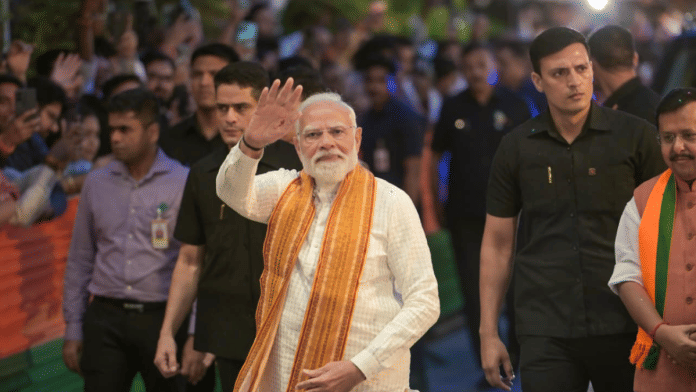


Where does India’s political heart lie? In light of the continued popularity and electoral success of the BJP, the answer is obvious — on the Right. But if politics includes the broader political economy, the conclusion may be different. That’s because India’s economic heart still beats on the Left. Prime Minister Narendra Modi’s genius is in recognising this duality. This is what makes it very difficult for anyone to defeat him. He has both his right and left flanks covered.
Consider pure politics first. India’s centre is most certainly on the right. What are the main features? First, a strong nationalism. Indians are proud of their country and wear their passion for it on their sleeves. They are not particularly impressed by or tolerant of attempts to weaken or bleed India either from the outside (think Pakistan and its terror apparatus) or from within (think Naxalites). And they would overwhelmingly support strong and decisive moves against such enemies. Modi has followed that in his actions.
Second, an embrace of religiosity even in the public sphere. Indians have always been deeply religious people. Secularism of the Nehruvian kind, inspired by Western thought, doesn’t have an innate appeal. It is too religious. If anything, it frowns upon the practice of religion. As practiced by the Centre-Left, and in a deviation from the original, it degenerated into distancing itself from the majority’s religious practices while appeasing those of religious minorities. India prefers its politics to embrace religion and treat all religions equally, which is closer to the conservative Gandhian philosophy than the liberal Nehruvian one. The country demanded a correction in the faux secularism of the post-independence years. Modi has achieved that.
Third, India is a civilisational country with a long history. Nationhood in the modern times may be less than 100 years old, but historical consciousness spans thousands of years. That history, with its warts and all, cannot be divorced from the modern nation. While the traumatic bits of invasion and the rule of those who came from foreign lands cannot be hidden either. Modi doesn’t shy away from this.
Also read: India’s east coast handles a higher volume. But the west coast has better economic outcome
Lack of speedy reforms
Consider the political economy next. Here, the hangover of the post-independence Left is much more entrenched. The first, and perhaps the most prominent, aspect of it is the proliferating demand for welfare. Supply has responded to demand with both central and state governments and parties from across the political spectrum promising and delivering an entire bouquet of benefits and transfers. Of course, much credit is due to the Modi government for making welfare more efficient via the Jan Dhan-Aadhar-Mobile trinity. Benefits don’t leak like before and the vulnerable receive their fair share. Nonetheless, Right-wing economics, which frowns upon the expansion of welfare, doesn’t exist in the BJP or any other party.
Second, the government remains the largest promoter of business in the country with over 250 operational public sector companies. They continue to dominate sectors like defence and natural resources. The irony is that while governments justify this for strategic reasons, the outcome is that India is hugely import–dependent in these sectors, which is a strategic burden, not advantage.
Third, the essential philosophy of the administrative apparatus, a relic of colonial rule, is the control/regulation of private activity. Despite some serious efforts at easing the environment for doing business, India remains an “approvals & permissions” economy with the bureaucracy dictating terms to entrepreneurs. On critical factors of production like land, there is a near impossibility in creating a market or enabling acquisition.
The truth is that there isn’t much popular clamour for changing any of these things. In fact, the clamour begins when reforms are attempted, as the Modi government found out when it tried to liberalise agriculture, the only sector untouched by market reform.
The politically astute Modi has chosen to conserve his considerable political capital and risk-taking capacity on the matter of market reform. On land, privatisation, and agricultural reforms, the government has strategically retreated. The lack of speedy reform may cost India at least 2 percentage points per year in growth, but it seems to work politically.
It will be interesting to see if, at some point, PM Modi tries to nudge India to the Right on economic issues. After all, he is the first PM who openly spoke of minimum government, maximum governance. A younger, aspirational population ought to support a more liberalised economy that would create more jobs, raise livelihoods, and make India a truly powerful country. But for now, India’s heart beats in two different places — Right and Left. And Modi and the BJP are tuned in like no other leader or party.
The author is Chief Economist, Vedanta. He tweets @nayyardhiraj. Views are personal.
(Edited by Aamaan Alam Khan)
Actually, BJP is left on society and right on economics.
Left in economics merits deeper nuance. No substitute for higher growth in a developing country. With a little more thought to equity, because inequality in India is at a level where it is undermining both the healthy growth of household consumption and the wider economy. Keeps private investment muted as well. Growth since 2019, which renewed the mandate so handsomely, has been about 5.5%. Inevitably, as the growth momentum is below other successful Asian economies, there is need for more populism to win elections. Cash transfer schemes, for example, even in the faster growing states. India’s per capita income of $ 3,000 does not live up to our potential.
My dream before I die is to see India as the world’s number one free-market economy.